


In 2000, the paper Distance Matters made a point that still feels uncomfortable today. No matter how good our tools get, working at a distance comes with a cost that does not fully go away.
Back then, the concern was email and early video calls. Today teams run on Slack, Zoom, shared docs, and a growing layer of AI tools. Communication is constant. Everything is recorded somewhere. But that does not automatically mean teams are aligned.
What Actually Breaks When Teams Move Apart
What the paper gets right is that collaboration is not just about exchanging information. It is about maintaining a shared understanding of what is happening and why. When people sit together, that understanding forms almost without effort. You overhear decisions, pick up context, notice when something is unclear, and resolve it quickly. Most of that never gets written down, but it keeps everyone moving in the same direction.
Once that environment disappears, nothing moves by default. Context has to be reconstructed, decisions have to be captured, and alignment has to be actively maintained. That is usually where things begin to drift.
This is what the paper was really pointing to. Remote work does not fail outright. It starts to strain in specific ways:
- teams lose shared context more easily
- tightly connected work becomes harder to coordinate
- tools help, but do not replace informal awareness
- processes can fix some gaps, but add overhead
- staying aligned simply takes more effort at a distance
None of this sounds dramatic on its own. But together, it explains why things start to feel slower, less clear, and harder to track as teams grow remotely.
Where It Shows Up Today
You can see the same pattern in how teams describe their own setups today.
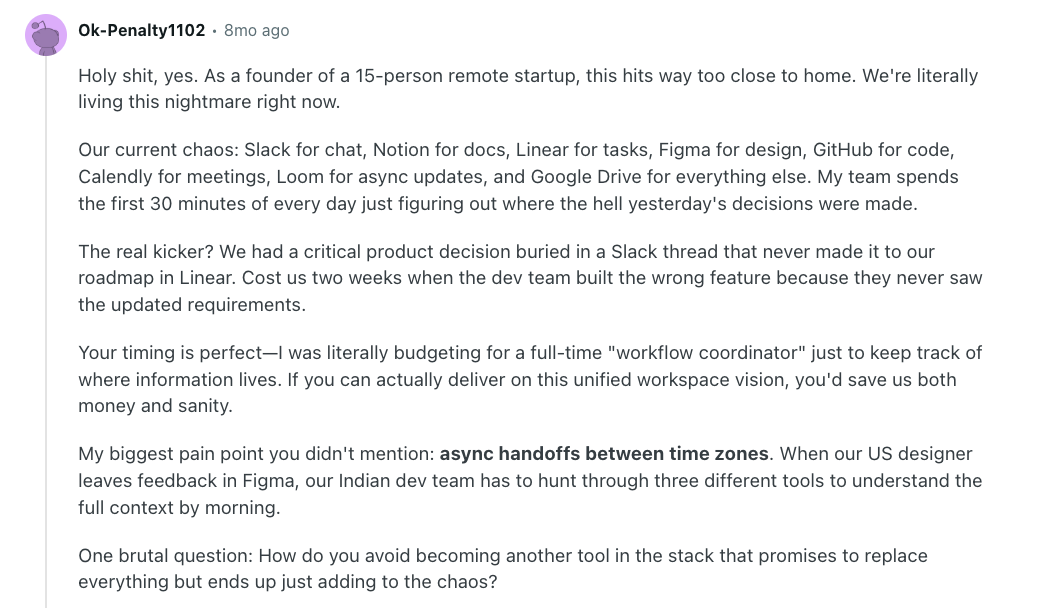 One founder laid it out bluntly. Their work was spread across Slack, Notion, Linear, Figma, GitHub, and more. Everything existed somewhere, but nothing was easy to track. So even though, all information were available but scattered, so people still felt lost.
In another discussion, the problem shows up even earlier.
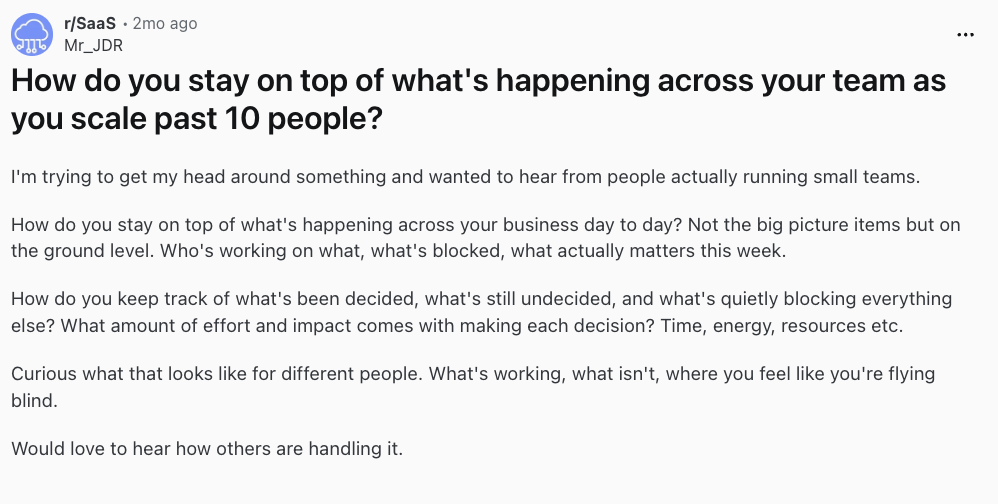
A SaaS founder described how things start to break around ten people. At some point, with enough information moving around, you stop knowing who knows what. And once that happens, alignment becomes slower and more fragile.
This is the modern version of what Distance Matters described as a loss of common ground.
The Problem Isn’t the Tools
The tricky part is that most tools are doing exactly what they are supposed to do. Messages are captured, documents are stored, code is tracked, but they do not stay connected. The reasoning behind a decision, the conversation that led to it, and the final implementation often live in different places.
Over time, that gap shows up in small ways. A decision gets revisited because no one remembers why it was made. A new team member struggles to understand how things evolved. A discussion moves forward without realizing that part of the context is missing. None of this feels like a major failure, but it slows everything down.
For smaller remote teams, this tends to show up early. There is less structure to absorb the gaps, so alignment depends heavily on shared context. When that context is scattered, progress starts to depend on reconstruction instead of momentum.
That is the lasting insight from Distance Matters. The real issue is not communication. It is the effort required to keep context intact as teams work apart.
A Simple Shift That Helps
There is no single tool that fixes this. But there is a simple shift teams can make.
Treat decisions as first-class artifacts. Decisions are not something that lives inside a meeting, or a thread, or someone’s memory. It should be captured, connected, and easy to find later.
In practice, this can be as simple as:
- writing down decisions as they happen, not after
- linking them to the work they affect
- making them visible to the team by default
It sounds small, but it changes how teams stay aligned. Instead of reconstructing context later, they carry it forward.
Although that does not remove the cost of distance, but it makes the cost visible, and easier to manage.
Reference
- Olson, G. M., & Olson, J. S. (2000). Distance Matters. Human–Computer Interaction, 15(2–3), 139–178. https://doi.org/10.1207/S15327051HCI1523_4
Try Stoa for saving meeting context in an agent-friendly way.
Newsletter
Get new posts in your inbox
Bring your team together to build better products. Fresh takes on remote collaboration and AI-driven development.