


Remote collaboration has improved a lot, but it still feels oddly flat. We can talk, share screens, write docs, and record meetings. Yet the actual feeling of building together often gets lost across tabs, transcripts, tickets, and follow-ups.
The paper "A Survey on Synchronous Augmented, Virtual and Mixed Reality Remote Collaboration Systems" is useful to visit. It reviews AR, VR, and MR collaboration systems and the interesting part is this paper does not treat remote collaboration as one category. Instead, it breaks these systems into three things:
- Environment: where the work happens
- Avatars: how people show up
- Interaction: what people can do together
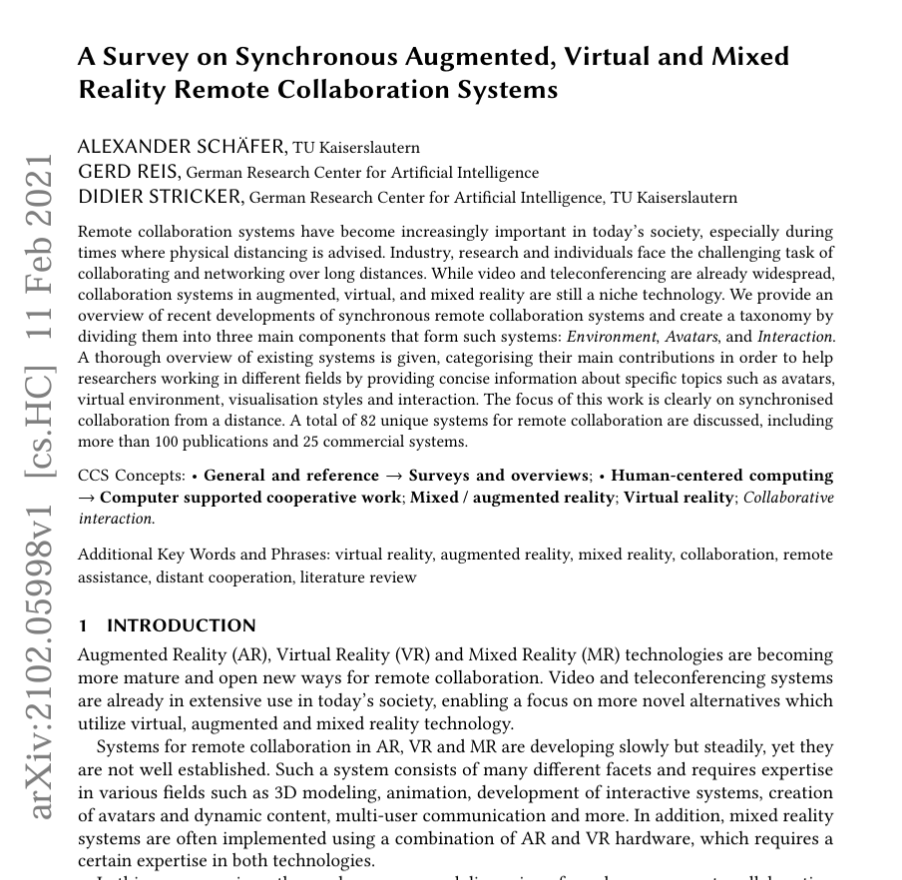
This is a better model than the usual "remote work equals video calls" framing. A good collaboration system is not just a communication layer. It is a room. And a room is valuable because it creates shared context where people can point, react, decide, sketch, and move together.
The paper’s first idea, environment, is the most important one. Every tool creates a place, whether it is a Zoom grid, a Figma canvas, a GitHub PR, or a VR room. The quality of collaboration depends on how useful that place is. Can everyone see the same thing? Can the work and the conversation stay connected? Can decisions survive after the call ends?
The second idea, avatars, is really about presence. In AR and VR, this might mean hands, bodies, gaze, or spatial position. But the broader point is that collaborators need to be legible to each other. You should know where someone’s attention is, what they are reacting to, and what they are doing.
That becomes even more interesting with AI agents. What is the avatar of an agent? Not a cartoon face. Its avatar is its visible work. The team should know what the agent is editing, what context it is using, what it changed, and why.
The third idea, interaction, is where most remote tools fall short. Many tools let teams talk about work. Fewer let them actually do the work together. The gap between great discussion and someone needs to turn this into something is where momentum dies.
This is where the paper connects to AI-native collaboration. It gives us three layers, but today we need a fourth: agency.
So the stack becomes:
- Environment: where we work
- Presence: how humans and agents show up
- Interaction: what we can do together
- Agency: what the system can do with us
That is the direction we care about at Stoa. Remote collaboration is moving from communication to production. The meeting should not just create a transcript. The room should help create the spec, capture the decision, update the artifact, and let agents act on the shared context.
The big takeaway from the paper is simple: remote collaboration is not about making distance disappear. It is about designing better shared contexts. AR, VR, and MR tried to rebuild the room visually. AI-native collaboration makes the room active.
The next generation of remote tools will not just connect people.
They will give teams a multiplayer space where people and agents can think, decide, and build together.
Try https://withstoa.com for saving meeting context in an agent-friendly way.
Newsletter
Get new posts in your inbox
Bring your team together to build better products. Fresh takes on remote collaboration and AI-driven development.