


You're reviewing a pull request that removes an awkward condition from the checkout flow. The engineer says it's redundant. Someone remembers that a customer needed it, but the ticket only says “update discount handling,” and the person who made the decision has left.
Your team now has to choose between delaying the change and accepting a risk nobody can explain. That's why traceability is important: it gives people a dependable route from today's work to the decisions and evidence behind it, without requiring the original author to retell the story.
Table of Contents
- What Traceability Buys Your Team in Practice
- Traceability as a Chain of Linked Records
- Auditability and Faster Incident Investigations
- Fewer Regressions and Faster Onboarding
- Where Traceability Falls Short and Common Misconceptions
- How to Set Up Traceability in Your Team Workflow
- Start Tracing Your Most-Revisited Decisions This Week
What Traceability Buys Your Team in Practice
Traceability is the ability to show where a decision, requirement, or code change came from, what it depends on, and what it affects. For a product team, that means connecting intent to implementation and verification, rather than merely keeping documents in the same folder.
Documentation tells you what someone wrote. Traceability lets you answer a question by following relationships between records. A detailed specification can still leave you stranded if you can't tell which version shipped or which test checks its acceptance criteria.
The questions linked records answer
Traceability benefits, the question each answers, and the cost of missing it
| Benefit | Question It Answers | Cost Without It |
|---|---|---|
| Auditability | Who decided this, on what basis, and when? | Reviews and disputes rely on memory and chat history |
| Faster onboarding | Why does this behaviour exist? | New hires re-ask questions the team already settled |
| Fewer regressions | What else does this change touch? | Changes break features nobody linked, found only after release |
| Faster incident response | Which releases contain the faulty decision or dependency? | Broad rollbacks that also pull back healthy releases |
These benefits serve different people, but they don't require separate documentation systems. A product manager needs the reasoning behind a rule. An engineer needs its implementation, while a reviewer needs evidence that someone checked the result.
The useful unit is therefore not a document. It's a connected answer: a decision with enough context and relationships for another person to act confidently.
Why the value grows with use
Say a permission change has a decision record, an approved pull request, and a linked access-control test. During review, those records explain who accepted the trade-off. During onboarding, they explain why the permission boundary exists.
Later, an engineer investigating unexpected access can use the same relationships to locate the relevant implementation. Nobody needs to create an incident-specific history from scratch.
Practical rule: Keep records that help someone make the next decision, not just prove that a previous conversation happened.
Small teams should judge this practice by the interruptions and reconstruction work they avoid. A large collection of links that nobody follows isn't an operational advantage. A short, reliable path to an answer is.
Traceability as a Chain of Linked Records
A customer reports that an invoice export is wrong. The code shows what the software did, but not why the team chose that behaviour. Without a route from code to requirement to decision, finding the answer depends on old messages and people's memories.
Parcel tracking offers a useful analogy: each scan records where a parcel was, when it was there, and who handled it. Software histories work similarly, but their paths branch and merge. A customer request can lead to a product decision, requirement, design, code change, test, and release.
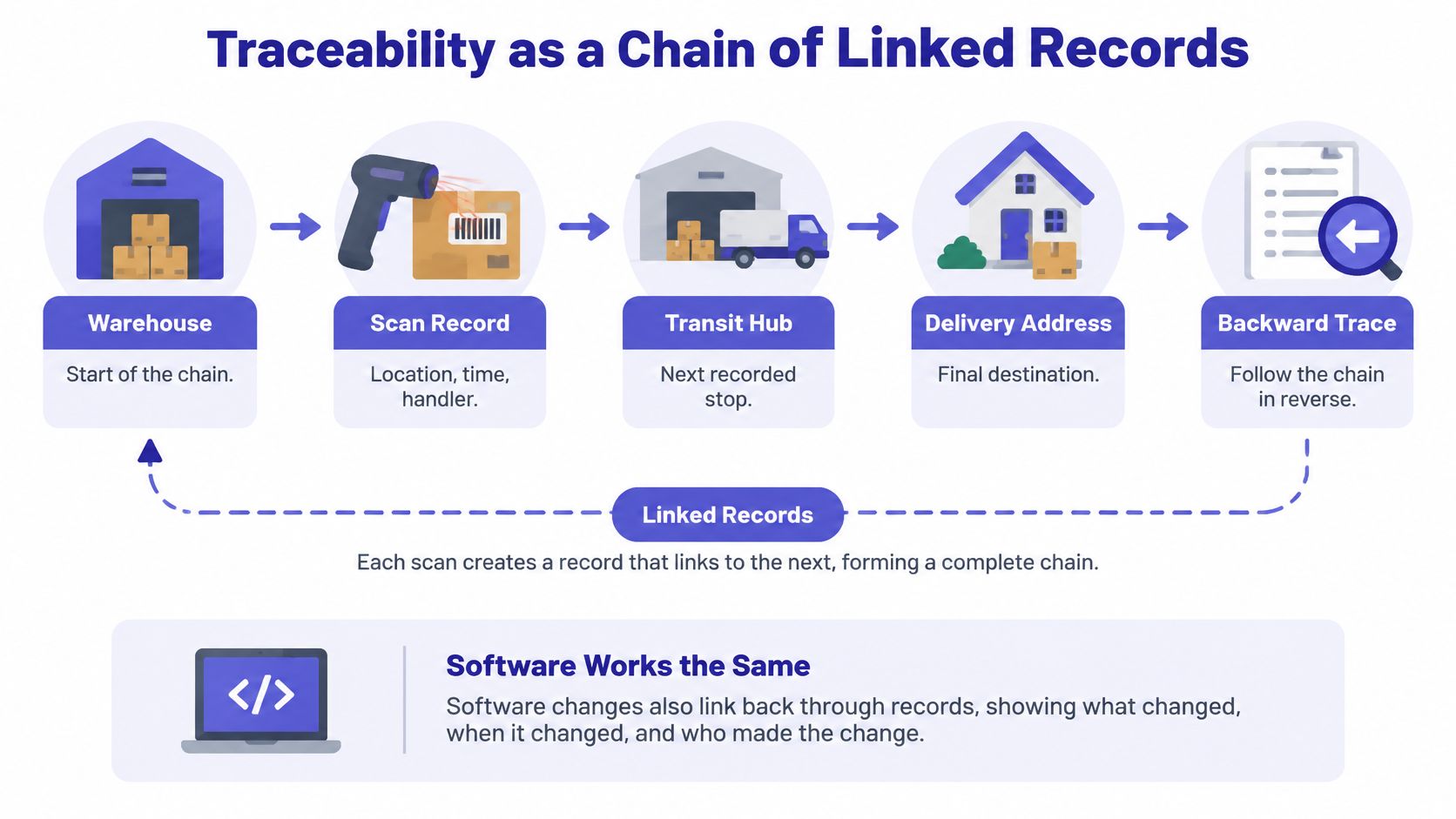
Give each stage a durable identity
For a feature such as exporting invoices, keep enough evidence to connect the requested outcome to the delivered behaviour.
Chain stages, identifiers and retained evidence
| Stage | Identifier | Links to | Evidence to keep |
|---|---|---|---|
| Customer request | Tracker ticket ID | None | Original request text and date |
| Product decision | Decision ID | Customer request ID | Meeting note, owner, rejected alternatives |
| Written requirement | Requirement ID | Decision ID | Acceptance criteria and version |
| Design artifact | Document or file ID | Requirement ID | Version reference and date |
| Code change | Commit hash | Requirement ID in commit message | Diff and review approval |
| Test result | Test run ID | Requirement ID and build ID | Pass or fail output and timestamp |
| Release | Version tag | Commit hashes | Deployment timestamp and environment |
Timestamps matter because an identifier alone may not show which version of a record applied. Link each test run to the build it exercised; a passing result for an older build says nothing about the version being released.
A useful chain has four parts: records of what happened, links to earlier records, agreed rules for maintaining the records, and a way to follow the links. Together, these let someone move from an outcome back to its inputs without relying on memory.
Connect tools without centralizing everything
Requirements can stay in Linear, code in Git, and designs in Figma. The tools do not need to share one database, but their references must remain stable, accessible to the right people, and retained long enough to be useful. Keeping those links current takes ongoing effort: tickets move, files are replaced, and old references can break.
For another record-intensive context, Verbal Experiment's guide to improve traceability in electronic lab notebooks discusses preserving the relationship between an activity and its supporting evidence.
If a commit points to a deleted ticket, mark the rationale as unknown and assign someone to look for remaining evidence. A recollection may help guide the search, but it cannot stand in for the missing decision record.
Try a retrieval exercise: ask a teammate unfamiliar with a feature to follow its production behaviour back to the originating decision. Notice where the links stop working. That is where the chain needs attention. Judge the effort by how much retrieval, rework, and repeated explanation it saves, not by how many links the team has created.
Auditability and Faster Incident Investigations
Auditability means someone outside the original work can check the trail without interviewing everyone involved. A reviewer should be able to establish who approved a change, what supported the approval, which tests ran, and whether the deployed artifact matches the approved work.
Consider a rounding bug reported after a release. With linked records, the investigator starts at the deployment, finds the relevant commit, follows its requirement reference, and reaches the planning decision that accepted the rounding rule.
That decision might reveal that the team intentionally rounded individual line items rather than the invoice total. The investigator can identify the owner, inspect the rejected alternative, and determine whether the implementation violated the decision or faithfully implemented a flawed rule.
Reconstruct events rather than recollections
Without those relationships, responders search chat for “rounding,” compare screenshots, and ask colleagues which discussion they remember. Similar conversations can point to different versions of the rule, leaving the team unsure which evidence applies.
The causal benefit is straightforward: linked records reduce the amount of history responders must infer.
NIST's incident-handling guidance explains that operating-system, service, and application logs can show which accounts were accessed and what actions occurred; correlating events helps analysts reconstruct incidents, and response steps should be documented and timestamped. Apply that discipline to product incidents too, while recognizing that security investigation and product debugging aren't identical tasks.
Retain the evidence that connects intention, execution, and deployment:
- Source decisions: The approved rule and the supporting rationale.
- Dependency versions: The components included in the affected build.
- Build inputs: Source revisions, configuration references, and generated artifacts.
- Approvals and tests: Who reviewed the change and what verification ran.
- Deployment events: Which artifact reached which environment, and when.
Make the handoff independently checkable
Software provenance is the chronology of a component's origin, development, ownership, and changes. For AI-assisted work, preserve the relevant input context and review evidence alongside generated output, rather than treating the agent's final file as the whole history.
For a specialist handoff example, consult crypto audit handoffs explained by BroLabel. Use the same practical standard internally: the receiving reviewer needs accessible evidence, not just a message saying that checks were completed.
Once containment is complete, use a project post-mortem format to connect the incident timeline to corrective work. Keep observations separate from hypotheses, and update conclusions when stronger evidence arrives.
A trustworthy chain lets responders identify the releases that contain the faulty change. They can then narrow containment instead of withdrawing healthy releases because nobody can establish their status.
Fewer Regressions and Faster Onboarding
A regression happens when a change breaks behaviour that previously worked. The difficult cases often involve a condition that looks unnecessary until you discover the product decision it protects.
Say your team accepted a discount rule that excludes already-discounted subscriptions. Later, an engineer refactors checkout and removes the exclusion because the surrounding code appears to handle eligibility.
If the requirement points to the relevant test, the engineer can inspect that test before editing. If the test runs against the changed build, it can expose the broken rule before release. The link doesn't replace the test; it helps the engineer find and interpret the right evidence.
Preserve the reason, not just the implementation
Onboarding has a similar retrieval problem. A new engineer sees a retry limit and wonders whether it's arbitrary, inherited, or deliberately chosen.
A useful decision record explains the failure mode the limit addresses, the alternatives considered, and the conditions under which the team should reconsider it. That lets the newcomer propose a sensible change even if the original author is unavailable.
This is a practical form of knowledge preservation: retain enough reasoning for someone else to continue the work, rather than preserving every message indiscriminately.
A record earns its maintenance cost when a teammate can use it without needing the author to explain it again.
The payoff depends on use. If reviewers never follow requirement references and new hires can't access the decision folder, the team is maintaining decoration.
Stale links also need attention. A document marked approved but superseded by an unlinked discussion can send a newcomer in the wrong direction. Mark replacement decisions clearly and keep the earlier record available as history.
Measure delivery friction without overstating the evidence
In Boston Consulting Group's 2024 survey, nearly half of global C-suite executives said more than 30% of their organizations' technology-development projects were both late and over budget. That's delivery-risk context, not proof that missing traceability caused those outcomes.
Within your own team, inspect narrower signals:
- Repeated planning questions: Which settled topics keep returning because people can't find the rationale?
- Decision-related regressions: Which defects violated a requirement the team had already accepted?
- Onboarding progress: How long does a new hire take to make a first commit, and where does missing context cause delays?
Don't attribute every improvement to linked records. Mentoring, development environments, and test quality matter too. Use these signals to identify specific points where easier access to reasoning changes how people work.
Where Traceability Falls Short and Common Misconceptions
A neatly traceable change isn't necessarily correct. You can establish exactly which meeting produced a requirement and still discover that everyone in the meeting accepted a false assumption.
Reviewing the underlying reasoning remains a human responsibility.

Suppose an AI agent implements throttling based on a planning discussion that assumed an upstream service enforces a rate limit. The output links cleanly to the discussion, requirement, and pull request, but nobody verified that the upstream protection exists.
Traceability establishes origin and relationships, not correctness. The missing control is validation of the assumption, not another reference to the same conversation.
Record what the team actually knows
Requirements-engineering research published by Springer identifies uses including finding requirement origins, tracking implementation, analyzing change impact, and connecting requirements to tests, while describing evidence associating more complete traceability with lower defect rates. That association doesn't eliminate ambiguous requirements, mistaken assumptions, or inadequate tests.
A useful extension is epistemic traceability, recording the basis and limits of what the team believes:
- Uncertainty: Which assumptions still need evidence?
- Dissent: What concern did someone raise that remains unresolved?
- Rejected alternatives: Why did the owner choose this approach?
- Validation status: Was the statement merely captured, reviewed, or checked against an observable result?
Keep captured intent distinct from verified behaviour. An automatically extracted meeting statement should not acquire approval merely because a tool placed it in a requirement file.
For a companion perspective on the topic, the following video is available.
More links aren't automatically better
Linking every chat message to every ticket creates maintenance obligations without necessarily improving retrieval. Prefer relationships that answer a meaningful question, such as why a permission boundary exists or which test protects it.
Nor is this practice useful only in regulated industries. A startup changing its billing model needs to understand inherited constraints even when no auditor will ask about them.
Boundary to remember: A complete history can explain a bad decision perfectly.
Treat missing evidence as unresolved work. Assign an owner to check the rate-limit assumption, record the result, and revise the requirement if necessary. That turns the history into a mechanism for correction rather than a polished account of an unchecked belief.
How to Set Up Traceability in Your Team Workflow
A pricing rule changes, and a teammate asks why it exists. If the answer is buried in an old chat, someone must search for it, ask the original decision-maker, or make a guess. Start with minimum viable traceability: connect the context needed for consequential changes, without creating a second documentation job.
In a controlled experiment with 71 participants, traceability made maintenance tasks 24% faster and produced 50% more correct solutions, according to the Springer requirements-engineering study. Treat those results as a reason to try a lightweight workflow, not as a forecast for your team. Judge the effort by whether people spend less time retrieving context, redoing work, and repeating explanations, not by how many links they create.
Build the habit around existing work
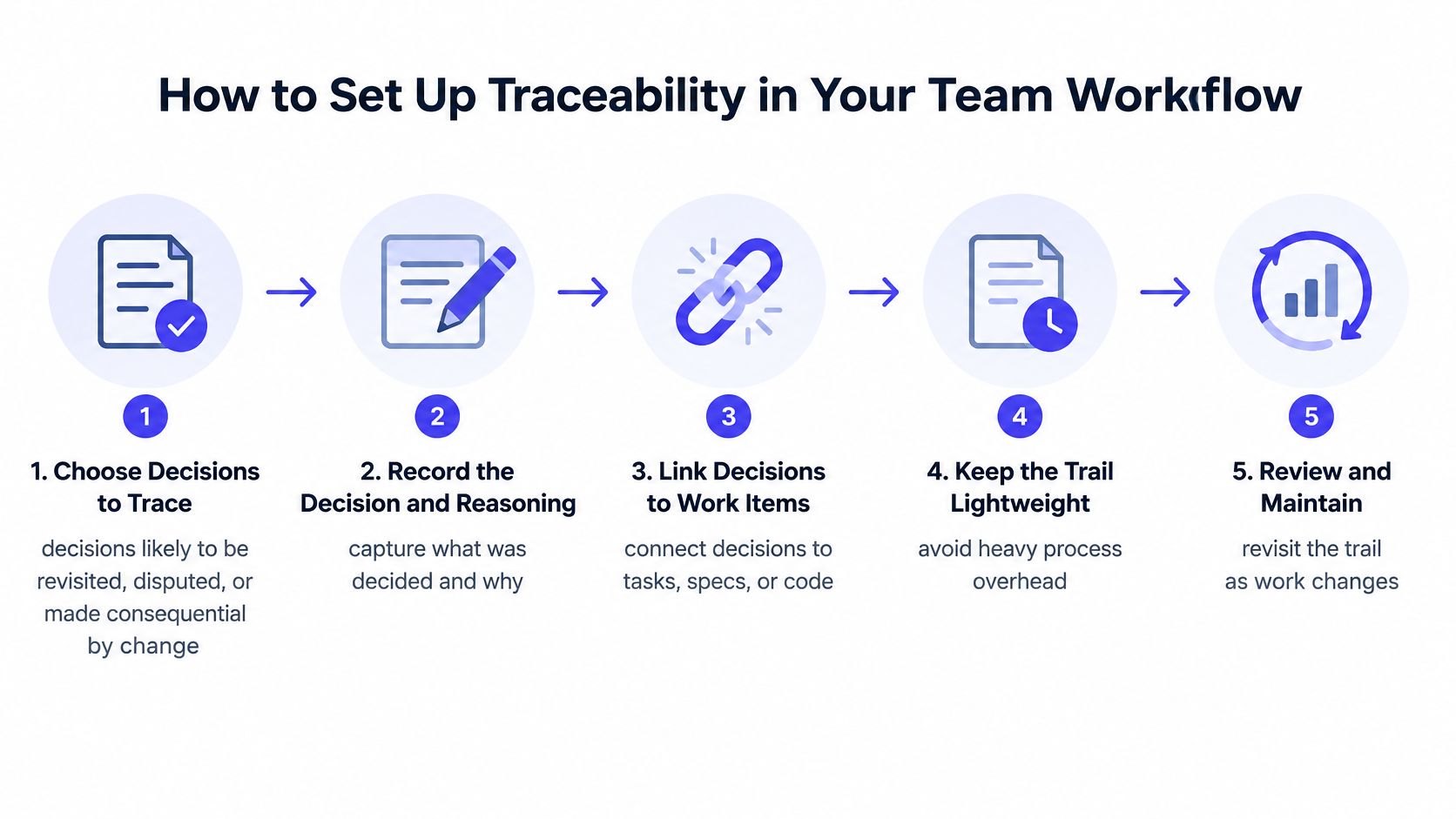
-
Choose decisions worth tracing. Start with pricing rules, permission models, data retention, or external dependencies that people are likely to revisit or dispute. Routine implementation details can stay unlinked unless they introduce a consequential constraint.
-
Assign stable identifiers and timestamps. Give each decision a durable reference and retain its creation and revision dates. Put the identifier in the relevant ticket and commit message, so a renamed document does not break the connection.
-
Connect rationale, implementation, and verification. Link the decision to the pull request or commit, then to the test or review that checks the result. A decision log template can provide a starting structure. Drop fields the team will not keep current.
-
Capture source material where practical. Preserve relevant meeting notes, chat references, and agent logs instead of asking engineers to reconstruct conversations later. Keep the workflow focused on engineering decisions; Yalc's sales automation guide addresses sales workflows rather than this engineering process.
-
Show validation status. Separate captured statements from reviewed decisions and verified outcomes. Assign an owner to unresolved assumptions, so an automatically recorded discussion is not mistaken for an approved or tested decision.
-
Add a relationship check to pull-request review. Ask whether the change points to an applicable decision or explains why none is needed. Check that the reference opens, applies to the version under review, and leads to evidence the reviewer can access.
-
Review whether the links save effort. Compare retrieval time, rework per release, and defects that escape to production with your starting observations. Ask whether teammates repeat fewer explanations, too. Remove or simplify any relationship whose upkeep costs more than the time it saves.
Keep the check beside existing reviews for tests, security, and compatibility. A separate approval queue just to confirm that references exist adds process without improving the records.
Decisions change. When one is replaced, update its status and link the replacement before closing the work. Otherwise, the old rationale can remain easy to find while no longer guiding the next change.
Start Tracing Your Most-Revisited Decisions This Week
Pick a small set of decisions your team keeps reopening. Choose topics where the missing history causes concrete friction, such as an unexplained billing exception or a permission rule nobody wants to touch.
For each, identify the owner, preserve the rationale, and connect the implementation to its verification evidence. Put the durable reference where engineers already work, then ask a teammate who wasn't involved to follow it.
Make the trial easy to judge
Use a short review checklist:
- Retrieval: Can someone find the applicable decision without asking its author?
- Rework: Did access to the rationale prevent an avoidable implementation change?
- Escaped defects: Did a missing or stale relationship conceal a relevant requirement?
Choose a review date before expanding the practice. If the records aren't helping, investigate whether you selected the wrong decisions, captured too much detail, or failed to maintain the references.
Git-backed Markdown, an issue tracker, and a shared decision folder can be enough to begin. A dedicated workspace is another option, but the acceptance test stays the same: can another person recover the context and use it safely?
Today, take the decision your team most recently debated twice and connect it to the code and evidence that implement it.
SpecStory, Inc. offers Stoa, a multiplayer AI workspace that captures meeting decisions, transcripts, and artifacts as plain files and keeps outputs traceable to their originating conversations. If automatic decision capture fits your workflow, visit SpecStory, Inc. and evaluate it against a real decision your team needs to retrieve.
Newsletter
Get new posts in your inbox
Bring your team together to build better products. Fresh takes on remote collaboration and AI-driven development.