


Your team finishes a product meeting with a promising idea, a rough sketch, and a chat full of follow-up questions. By the time someone opens a pull request, the reasoning has scattered across messages, design comments, and people's memories. An AI coding agent can build faster, but it can't reliably recover a decision nobody recorded.
AI driven product development works best when it connects intent to implementation. The useful question isn't just how quickly an agent can produce code. It's whether your team can explain why that code exists, who approved it, and what evidence says it's ready for users.
Table of Contents
- What AI Driven Product Development Means
- Why the Shift Matters Now
- Where AI Fits Across the Product Lifecycle
- Measuring Speed Without Fooling Yourself
- How Small Teams Adopt in Three Stages
- Pitfalls That Turn Speed Into Rework
- Compact Case Examples From Small Teams
- Run a Two-Week Pilot Before Your Next Sprint
What AI Driven Product Development Means
Say you're part of a five-person team. Customer ideas arrive faster than you can investigate them, the designer needs clearer requirements, and engineers keep asking questions everyone thought the kickoff had answered. Adding an agent to that workflow can produce more drafts without resolving any of the uncertainty.
A better approach changes how the team works together.
AI driven product development is a way of working in which AI agents contribute from discovery through launch, while people retain responsibility for choosing problems, approving decisions, and judging whether the result is good enough.
Think of a traditional workflow as an assembly line. Product hands requirements to design, design hands screens to engineering, and engineering hands a build to QA. Each person may wait for the previous handoff or discover missing information late.
An AI driven team works around a shared workbench. The planner, builder, and inspector see the same plan. Agents can draft specifications, explore alternatives, and check implementation against agreed requirements without becoming the authority on what should ship.
The collaboration matters more than the number of tools involved.

What changes in daily work
The first draft may come from an agent rather than a blank document. The bottleneck shifts toward deciding what's correct and reviewing what was produced. And the team records intent during the work, rather than reconstructing it afterward.
Figr's guide to AI-powered product management offers a useful companion for thinking about the product manager's responsibilities in this model.
Traditional versus AI driven product development
| Dimension | Traditional workflow | AI driven workflow |
|---|---|---|
| First draft of specs | Written by a product manager over several days | Drafted by an agent from team notes, then reviewed |
| Main bottleneck | Engineering capacity | Decision clarity and review capacity |
| Where AI acts | Rarely used, mostly for ad hoc questions | Discovery, design, code, tests and release notes |
| Human role | Writes and builds the product | Sets intent, reviews output and approves release |
| Main risk | Slow feedback and late surprises | Plausible but unverified output |
| Evidence of intent | Scattered across chats, docs and meetings | Traceable from decision to commit |
These are contrasting workflow patterns, not universal descriptions of every team. A disciplined traditional team may already preserve excellent decision records.
The core test remains straightforward: can you trace any shipped change back to the decision that authorized it?
Why the Shift Matters Now
In 2025, 59% of developers reported using AI for core development responsibilities, such as code generation, and 67% said AI improved the quality of their work, according to Figma's 2025 AI report. Those findings describe reported usage and perceptions, not independently verified improvements in released software.
The adoption shift is worth separating from the productivity question.
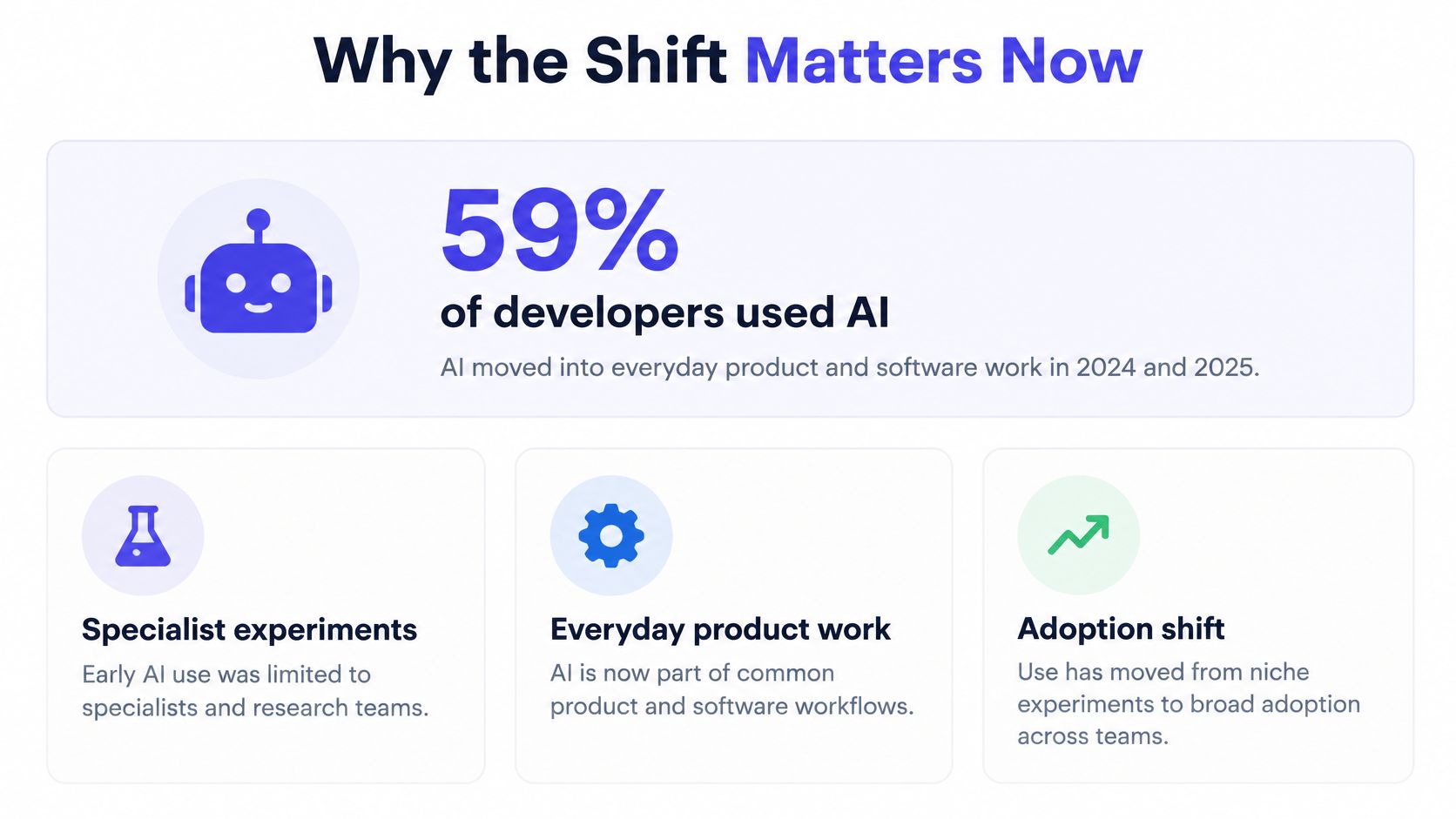
In McKinsey's early-2024 global survey, 65% of respondents said their organizations regularly used generative AI, while 72% said their organizations used AI in at least one business function. Product and service development was among the functions where generative AI was most commonly deployed.
That makes AI relevant beyond the engineering editor. A product manager summarizing interviews and a designer exploring flows are participating in the same operating change as an engineer generating code.
Faster implementation has conditions
In McKinsey's developer productivity study, developers completed coding tasks as much as twice as fast with generative-AI assistance, but time savings fell below 10% for tasks developers considered highly complex. The distinction matters: generating familiar implementation patterns isn't the same job as navigating an unfamiliar framework or resolving ambiguous domain rules.
A small team should interpret this as an opportunity to remove mechanical work, not permission to compress every estimate. The engineer who finishes a straightforward endpoint quickly may still need substantial time to understand authorization rules, migration risks, or an undocumented dependency.
Faster production of an answer is useful only when the team can establish that it's the right answer.
The practical implications are specific:
- Use AI where the work is explainable. Clear inputs and checkable outputs make assistance easier to evaluate.
- Protect judgment time. Spend saved effort on customer evidence, architecture, and review rather than automatically adding scope.
- Connect the workflow. A generated implementation should inherit approved requirements, not start from an isolated prompt.
AI is already accessible to small teams. The harder work is making its contributions accountable to product decisions.
Where AI Fits Across the Product Lifecycle
Start with a feature such as allowing marketplace sellers to pause availability. The same request looks different to a customer researcher, designer, engineer, and support lead. AI can help each person, but the team needs a consistent record of what pausing means.
Use a stage map to separate agent contributions from human authority.
AI contribution and human decision at each lifecycle stage
| Stage | Where AI helps | Decision that stays with the team | Artifact to keep |
|---|---|---|---|
| Discovery | Clusters interviews, tickets and usage data into themes | Which problem is worth solving | Problem statement with customer evidence |
| Design | Explores layout and flow variants; drafts user stories and acceptance criteria | Which option ships | Chosen design with rejected alternatives |
| Engineering | Generates, refactors and tests code from clarified requirements | Architecture and scope limits | Pull request linked to the decision |
| QA | Drafts test cases, edge cases and regression checks | Which residual risk is acceptable | Test report with escaped-defect log |
| Launch | Drafts release notes, docs and support answers | Go or no-go and rollout size | Launch note and post-launch review |
Discovery and design preserve the reasoning
During discovery, an agent can group seller complaints about missed orders, scheduling conflicts, and temporary closures. Ask it to attach each theme to the original interview excerpt or support ticket. Otherwise, a convincing summary can conceal weak evidence.
The team then chooses the problem. Perhaps sellers need temporary pauses, not a full scheduling system. Record that boundary in the problem statement so later drafts don't expand the feature.
During design, agents can explore a pause toggle, a date-based control, or a status menu. People still need to assess comprehension, accessibility, and compatibility with existing behavior. Keep the chosen design alongside rejected alternatives and a short explanation of the trade-off.
Ekipa's discussion of why software design workflows are shifting provides context for this move from producing a single handoff to evaluating alternatives collaboratively. For the product lead, practical AI for product managers starts with making those alternatives and decisions inspectable.
Engineering converts approved intent into reviewable changes
Give the coding agent the accepted design, interface contracts, scope boundaries, and representative tests. For the marketplace feature, that includes what happens to existing orders and whether paused sellers remain visible in search.
An enterprise randomized controlled trial involving 96 full-time Google software engineers found that AI features reduced time spent on a complex, enterprise-grade development task by approximately 21%, after controlling for factors known to affect task duration. That result supports integrating assistance into real engineering work, but it isn't a universal multiplier for team velocity.
Require a pull request to identify its authorizing decision and the acceptance criteria it satisfies. A reviewer should be able to follow those references without asking the original meeting participants to explain them again.
QA and launch establish readiness
For QA, ask the agent to propose edge cases independently of the implementation. A seller might pause while an order is being placed, change time zones, or attempt to resume an account restricted for another reason. Humans decide which risks block release and which can be monitored.
For launch, agents can draft documentation and support answers from the accepted behavior. The release owner checks that those drafts describe what shipped, then chooses rollout size, monitoring, and rollback conditions.
Keep a primary artifact for each stage, linked to the same decision record. You don't need a sprawling document system. You need a reliable path from customer evidence to the released behavior.
Measuring Speed Without Fooling Yourself
Coding time is an incomplete measure because users don't receive a feature when an agent finishes generating it. They receive it after review, testing, integration, and deployment. A team can shorten implementation while making delivery slower.
Measure the path from accepted decision to validated work, then inspect where effort moved.
Metrics to track in an AI driven workflow
| Metric | What it reveals | How to read it |
|---|---|---|
| Median decision-to-tested-PR time | Throughput from agreement to validated work | Segment by task complexity and AI use |
| Suggestion acceptance rate | How often AI output is kept | Low rates warrant checking context and task suitability |
| Escaped defects per release | Quality problems that reached users | A rise signals gaps in review or tests |
| Review rework hours | Work required downstream after coding | Check whether extra rework outweighs coding savings |
| Lead time to deployment | End-to-end delivery speed | Judge alongside quality and rework, never alone |
Define the clocks before collecting results
Start the decision-to-tested-PR clock when an owner accepts the scope, not when someone first mentions an idea. Stop it when a reviewable pull request passes the agreed checks. Record waiting time separately from active work so a review queue doesn't disappear inside an engineering estimate.
Define rework consistently. Include corrections to rejected implementation, missed acceptance criteria, and unnecessary generated changes. Don't classify new product requests as implementation failures.
Suggestion acceptance needs interpretation too. Rejected output may reflect missing context, an unsuitable task, or a reviewer correctly refusing a poor approach. High acceptance isn't proof of quality if defects later reach users.
Read the measures together
Consider a hypothetical feature where the agent produces a draft quickly, but reviewers spend longer correcting permissions and reconstructing intent. The team then discovers a customer-visible regression after deployment. Coding improved locally, but the delivery result deteriorated.
That example doesn't require a dramatic benchmark to diagnose. The review record and defect log tell the story.
For useful cycle time reduction, compare similar work in your own repository. Separate routine changes from unfamiliar integrations, and label whether AI drafted, tested, or substantially revised the implementation.
- Compare comparable tasks. Don't treat a documentation update and a database migration as equivalent work.
- Keep sample details visible. Show which changes contributed to each measure rather than publishing an unexplained average.
- Investigate exceptions. A slow feature may expose a missing interface contract rather than an agent problem.
Dashboard rule: Never report a speed measure without its quality and rework companions.
If implementation gets quicker while correction work grows, investigate the full effort before declaring a productivity gain.
How Small Teams Adopt in Three Stages
Adoption should progress through exit criteria, not enthusiasm. A successful demonstration proves that an agent can produce something. A successful operating model proves that teammates can understand, check, and maintain the result.
Use the following schedule as a proposed pilot plan, not an evidence-based promise about how long adoption takes.
Adoption stages and exit criteria
| Stage | Scope | Exit criterion |
|---|---|---|
| Pilot, weeks 1–2 | One team, one feature, one repository | Team traces one feature from decision to commit |
| Standardize, weeks 3–6 | Shared context template, review gate and data rules | Two features ship with the same workflow and no unplanned rework |
| Scale, after week 6 | All product streams, with owners and monthly audits | Core metrics stay stable for four consecutive weeks |
Pilot with explicit boundaries
Choose a feature that matters but doesn't require an irreversible migration or broad access to sensitive information. Record the measurement baseline before work starts. Preserve prompts, relevant outputs, and human edits alongside the feature artifacts.
Assign distinct responsibilities, even if a small team needs people to wear multiple hats:
- Decision owner: Approves product scope and any proposed change to it.
- Drafter: Operates the agent and records the context used.
- Reviewer: Checks the output and corrections before merge.
Set a data rule immediately. State which customer information may enter approved AI tools, which must be redacted, and which must stay out entirely. A vague instruction to be careful isn't an operating rule.
Standardize the context and review gate
Build a reusable context template containing acceptance criteria, architecture constraints, interface contracts, representative tests, and open questions. Require the agent to distinguish an approved requirement from an assumption or suggestion.
This isn't bureaucracy for its own sake. A 2025 survey on AI adoption reported inaccurate outputs as a challenge for 64.2% of respondents. Your workflow needs a way to catch incorrect output before teammates mistake it for an agreed fact.
Make automated checks and human review mandatory before merge. Keep approval separate from generation, and rotate drafter and reviewer responsibilities monthly so verification knowledge doesn't become concentrated in a single person.
Scale only the repeatable parts
Extend a stable workflow to other product streams rather than copying every prompt unchanged. A billing change and a visual prototype need different risk controls, even when they share the same decision record format.
Run a monthly audit of AI-generated proposals that became product decisions. Sample a change and ask whether someone can identify the evidence, approver, implementation, and validation without interviewing its author.
Keep the audit record useful, not exhaustive. Preserve material prompts and changes, redact secrets, and apply appropriate access controls to customer evidence.
Move forward only when the exit criterion is met. If the team still needs verbal explanations to connect scope to code, improve the pilot rather than spreading the ambiguity.
Pitfalls That Turn Speed Into Rework
The most tempting mistake is accepting output because it looks finished. Familiar naming, clean formatting, and confident explanations can make unverified code feel safer than it is. Review the behavior, not the presentation.
Plausible code without adequate tests
An enterprise study summarized in a review of AI-assisted development evidence reported 33% suggestion acceptance and 20% line-of-code acceptance, alongside inconsistent code quality and weak performance on domain-specific logic. Require behavioral tests and rigorous review rather than treating generated code as a near-final implementation.
Use a deliberate approach to testing AI-generated code: derive expected behavior from the requirement, not merely from what the generated function happens to do.
Requirements nobody approved
The symptom is a feature in the pull request that appears in no accepted specification. The agent has filled a gap with a plausible product choice, such as notifying all customers when a seller pauses.
Require every requirement to reference customer evidence or an explicit owner-approved decision. Our Feature Kickoff template recommends giving every open question an owner and a deadline before the kickoff meeting ends.
Requests without usable context
A prompt such as “build seller pausing” leaves authorization, state transitions, and existing orders undefined. The agent must either ask questions or make assumptions.
Supply the shared context template and require unresolved behavior to remain visibly unresolved. Don't reward an agent for completing work by inventing the missing rules.
Governance postponed until release
The warning sign is a last-minute search for who approved a change or whether customer information entered an unapproved tool. The team has treated accountability as release paperwork.
Apply the decision ownership and data controls during drafting. Retrofitting them afterward won't reliably recover what happened.
Activity mistaken for delivery
A large diff, many accepted suggestions, and a busy agent session can coexist with an unfinished feature. Count tested, accepted work rather than generation volume.
Use the paired dashboard measures to identify where the apparent progress stopped. Ask what reached users safely, not how much text or code appeared.
Benchmarks treated as forecasts
A team sees a promising result elsewhere and builds its delivery plan around the same gain. Its repository, domain rules, and reviewers may make that comparison unsuitable.
Use the staged adoption criteria to test the workflow locally. If downstream correction consumes the saved implementation effort, the process needs fixing, whether the agent's draft looked impressive or not.
Compact Case Examples From Small Teams
The following are illustrative scenarios, not measured customer results. Each shows how a small team might use the decision trail to diagnose an outcome without attributing every improvement or failure to AI.
A marketplace team clarifies the backlog
A seed-stage marketplace struggles with user stories written from memory after customer calls. In this scenario, an agent drafts stories from call notes, attaches supporting excerpts, and routes each story to a named product owner before backlog entry.
The illustrative outcome is less scope renegotiation during implementation because engineers can inspect accepted boundaries. The team would assess that outcome through clarification requests and review rework, not claim a measured discovery-time improvement.
What should it do differently next time? Include contradictory customer feedback in the draft, so the owner sees disagreement rather than only the dominant theme.
A remote team preserves design alternatives
A distributed design and engineering team uses an agent to generate prototype variants. Previously, the final screen survived, but the reasons for rejecting other flows stayed in a call recording.
The team stores the selected design and rejected alternatives beside the feature brief. The illustrative outcome is that a teammate can understand the choice without reopening the debate. Its next improvement would be to record the accessibility and interaction assumptions used during evaluation, not just screenshots.
The useful artifact is the explanation behind the prototype.

A developer-tools team narrows the review gate
A developer-tools team pilots AI for test drafting and release notes. In this scenario, routine tests become easier to prepare, but a module with intricate domain rules develops regressions that the generated checks don't catch.
The illustrative outcome is a targeted domain-review gate for that module rather than a blanket ban on agent assistance. The team would compare its defect log and review effort before judging success. Next time, it would include a domain specialist when choosing representative test cases.
The shared lessons are operational:
- Name an owner. Someone must authorize a proposal before it becomes a requirement.
- Inspect correction work. Faster drafting isn't enough if teammates inherit more cleanup.
- Pilot before expanding. Apply stricter controls where the actual failures occur.
Run a Two-Week Pilot Before Your Next Sprint
Treat a two-week pilot as a bounded learning exercise, not a commitment to reorganize the company. Choose a feature small enough to finish and meaningful enough to expose the handoffs between product, design, and engineering.
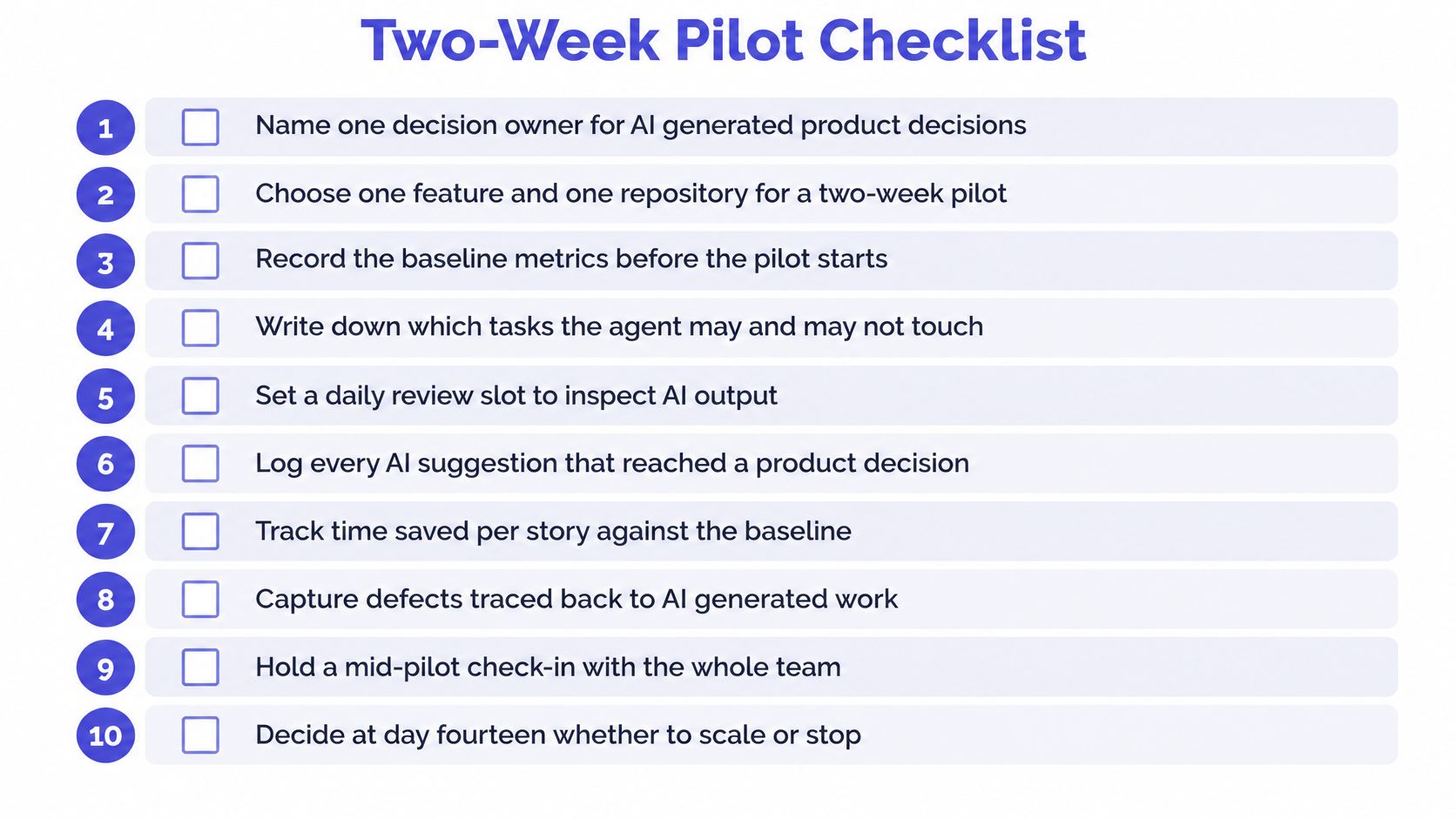
Use the checklist as a working agenda rather than a scorecard for tool adoption.
Prepare the work in order
- Name the decision owner for AI-generated product decisions.
- Choose the pilot scope, using a single feature and repository for the two-week exercise.
- Record the baseline, including decision-to-tested-PR time, review rework, and escaped defects.
- Set the data rule for customer information that may enter AI tools.
- Write the context template with acceptance criteria, constraints, interface contracts, tests, and open questions.
- Require a merge gate consisting of automated checks and human review.
- Log material prompts, outputs, and human edits for each proposed change.
- Circulate the feature brief at least 48 hours before kickoff, following our Feature Kickoff template's recommendation.
- Assign an owner and deadline to every open question before the kickoff ends.
- Review the pilot at the end of the second week and decide whether to standardize.
Keep the setup lightweight. A repository folder containing a decision record, feature brief, review notes, and test results can be enough, provided teammates can follow the references.
For a shared working environment, Stoa is our multiplayer AI workspace for product teams. It can keep decisions and drafts together, but the checklist works with any toolset.
For a visual companion to the working model, use the video below.
Make the pilot decision explicit
The pilot passes when the team can trace the completed feature from its authorizing decision to the shipped commit, with validation attached, and extra rework hasn't consumed the implementation savings. If the records are incomplete or quality deteriorates, revise the workflow before extending it.
Don't approve expansion because people enjoyed the demonstration. Ask a teammate who didn't draft the change to explain its purpose, scope, and release evidence from the artifacts alone.
Schedule the pilot before your next sprint planning meeting. Put the owner, feature, review date, and pass condition on the calendar so the experiment ends with a decision.
We build Stoa at SpecStory, Inc. to help product teams turn live conversations into shared decisions, specifications, and working prototypes. Visit SpecStory, Inc. to explore a shared workspace for your pilot and keep the path from product intent to implementation visible.
Newsletter
Get new posts in your inbox
Bring your team together to build better products. Fresh takes on remote collaboration and AI-driven development.