


Your roadmap probably looks familiar. A search feature, a workflow improvement, a reporting surface, perhaps an assistant tucked into an existing product. Yet every story now raises questions that traditional software could often postpone: Which data can the system use? How will we evaluate an answer? Who owns a failure? What happens when the model changes?
That's the practical reality of artificial intelligence product management. The work isn't prompt writing with a roadmap attached. It's the discipline of keeping product intent, data, evaluation, ownership, and customer outcomes connected while a probabilistic system sits inside the experience.
This guide is for product managers, founders, engineering leads, and small teams building AI features or leaning heavily on AI in their own product work. By the end, you'll have a clearer way to define the role, shape the daily workflow, measure value beyond activity, and establish an operating loop that doesn't collapse when the underlying model changes.
Table of Contents
- Why AI Changes the Product Manager Job
- What AI Product Management Actually Means
- The Capability Story That Shapes the Role
- The Daily Work Inside an AI Product Team
- Data, Models, and the Trust Trade-Off
- Measuring Outcomes Instead of Activity
- Ethics, Risk, and a Minimal Operating Loop
- What to Do on Monday Morning
Why AI Changes the Product Manager Job
The first planning meeting after an AI initiative starts can feel deceptively normal. The team still discusses users, priorities, designs, dependencies, and delivery dates. Then someone asks whether the assistant should answer from company documents, whether unsupported claims need citations, or what the product should do when confidence is low. The roadmap hasn't changed much, but the definition of “done” has.
A conventional feature usually gives the team a relatively stable contract. Given an input, the software should follow known rules and return an expected result. An AI feature introduces a behavior surface that must be tested across examples, edge cases, context, and changing data. The PM now helps define not only what the interface does, but also what acceptable model behavior looks like.
That changes the daily job without turning every PM into a machine-learning engineer. Product leaders still need customer insight, prioritization, clear communication, and commercial judgment. They also need enough fluency to ask whether the data is fit for purpose, whether a simpler rule would work, and whether a useful demo can survive contact with real workflows. The practical distinction between using AI as a PM and building AI into a product is explored well in this guide to AI for product managers.
The useful mindset is operational rather than technological. Treat each AI initiative as a loop:
- Decide what user problem and behavior the team is targeting.
- Ground the system in appropriate data and context.
- Evaluate outputs against explicit acceptance criteria.
- Assign ownership for launch, monitoring, and failure response.
- Measure customer and business outcomes, not just generated activity.
That loop is the thread connecting the rest of this guide. It gives an AI PM a way to move faster without confusing speed with product quality.
What AI Product Management Actually Means
AI product management is the practice of defining, building, launching, and improving a product whose behavior depends on data, models, or generated outputs. The PM still owns the user problem and business direction, but also helps manage uncertainty inside the product.
The difference becomes clear across five decision areas:
| Decision Area | Traditional PM | AI PM |
|---|---|---|
| Uncertainty | Primarily manages technical and market uncertainty | Also manages probabilistic behavior and confidence limits |
| Iteration loop | Requirements, implementation, testing, release | Data, prompts or model changes, evaluation, release, monitoring, iteration |
| Evaluation criteria | Functional correctness, usability, adoption | Product outcomes plus output quality, safety, reliability, and review cost |
| Ownership of behavior | Engineering owns implementation defects | Product, engineering, data, and operational owners share responsibility for model behavior |
| Post-launch work | Fix bugs and improve usage | Monitor drift, failures, user overrides, data changes, and model updates |
A non-deterministic product is closer to managing a research collaboration than shipping a simple CRUD application. You can define the goal precisely, but you can't describe every valid output with a short list of static requirements. The PM must make uncertainty visible and decide where the system may act independently, where it should ask for clarification, and where a human must review the result.
That's why the discipline spans discovery, modeling choices, ethics, workflow design, and measurement. A feature brief that says “summarize customer calls” is incomplete. A workable brief identifies the source material, intended audience, unacceptable omissions, sensitive content, review path, latency expectations, and evidence that the summary helps someone complete a real task.
A practical definition for colleagues or candidates is simple:
An AI PM owns the product system around the model, not just the model-shaped feature.
That system includes the user experience, context supplied to the model, evaluation set, fallback behavior, data permissions, human oversight, and feedback loop. For a broader treatment of artificial intelligence in product management, it's useful to compare how the discipline is expanding beyond feature specifications.
The role doesn't require every PM to train models. It does require every AI PM to understand the consequences of model choices and to make the team's assumptions testable.
The Capability Story That Shapes the Role
The history of AI explains why today's product decisions feel different from earlier software work. Each milestone widened the range of behavior a product team could plausibly place in front of users.
In 1950, Alan Turing framed machine intelligence as an experimentally testable question. The 1956 Dartmouth summer research project gave the field its formal name and proposed that learning and intelligence could be described precisely enough for machines to simulate them. In 1986, work on backpropagation made multilayer neural networks substantially more practical by providing an effective way to adjust internal parameters from errors.
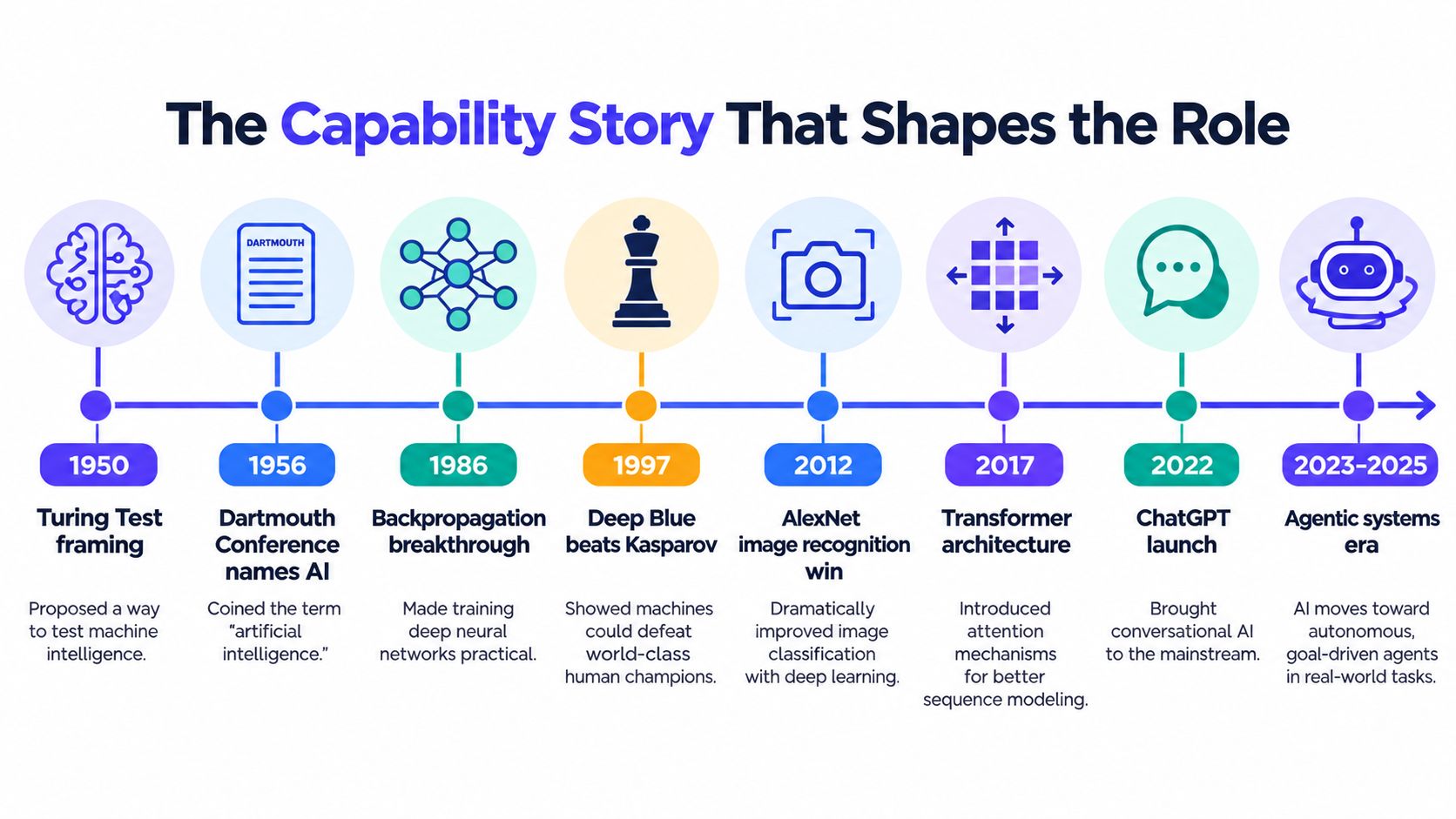
The next milestones showed what specialized systems could achieve. IBM's Deep Blue defeated Garry Kasparov in 1997, demonstrating exceptional performance in a constrained domain. AlexNet's 2012 breakthrough on ImageNet established deep learning as the dominant approach for large-scale visual recognition. The 2017 Transformer architecture made highly scalable language modeling possible, changing the economics and usability of language-based systems.
Then the interface changed. GPT-3 reached 175 billion parameters in 2020, and ChatGPT launched publicly in 2022, bringing conversational AI into mainstream knowledge work. The important product consequence was that models became larger. General-purpose interfaces could interpret intent, generate artifacts, and interact with tools, so teams could build workflows around capabilities rather than a fixed menu of commands. The milestone sequence is documented in IBM's history of artificial intelligence.
For product managers, this progression changes the planning question. Earlier systems encouraged teams to specify narrow inputs and outputs. Modern AI products require decisions about capability boundaries, evaluation, safety, workflow integration, and human oversight. The interface may be a chat box, but the product is the surrounding system that determines what the model knows, what it may do, and how users recover when it's wrong.
A roadmap item such as “add an AI analyst” therefore hides several product decisions:
- What evidence can the assistant access?
- Which tasks require citations or traceable sources?
- What does a useful answer look like for a specific user role?
- Which errors are tolerable, and which require refusal or escalation?
- How will the team detect quality loss after launch?
The history matters because it explains why AI product management isn't a cosmetic layer over ordinary feature work. The underlying capability now reaches into interpretation and generation, so product judgment must include behavior.
The Daily Work Inside an AI Product Team
An AI PM's calendar usually contains fewer purely linear handoffs. The team spends more time turning ambiguous behavior into something testable, then checking whether the system performs that behavior under realistic conditions.
Discovery starts with behavior
Customer discovery still asks what users need, but AI adds questions about acceptable delegation. Does the user want a draft, a recommendation, a classification, or an action taken on their behalf? What evidence would make the output credible? When would a user rather receive no answer than a confident wrong one?
The PRD changes accordingly. Instead of listing only screens and endpoints, it should include:
- Representative tasks: The inputs and workflows the feature must support.
- Failure modes: Missing context, unsupported claims, unsafe requests, ambiguous instructions, and degraded source data.
- Evaluation criteria: Human judgments, automated checks, task completion, and review effort.
- Fallback behavior: Clarification, refusal, source display, escalation, or a deterministic alternative.
- Ownership: The people responsible for data, launch approval, monitoring, and incident response.
Data work also becomes part of product planning. Someone must determine which sources are allowed, how stale information is handled, whether labels are consistent, and how provenance reaches the user or reviewer. A model decision without a data decision is usually an incomplete product decision.
Model choice follows the workflow
Build-versus-buy is not just a technical procurement question. A hosted model may improve capability and reduce initial infrastructure work, but it can introduce privacy, latency, cost, or vendor-dependency constraints. A smaller or specialized model may be easier to control, yet require more data preparation and maintenance.
Prompt and context design deserve similar treatment. A system instruction can shape behavior, but it can't repair missing permissions or unreliable source material. Context engineering is useful when the team treats retrieval, filtering, formatting, and provenance as part of the product rather than as prompt decoration. The practical workflow is also compatible with broader product development stages for founders, provided AI evaluation is added before and after release.
A 2024 McKinsey study compared product-development activities performed with and without generative-AI tools by 40 product managers across the United States, Canada, Europe, and Latin America over a six-month cycle. The researchers reported an estimated 5% acceleration in time to market, a 40% improvement in product-manager productivity, and a 100% improvement in employee experience, but the sample means those figures should be treated as directional rather than universal benchmarks. McKinsey's study also matters because the benefits covered discovery, planning, and managerial work, not only code generation.
The calendar implication is straightforward. Drafting may shrink, while evaluation, data review, edge-case analysis, and cross-functional alignment grow. Teams that use AI to produce more artifacts without expanding verification have increased output, not necessarily improved product management. A practical perspective on AI across the build process is available in this guide to AI for product development.
Data, Models, and the Trust Trade-Off
The most dangerous AI product mistake is treating a compelling demo as evidence of a reliable product. A demo proves that the system can produce an impressive output on selected inputs. It doesn't prove that the output is accurate enough, traceable enough, safe enough, or useful enough in the customer's actual workflow.
A controlled GitHub Copilot trial makes the distinction concrete. Developers with real-time code suggestions completed a specific HTTP-server implementation 55.8% faster, with a 95% confidence interval of 21–89%. The result is meaningful for that task, but the trial didn't establish production reliability, maintainability, security, or customer value. The findings are available in the controlled Copilot trial.
Compare the constraint layers
| Decision | Traditional PM emphasis | AI PM question |
|---|---|---|
| Data | Is the required product data available? | Is it representative, permitted, current, traceable, and useful for evaluation? |
| Model | Can engineering implement the required behavior? | Which capability, latency, cost, and controllability trade-off fits the task? |
| Evaluation | Does the feature pass functional tests? | Does it produce acceptable outputs across normal, difficult, and unsafe cases? |
| Ethics | Does the design create obvious user harm? | Who could be misrepresented, excluded, exposed, or overruled by the system? |
| Ownership | Who fixes the feature after release? | Who monitors behavior, approves changes, and responds when model quality falls? |
The trust gap makes these questions operational. A randomized workplace study of generative-AI coding tools found that sustained use increased perceptions of usefulness and enjoyment, while perceptions of trustworthiness in generated code remained unchanged. The same study reported that 84% of participants saw positive changes in daily work practices and 66% saw changes in how they felt about their work. Those signals can coexist with unresolved verification risk, as described in the workplace study of generative-AI coding tools.
That's why launch criteria should pair speed with control. Track review duration, substantive edits, test failures, security findings, rollback incidents, acceptance rate, and the percentage of outputs accepted without meaningful inspection. A faster draft that demands longer review may not reduce total work. A more enjoyable workflow that increases defects may damage the product while improving internal sentiment.
Practical rule: Every AI productivity metric needs a corresponding verification metric.
The data and context layer deserves equal attention. A model can't compensate for incomplete permissions, stale documents, contradictory records, or poorly defined labels. Teams using retrieval or context engineering should document which sources entered an output, how they were selected, and what the system does when evidence is absent. More detail on that layer appears in this guide to context engineering in AI.
Measuring Outcomes Instead of Activity
The most common AI PM failure mode is mistaking local efficiency for customer value. A team generates more summaries, drafts more code, or closes more tickets, then declares success without checking whether customers complete important tasks more reliably or whether the business absorbs fewer problems.
Recent survey data exposes the gap. 97% of product managers reported personal productivity gains from AI, while 64% reported better product outcomes, and 85% still relied on their own expertise to validate AI-generated work. 33% cited lack of trust as a barrier, according to the 2026 Product Focus survey.
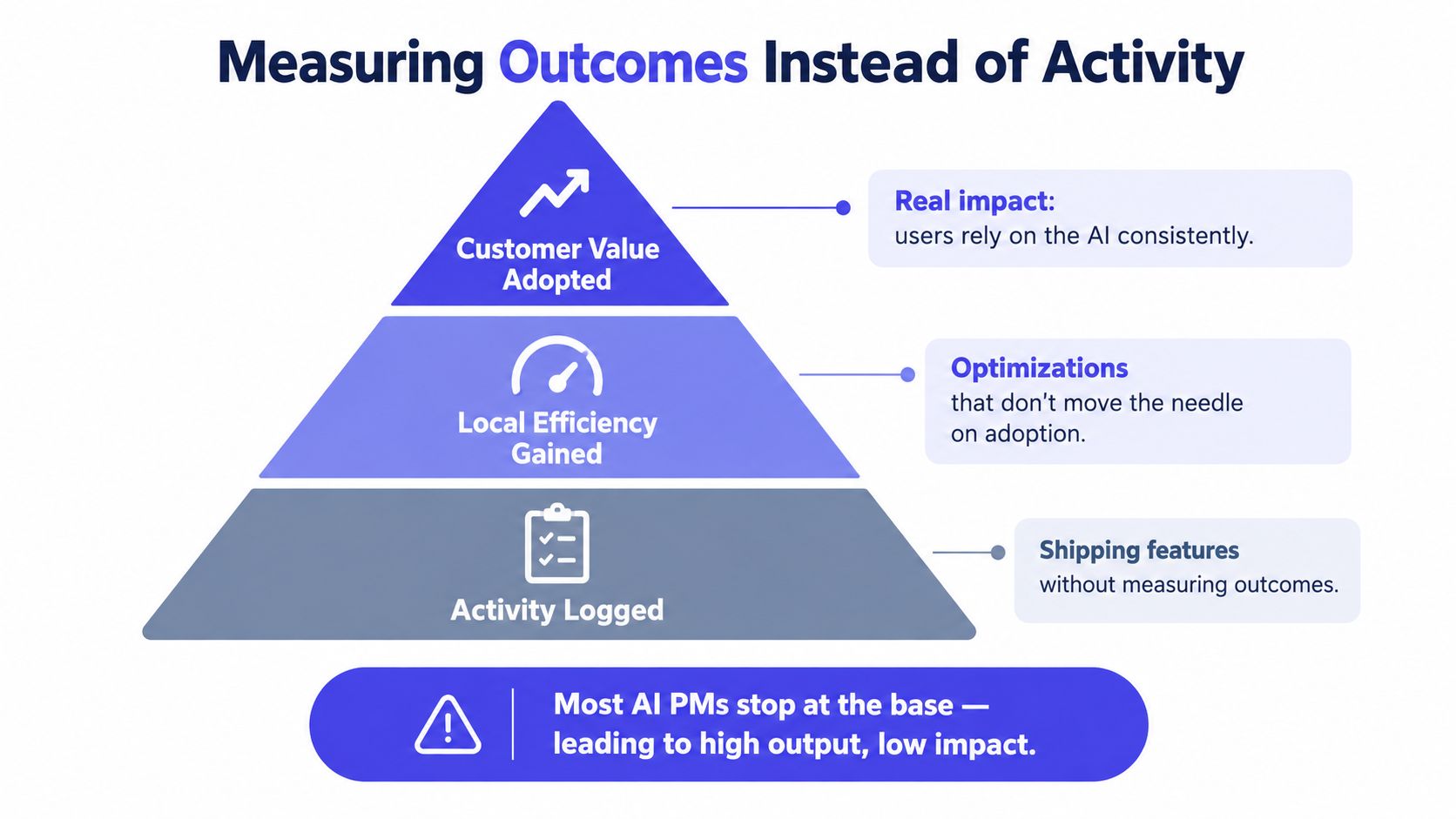
The numbers point to a practical hierarchy. Activity tells you that the team shipped or generated something. Local efficiency tells you that a task became faster or easier. Customer value tells you whether users adopted the capability and achieved a better result. The first two levels matter, but they're weak substitutes for the third.
Use a one-page outcome memo
Before launch, write a short memo with four layers:
- User job: State the customer task in observable terms. “Summarize a call” is an output. “Prepare an accurate follow-up that a sales representative can send” is a job.
- Baseline: Record how the task works without AI, including completion quality, time, error patterns, and review effort. If instrumentation is limited, use a small, manually reviewed sample rather than pretending the baseline doesn't matter.
- AI contribution: Specify which part the system changes. It may reduce drafting effort, improve retrieval, surface a missed issue, or route work to the right person.
- Outcome and guardrails: Track adoption quality, task completion, retention, revenue, error rates, support burden, and human overrides where relevant. Pair these with acceptance rate, manual edits, review duration, test failures, security findings, and rollbacks.
The point isn't to create enterprise bureaucracy. A seed-stage team can keep the memo to one page and review it at each meaningful model, prompt, or workflow change. What matters is separating model performance from product value. A model may score well on an evaluation set while users ignore the feature because it arrives at the wrong moment. Conversely, a modest model may create value if it fits a high-friction workflow and gives users a safe way to correct it.
An outcome review should ask three blunt questions:
- Did users adopt the capability for the intended task?
- Did the feature improve the result, not only the production process?
- Did verification and support costs stay within the team's tolerance?
A launch passes when the answers remain defensible after users encounter difficult cases, not merely when the system looks impressive in a controlled demo.
Ethics, Risk, and a Minimal Operating Loop
Ethics becomes practical when a team assigns responsibilities before something goes wrong. “The product team owns it” is not an operating model. Someone must own the source data, someone must define evaluation criteria, someone must approve launch, someone must monitor behavior, and someone must coordinate the response to a serious failure.
Survey evidence points to organizational friction rather than model choice as a central constraint. Limited integration with existing tools was identified as the leading barrier to getting more value from AI at 47.1%, followed by insufficient AI training at 42.6%. A separate finding reported that only 23% of organizations had a clear AI strategy with defined ownership. These figures come from the State of Product Management 2026 survey.
A small team doesn't need a committee for every prompt change. It needs a visible loop with clear handoffs.
Capture the decision
Record the user problem, intended behavior, data sources, excluded data, model or provider choice, known limitations, and the reason the team chose AI over a simpler alternative. Keep the record close to the product artifacts rather than hiding it in a private chat.
Define acceptance before launch
Write examples of acceptable and unacceptable outputs. Include normal cases, ambiguous requests, missing context, sensitive information, unsupported claims, and adversarial inputs where relevant. Decide which failures require a correction, a refusal, a human review, or a fallback.
Connect the system to the workflow
An AI feature that lives outside the user's real process will accumulate work around itself. Put outputs where users already review, edit, approve, or act. Integration means more than adding an API call. It includes permissions, source context, feedback capture, notifications, and a clear path back to the underlying record.
Assign ownership after release
Name one accountable product owner and one operational or technical owner. The product owner decides whether behavior still serves the user and business goal. The technical owner monitors system health, evaluation results, data changes, and incidents. Legal, security, design, and operations contribute where the risk requires it, but shared contribution shouldn't mean invisible accountability.
Monitor and respond
Keep a small dashboard for output acceptance, corrections, overrides, review effort, failures, and support signals. Define what triggers investigation and who can pause, restrict, or roll back the feature. For teams explaining the relationships among governance, controls, and responsible use, this AI compliance diagram can provide a useful visual reference.
Ownership is a product feature. Users trust a system more when the team can explain what it knows, how it is checked, and what happens after a failure.
The loop should be lightweight enough to run every week and specific enough to survive a handoff. Log decisions, preserve provenance, test behavior, connect outputs to the workflow, assign owners, monitor results, and respond visibly. Model selection matters, but the operating loop determines whether the product remains dependable.
What to Do on Monday Morning
Start with one workflow, not an AI strategy presentation. Choose a task where users already spend time reviewing, classifying, searching, drafting, or reconciling information. Avoid a broad promise such as “add an assistant.” Name the exact job and the consequence of getting it wrong.
Then write a one-page evaluation memo:
- Target task: What should the user complete?
- Baseline: How is the task handled today?
- Expected change: What will AI draft, retrieve, classify, recommend, or execute?
- Acceptance test: What makes an output usable, and what makes it unsafe?
- Outcome metric: Which customer or business result should move?
- Control metric: Which edits, overrides, failures, or review costs must stay within tolerance?
- Owner: Who decides whether the feature remains live?
Run the evaluation before polishing the interface. A rough prototype with real examples teaches more than a convincing demo built on carefully selected inputs. Include difficult cases early, record the system's sources, and make the fallback path visible to users.
After launch, review the same memo on a regular cadence. Look for the difference between people trying the feature and relying on it, between accepted outputs and lightly edited drafts, and between time saved in one team and support work created elsewhere. Assign a named owner for failures before the first incident, not after it.
AI product management is the discipline of keeping intent, evaluation, and accountability visible while the model underneath the product changes. Teams that preserve that visibility can improve the product as capability evolves. Teams that track only activity will struggle to tell whether they're building a better product or merely producing more artifacts.
SpecStory, Inc. offers SpecStory, Inc., a multiplayer AI workspace where product conversations become shared decisions, Markdown PRDs, implementation paths, and traceable code-oriented artifacts. Visit the workspace to keep intent, evaluation criteria, and unresolved questions connected from the meeting through the first commit.
Newsletter
Get new posts in your inbox
Bring your team together to build better products. Fresh takes on remote collaboration and AI-driven development.