


Most AI coding guides start in the wrong place. They tell you to find a better model, refine your prompt, or switch from autocomplete to an autonomous agent. Those choices matter, but they rarely fix the failure I see most often: the agent never received the product context that humans discussed before coding began.
A useful AI coding workflow starts before the editor opens. It turns decisions, constraints, designs, and unresolved questions into durable artifacts that an agent can inspect, test against, and connect to its eventual commit. Without that chain, teams generate code faster while creating more review, debugging, and alignment work downstream.
Table of Contents
- The Hidden Bottleneck in AI Coding Workflows
- Why AI Coding Adoption Outpaced Dependable Gains
- Converting Live Conversations Into Executable Context
- Classifying Tasks by Risk for Agent Assignment
- Building a Test-Gated AI Coding Pipeline
- From Meeting to First Commit, A Practical Example
The Hidden Bottleneck in AI Coding Workflows
The popular assumption is that AI coding productivity depends mainly on prompt quality. Better instructions help, but a polished prompt can't recover a decision that was never recorded, a constraint buried in a meeting, or a disagreement left unresolved in chat. An agent can produce syntactically convincing code while implementing the wrong interpretation of the feature.
The evidence points to a context problem, not a simple generation problem. Stack Overflow's 2025 AI survey found that 84% of developers use or plan to use AI tools, yet only 16.3% said AI made them significantly more productive and 41.4% reported little or no effect. The same survey found that 75.3% don't trust AI answers and 45% find debugging AI-generated code time-consuming.
Prompts can't replace organizational memory
Product teams distribute intent across too many places. A designer clarifies a state in Figma, a product manager changes the acceptance criteria in a meeting, an engineer identifies an API limitation in Slack, and the ticket retains none of it. The coding agent sees the ticket and perhaps a few files, but not the reasoning that made those artifacts meaningful.
That gap creates a familiar failure pattern:
- Plausible implementation: The agent fills in missing decisions with assumptions that look reasonable in isolation.
- Hidden misalignment: The code satisfies the literal request but violates an interaction rule, business invariant, or previously agreed exclusion.
- Expensive review: A human must reconstruct the original conversation before judging whether the implementation is correct.
- Repeated clarification: The same question resurfaces in another meeting or coding session because nobody preserved the answer.
Practical rule: Treat missing context as a workflow defect, not a prompting defect.
The fix isn't to paste every conversation into every prompt. Unfiltered transcripts overwhelm people and agents alike. Teams need a process that extracts decisions, labels uncertainty, preserves supporting evidence, and makes the resulting context available where implementation happens.
The workflow is the product
A dependable system connects five things: conversation, decision, requirement, code change, and test evidence. Each link gives the next participant enough information to act without reopening the entire history.
This changes how teams evaluate AI coding tools. Acceptance rate and generated lines can describe activity, but they don't show whether the code reflects product intent or survives integration. A stronger workflow asks whether an agent can explain which requirement it implemented, which assumptions it made, which interfaces it changed, and which tests prove the behavior.
The model still matters. Yet even a capable model can't infer context that the team never made durable. Prompt refinement is useful after the organization has created a reliable memory layer. Before that, better prompts often produce faster versions of the same misalignment.
Why AI Coding Adoption Outpaced Dependable Gains
AI coding adoption grew because inline assistance fits the developer's existing environment. GitHub reported in June 2023 that Copilot had been activated by more than 1 million developers and adopted by over 20,000 organizations. Developers accepted nearly 30% of suggestions during their first year, completed programming tasks 55% faster in a controlled study, and generated 46% of the code in files where Copilot was enabled. GitHub also reported that more than 3 billion lines of code had been accepted through the system. GitHub's report on Copilot's economic impact documents those vendor-reported findings.
Those figures explain why the tools became part of normal development infrastructure. The assistant sits inside the editor, proposes implementation details, and leaves the developer responsible for acceptance, testing, review, and integration. That model scales more easily than asking teams to abandon their tools and hand an entire feature to an opaque system.
The productivity story becomes less straightforward once tasks involve unfamiliar architecture, implicit requirements, or security-sensitive behavior. A randomized controlled trial by METR, summarized in a 2025 research review, found that experienced open-source developers took 19% longer when using AI tools, despite expecting to become 20% faster. The difference isn't a contradiction. It shows that drafting speed and completed delivery are separate measures.
Where the time goes
AI assistants are often useful for boilerplate, documentation, test scaffolding, repetitive refactoring, and narrowly defined transformations. They become less predictable when the work requires the developer to understand a broad system, reconcile conflicting requirements, or validate behavior that isn't fully represented in existing tests.
The hidden work usually appears after generation:
- reading unfamiliar code closely enough to detect incorrect assumptions,
- checking whether the patch preserves existing contracts,
- debugging failures caused by integration details,
- investigating dependencies and configuration,
- asking product questions that the original request left unanswered.
A team that measures only typing speed or accepted suggestions misses those costs. It may conclude that the workflow is improving because the agent produces a large patch, while developers spend longer determining whether the patch is safe to merge.
Measure delivery, not generation
The right scorecard combines cycle time, review effort, escaped defects, test failures, and rework. Acceptance volume can remain a useful diagnostic, but it shouldn't become the objective. A high acceptance rate may mean the suggestions fit local syntax, not that the resulting feature matches the product decision.
This is why a practical research habit helps. Teams evaluating an AI coding approach can maintain a small evidence file with tool behavior, task outcomes, review findings, and known limitations. A curated research page can support that practice by giving teams a place to organize relevant material before they convert observations into workflow changes.
The central lesson is uncomfortable but useful: adoption can scale before dependable productivity does. An agent makes the cost of an unclear requirement visible sooner, but it doesn't remove the requirement. Teams gain durable speed when they reduce ambiguity before generation and shorten the path from generated code to verified behavior.
Converting Live Conversations Into Executable Context
The most valuable artifact in an AI coding workflow isn't always a prompt. Often, it's a compact record of what the team decided, why it decided it, and what remains unknown. That record should be created close to the conversation, not reconstructed days later from memory.
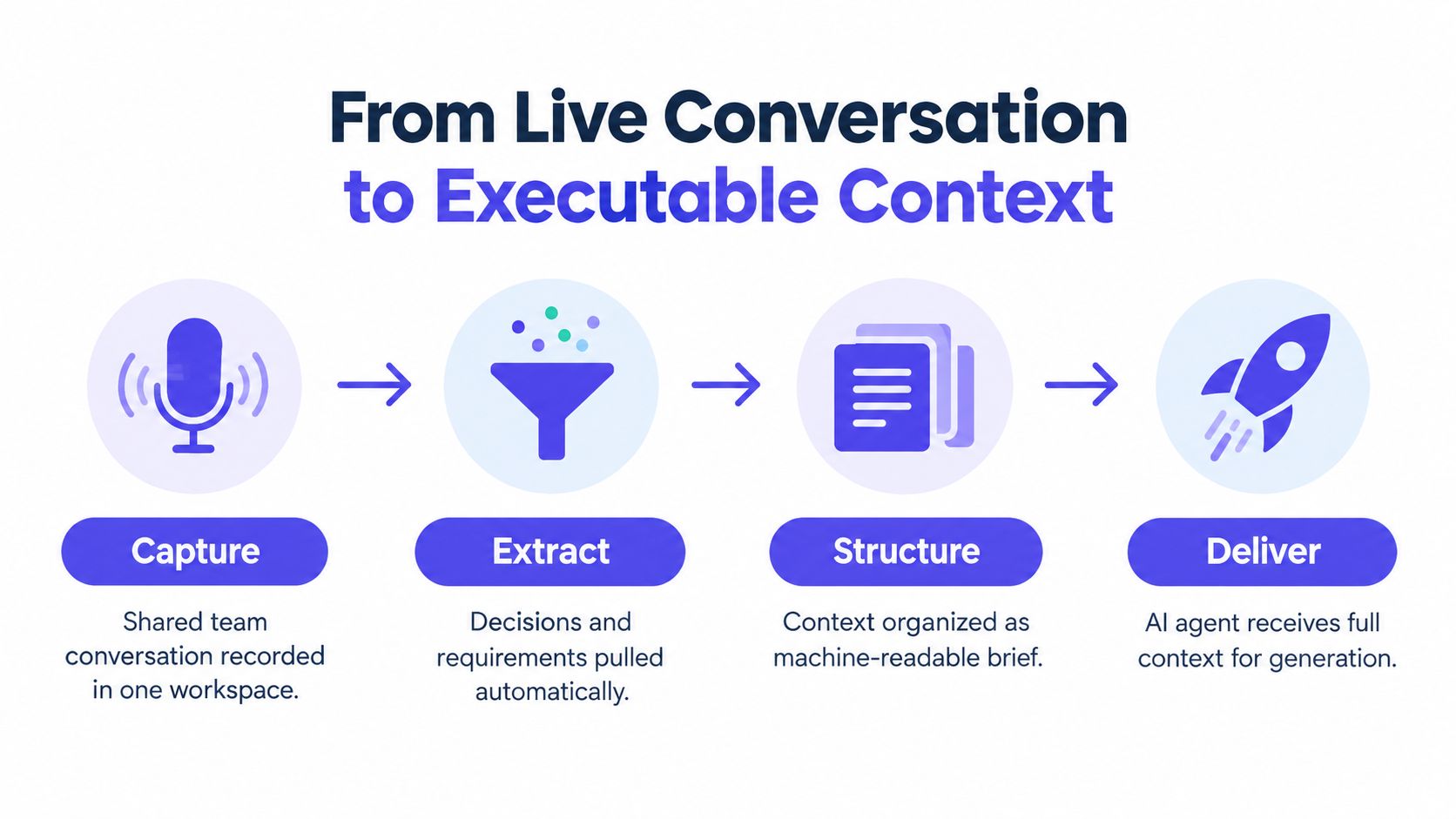
Capture decisions while people are talking
Start with a shared conversation space where the team can distinguish discussion from commitment. A transcript alone isn't enough. The workflow should identify:
- Intent: What user or business problem is the feature solving?
- Decisions: What behavior did the team explicitly choose?
- Constraints: Which APIs, systems, legal rules, design patterns, or performance boundaries matter?
- Open questions: What remains unresolved, and who owns the answer?
- Non-goals: Which tempting extensions are outside the current change?
Keep the original discussion available, but promote the important parts into structured notes. This gives engineers and agents both the source material and a concise working brief.
Turn the record into a context packet
A useful context packet is short enough to read and specific enough to execute. I structure one around a feature objective, acceptance criteria, edge cases, relevant interfaces, repository conventions, examples of expected behavior, and unresolved questions. Every assumption should be visible. If the team hasn't decided something, write open rather than allowing the agent to choose on its own.
The packet should also state what changed since the previous decision. That small piece of versioned history prevents an agent from following an obsolete ticket or design comment.
A practical format might include:
- Outcome: The behavior users should experience.
- Rules: Invariants the implementation must preserve.
- Boundaries: Files, services, and interfaces in scope.
- Examples: Valid, invalid, empty, and failure cases.
- Evidence: The tests or checks that will demonstrate completion.
- Questions: Items that block implementation or require follow-up.
The principles behind this approach align with broader guidance on context engineering for AI agents. The point isn't to build a larger prompt. It's to make the team's reasoning inspectable and reusable.
Preserve traceability into the repository
Store the context packet beside the implementation plan or issue reference, then link commits and pull requests back to it. An engineer should be able to move from a changed line to the requirement, from the requirement to the decision, and from the decision to the original conversation when necessary.
That traceability helps in three ways. It lets reviewers judge intent rather than only syntax, gives agents a stable source for later tasks, and exposes stale decisions before they turn into code. It also reduces Slack archaeology, the practice of searching old messages to recover why a seemingly strange implementation exists.
Don't ask developers to maintain a perfect document after every meeting. Automate extraction where possible, then require a human to confirm decisions and close or assign open questions. The human checkpoint matters because transcripts capture words, not necessarily commitments.
Classifying Tasks by Risk for Agent Assignment
An agent shouldn't receive the same authority for a README update and an authorization change. The safest teams classify work before generation, then match the task's risk and context requirements to an appropriate level of human ownership.
| Task category | Suitable agent role | Human responsibility |
|---|---|---|
| Boilerplate, documentation, tests, and mechanical refactoring | Draft and revise within a narrow scope | Confirm intent, style, and coverage |
| Core business logic and data transformations | Propose options and implement a vertical slice | Own invariants, edge cases, and review |
| Authentication, authorization, payments, data access, shell execution, and infrastructure | Assist with analysis and test generation | Design, threat-model, inspect, and approve |
A study of 120 professional developers and 480 modules reported a 31.4% productivity increase with AI-assisted development but 23.7% more vulnerabilities per 1,000 lines. It also reported 47% more high-severity vulnerabilities, 89% more critical vulnerabilities, and found that 76% of vulnerabilities in generated code went undetected during participant code reviews. These findings are from the study published in the IJFMR research paper, and they support a cautious operating model rather than a blanket rejection of AI.
Low-context work
Agents are well suited to tasks with clear inputs, predictable outputs, and strong automated checks. Examples include adding repetitive serializers, expanding unit-test cases, updating documentation, applying a known refactoring pattern, or wiring established components together.
Even here, give the agent repository conventions and a definition of done. “Add tests” is weak context. “Add tests for empty input, malformed input, and the existing success path, then run the package test command” is executable context.
Domain logic
Business logic needs more than code familiarity. The agent must understand what the system is allowed to do, what it must never do, and how competing rules interact. Ask it to state invariants, propose alternatives, and list failure modes before writing the patch.
Then implement one vertical slice. A narrow slice makes it easier to compare behavior against the decision record and prevents the agent from inventing architecture across unrelated modules.
Security-critical work
Keep humans firmly accountable for authentication, authorization, payments, secrets, data access, and infrastructure configuration. Generated code can repeat insecure patterns across projects, particularly when a template looks conventional but mishandles input, privilege, or failure behavior.
For broader organizational context, teams comparing collaboration and employee experience approaches may find employee experience platforms compared useful when thinking about how shared context and communication practices support technical execution. The same principle applies inside engineering: tools should clarify ownership, not obscure it.
Building a Test-Gated AI Coding Pipeline
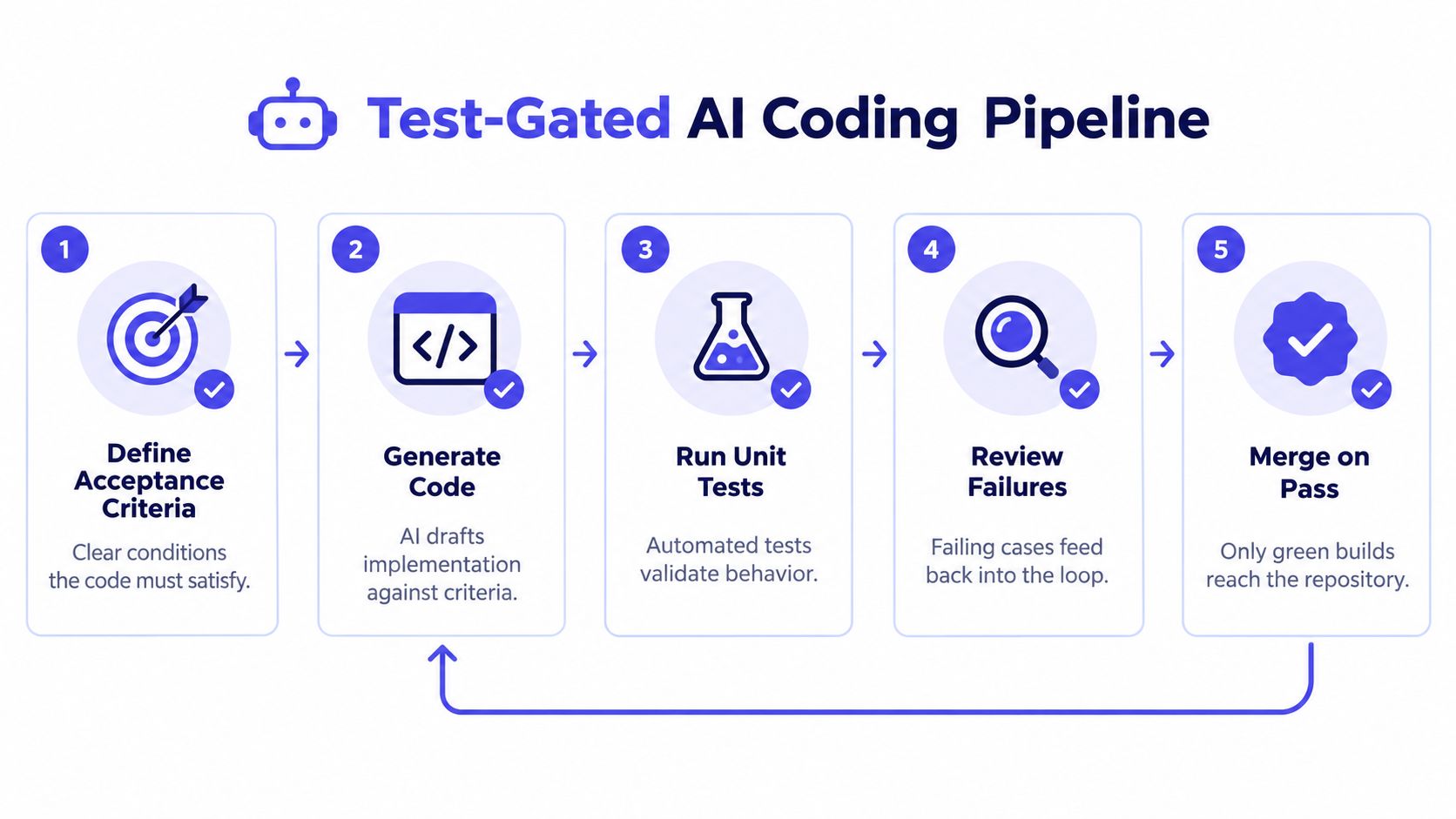
Generation should be one stage in a controlled loop, not the final handoff. A practical pipeline starts with an executable requirement and ends only when automated checks, human inspection, and traceability all agree that the change is ready.
Define before generating
Write acceptance criteria as observable behavior. Include edge cases, failure responses, permissions, data boundaries, and compatibility requirements. Give the agent the relevant files, repository instructions, context packet, and commands it can run.
Ask for a small plan first. The plan should identify changed interfaces, assumptions, risks, and tests. Reject or revise the plan before requesting implementation if it ignores a requirement or expands the scope.
Generate a narrow patch
Large autonomous changes are difficult to review because they mix decisions, refactoring, and implementation. A narrow patch creates a tighter feedback loop. It also lets the agent use test results as concrete evidence rather than guessing whether a broad transformation worked.
The agent should produce tests with the code where practical. It should also explain which acceptance criterion each test covers and identify any criterion it couldn't verify.
Let automation reject weak work
Run the checks that match the repository and risk:
- Unit tests for local behavior and edge cases.
- Integration tests for service, database, and API contracts.
- Type and lint checks for structural and style errors.
- Dependency scans for risky or unexpected packages.
- Secret detection for credentials and sensitive material.
- Static analysis for common correctness and security problems.
- Adversarial tests for authorization, injection, malformed input, and privilege boundaries.
A green build doesn't prove that the product decision was correct, but a failing gate gives the team concrete evidence to investigate. For high-risk changes, use least-privilege fixtures and test the ways an attacker or malformed client could exercise the code.
Review the diff, then merge
Humans should inspect the diff for unintended behavior, confusing abstractions, changed contracts, and assumptions that tests don't cover. The reviewer must understand the code before approving it. If the agent can't explain a section clearly, simplify or rewrite it.
Google's 2025 DORA research reported that more than 80% of surveyed technology professionals perceived productivity gains from AI and 59% perceived improved code quality. The same reporting noted that 45% of developers consider debugging AI-generated code time-consuming and that only 31% currently use AI agents. Google's DORA research summary reflects the tension: teams see value, but the verification loop remains essential.
Focus tools can also support the human side of this pipeline. For example, study mode app blocker features can help protect review time from distractions while an engineer examines a security-sensitive diff or follows a failing test through the codebase. The workflow itself is described in more detail in this guide to AI-driven software development.
Merge only after the required checks pass and a responsible engineer has reviewed the result. Measure escaped defects and rework alongside cycle time. That keeps the team from optimizing for fast generation while increasing the cost of ownership.
From Meeting to First Commit, A Practical Example
Consider a small product team discussing a notification preference feature. The product manager wants users to control email categories, the designer defines the empty and disabled states, and the engineer points out that the existing account service already owns notification settings. The meeting also reveals an unresolved question about whether administrators can override user preferences.

Instead of leaving those details in a transcript and scattered messages, the team captures them in a shared workspace. The resulting brief records the user outcome, the categories in scope, the disabled-state behavior, the existing service boundary, and the administrator override as an open question assigned to the product manager.
The agent then turns the confirmed material into a Markdown plan. It lists the data shape, endpoint changes, UI states, acceptance criteria, and tests. The engineer corrects one assumption before coding: the feature must preserve existing preferences for categories that aren't part of the first release.
The context follows the developer
Inside the repository, the engineer gives the coding agent the approved plan, relevant account-service files, repository conventions, and test commands. The agent first summarizes the intended change and names the interfaces it expects to touch. That response becomes an early alignment check. If it mentions a new service or migration that the team never discussed, the engineer can stop before a large patch exists.
The agent implements the smallest vertical slice, adds tests for saved preferences, empty preferences, invalid categories, and the disabled UI state, then runs the local checks. One test exposes an accidental default that would enable every category for existing users. Because the requirement and test are explicit, the agent can correct the behavior without a new round of product archaeology.
The workflow resembles the practices described in conversation-driven development, where the conversation isn't disposable preparation. It becomes part of the implementation record.
After the first patch passes automated checks, the engineer reviews the diff against the decision brief. The product manager resolves the administrator question, but that answer remains outside the current scope, so the team records it for a later change instead of expanding the patch midstream. The engineer commits the focused implementation with a message that references the feature brief and opens a reviewable pull request.
The following video illustrates the broader idea of connecting collaborative discussion with development work:
This example doesn't depend on a particular model or editor. It depends on preserving intent, separating decisions from open questions, giving the agent a bounded context packet, and making tests part of the request rather than an afterthought. The first commit becomes easier to review because the team can trace it back to an agreement instead of reconstructing that agreement from memory.
The practical shift is small but consequential. Stop asking only, “What prompt should I use?” Ask, “What did we decide, where is it recorded, how can the agent access it, and what evidence will prove the implementation is right?” That is how an AI coding workflow moves from meeting to first commit without losing the product between them.
SpecStory, Inc. offers Stoa, a multiplayer AI workspace that captures live product conversations, decisions, designs, and open questions as executable context, then helps collaborative agents draft PRDs and work in shared sandboxes with traceable outputs. Visit SpecStory, Inc. to connect team discussions with the coding workflow and preserve the path from agreement to commit.
Newsletter
Get new posts in your inbox
Bring your team together to build better products. Fresh takes on remote collaboration and AI-driven development.