


A roadmap thread ends with a string of thumbs-up reactions. The PM updates Jira, everyone leaves the call, and the team feels fast. Three days later, engineering starts implementation, discovers a billing constraint nobody documented, and reopens the decision in a different channel. Design revises the flow, security adds a requirement, and the original agreement becomes a vague memory.
That pattern isn't a communication problem alone. It's a decision traceability problem. A collaborative decision making process should turn private knowledge, design judgment, technical risk, and customer evidence into a shared artifact that survives the meeting and connects directly to a PRD, design file, ticket, pull request, or commit. The aim isn't to make every decision democratic. It's to make the reasoning visible, the disagreement safe to express, and the ownership impossible to misunderstand.
Table of Contents
- Why Product Decisions Feel Fast but Ship Slow
- What Makes Collaborative Decision Making Work
- Responsibility Models for Product Teams
- A Repeatable Collaborative Decision Making Process
- AI Workspaces and Developer-First Tooling
- Metrics That Show Whether Decisions Are Healthy
- Common Pitfalls and How to Fix Them
- How to Start a Better Decision Process Next Week
Why Product Decisions Feel Fast but Ship Slow
The apparent speed of a product team often ends when the meeting ends. A decision feels complete because people agreed verbally, but implementation still depends on unanswered questions: Which constraint mattered most? Who owns the trade-off? Was the security concern rejected, resolved, or just missed? If nobody can answer without searching chat history, the team hasn't finished deciding.
I define collaborative decision making as structured perspective integration with a traceable output. People contribute independently, challenge assumptions, compare evidence, and then record a choice with its rationale, objections, owner, and next action. That differs from opinion collection, where participants state preferences and a senior person chooses without discussion. It also differs from consensus theater, where nobody objects because the social cost of reopening the topic feels higher than the cost of shipping a flawed interpretation.
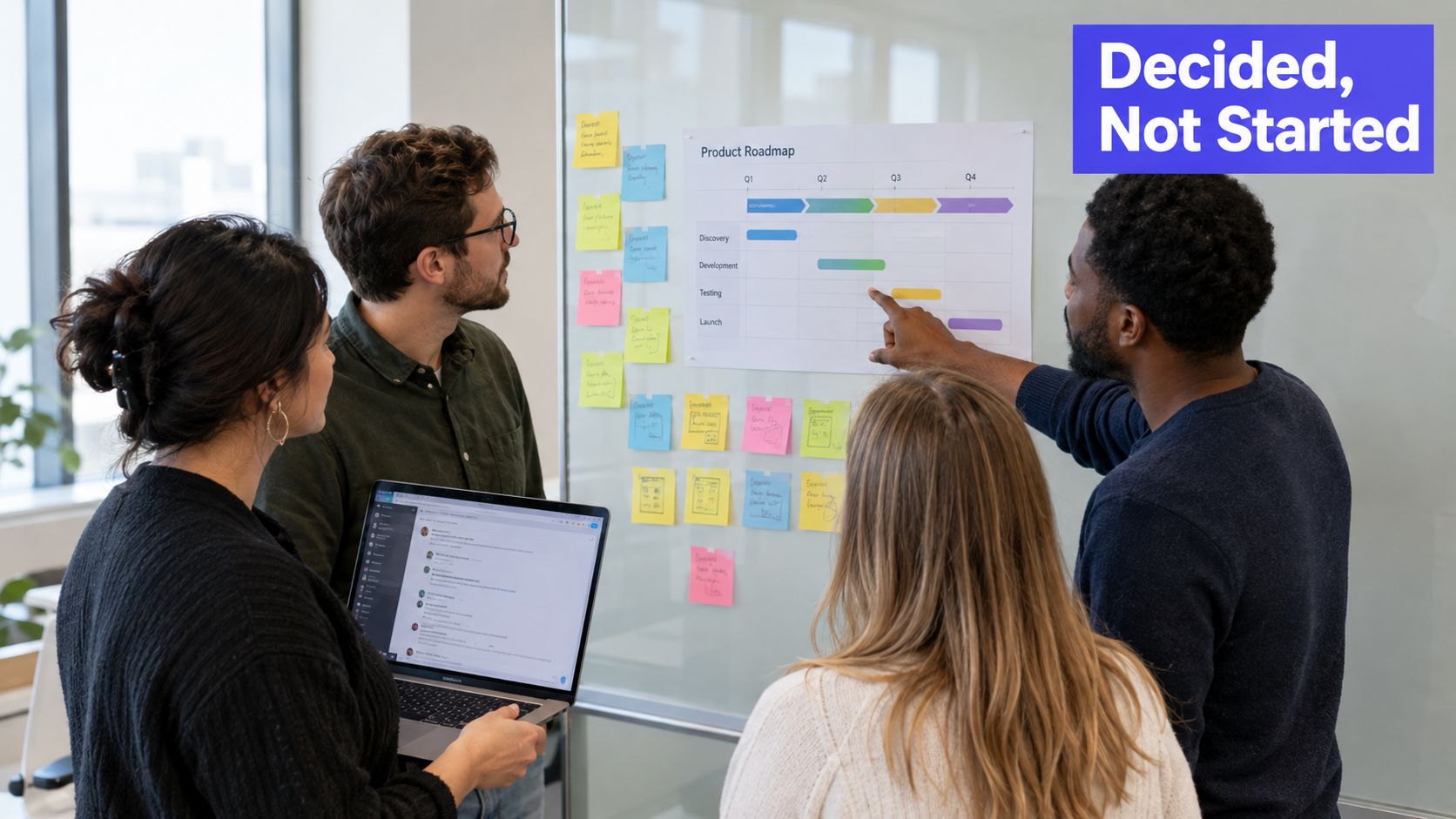
Velocity needs a visible trail
The trade-off isn't speed versus process. It's fast decisions with context versus fast conversations followed by slow reconstruction. A lightweight record can contain:
- Decision: The precise question the team answered.
- Options: The alternatives considered and the criteria used.
- Rationale: The evidence that drove the choice.
- Dissent: Objections, risks, and unresolved assumptions.
- Ownership: The person accountable for the decision and each implementation action.
- Review point: The signal or date that would justify revisiting it.
A useful real-time decision-making workflow treats the conversation and the work artifact as one connected stream. The team can move quickly, but engineers shouldn't have to infer intent from a reaction emoji or reconstruct product logic from a sequence of unrelated messages.
Practical rule: A decision isn't ready to ship until someone who missed the meeting can understand what was chosen, why it was chosen, and what happens next.
What Makes Collaborative Decision Making Work
Collaboration improves decisions only when people combine perspectives, rather than taking turns defending preferences. A foundational experimental study compared a collaborative rule, in which members exchanged and integrated information, with a consultative rule, in which members mainly sought input. It analyzed 91 collaborative groups and 85 consultative groups. Collaborative groups made more rational choices than the average rationality of their individual members and came closer to the rationality of their best-performing member than consultative groups did. The study supports a direct product lesson: the value of a staff engineer, researcher, or designer appears when the process lets the group use that person's specialized knowledge.
Teams lose that benefit when discussion stays with information everyone already knows. Shared facts feel safe, while unfamiliar evidence can slow agreement and expose weak assumptions. A meta-analysis of 65 hidden-profile studies covering 3,189 groups found that groups mentioned approximately two standard deviations more common information than unique information and were eight times less likely to identify the correct solution than groups given complete information. The meta-analysis also found that increasing information coverage mattered more than increasing the proportion of unique information discussed.
Cross-functional alignment makes this integration possible. See our guide to cross-functional alignment for the operating details.
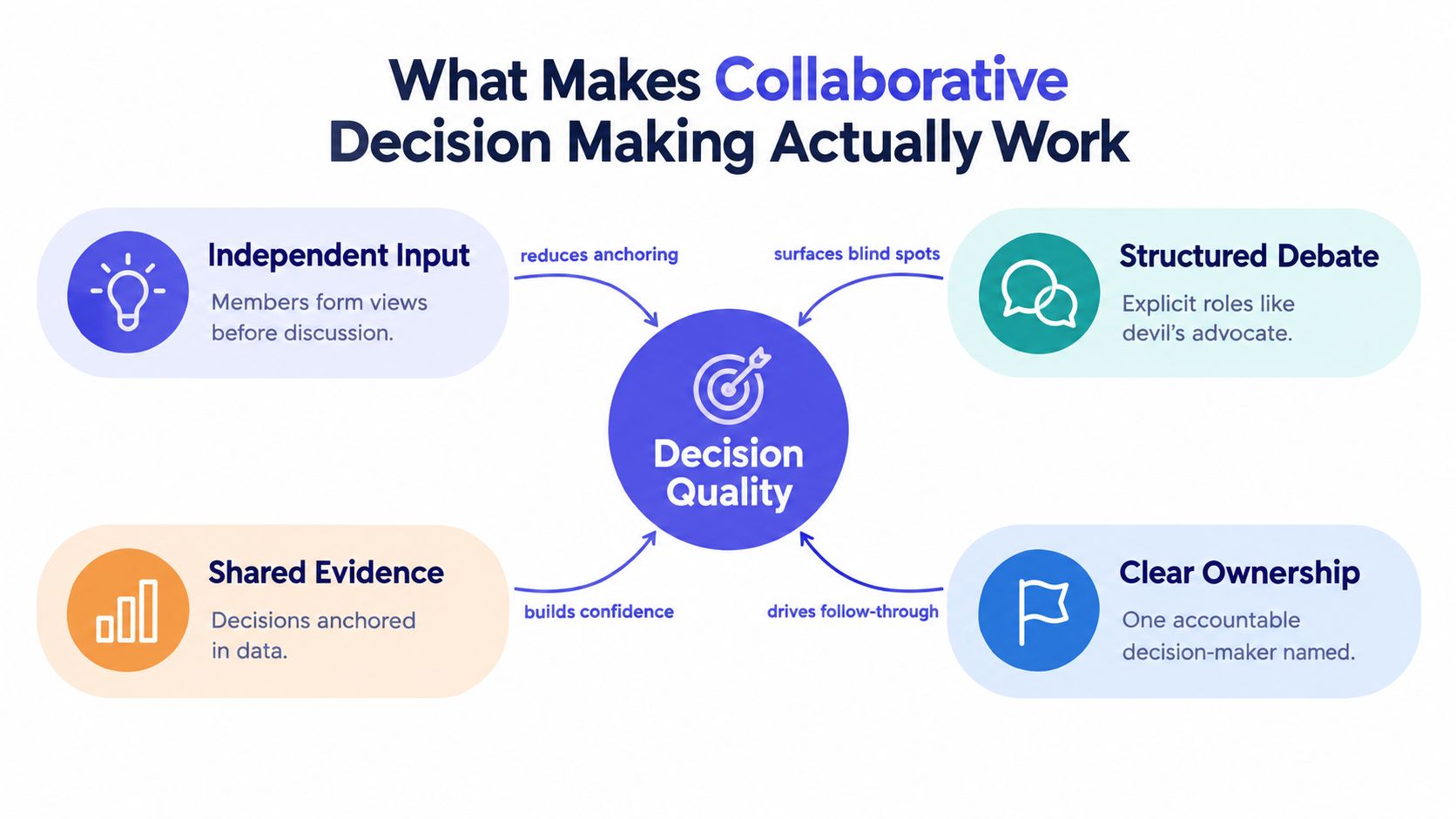
Four conditions create useful disagreement
Independent input should come before discussion. Ask each participant to record a preferred option, supporting evidence, largest risk, and one fact others may not know. This reduces anchoring on the first confident speaker and gives quieter specialists a route into the decision without competing for airtime.
Structured debate keeps challenge focused on the proposal. Assign a rotating skeptic, ask what would disprove the favored option, and distinguish criticism of an assumption from criticism of its author. Preserve rejected objections in the decision record. They may matter when conditions change.
Shared evidence requires clear labels for observed facts, interpretations, and guesses. A customer interview, production constraint, and executive preference can all influence a choice, but they should not be treated as the same kind of evidence. That distinction also helps teams review AI-generated suggestions without mistaking fluent output for verified evidence.
Clear ownership prevents collective accountability from becoming individual responsibility for nothing. Name the decision owner, contributors, dissenting voices, and implementation owner. When coding agents join the conversation, record which recommendation came from the agent, who checked it, and who accepts the resulting engineering risk.
Incentives shape information flow. Controlled experiments using three-person hidden-profile tasks found that competitive conditions caused participants to withhold unshared information and resist evidence that challenged their initial preferences more than cooperative conditions. The effect on decision quality was mediated by reduced use of information that contradicted those preferences. The research points to a practical ritual: reward people for finding risks, and require every automated recommendation to have a named human reviewer.
Responsibility Models for Product Teams
A team can't collaborate cleanly if nobody knows whether they're advising, deciding, or delivering. Responsibility models give the conversation a boundary, but the right model depends on the decision's complexity. A reversible copy change doesn't need the same machinery as a launch involving engineering, design, security, and support.
| Model | Best for | Key strength | Common risk |
|---|---|---|---|
| DACI | Small product teams making feature and roadmap decisions | Separates Driver, Approver, Contributors, and Informed stakeholders | The Approver can become a bottleneck |
| RAPID | Cross-functional decisions with substantial functional input | Names a Decider and separates Recommend from Perform | The vocabulary can feel heavy for routine choices |
| RACI | Larger organizations with recurring delivery responsibilities | Makes Responsible, Accountable, Consulted, and Informed roles visible | Mechanical use can create bureaucracy and too many reviewers |
DACI works well when a PM drives the decision, an executive or product lead approves it, specialists contribute evidence, and adjacent teams need notification. The Driver owns the process, not necessarily the final authority. That distinction prevents a common failure mode where the person writing the document is assumed to own every consequence.
RAPID is useful when recommendations and execution require different expertise. Security may recommend controls, engineering may perform the work, and a product leader may be the Decider. This model is valuable when a decision can stall because every contributor believes they have veto power.
RACI fits organizations with stable handoffs and many stakeholders. It becomes counterproductive when teams assign every letter to every person, turning a simple decision into a permissions exercise. Keep the model proportional to risk, reversibility, and cross-functional dependency.
Teams that want a broader perspective on personal and group choice can also review the Acheloa Wellness coaching approach. For product work, the key is to translate any framework into one visible question: who decides, who must be heard, and who turns the decision into reality?
A Repeatable Collaborative Decision Making Process
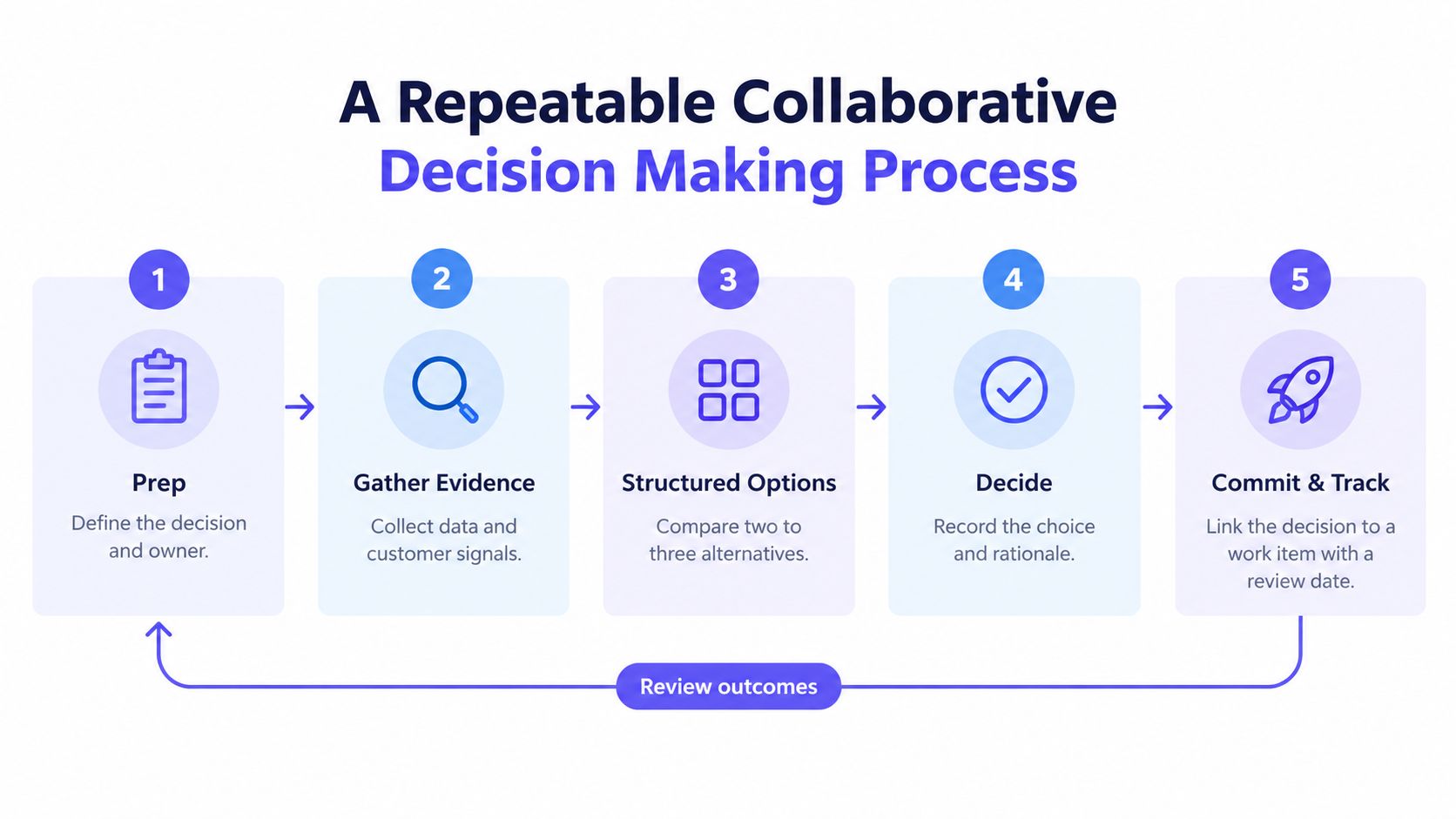
A good process should fit inside the tools your team already uses. The following sequence works for roadmap choices, design critiques, architecture reviews, and AI-generated implementation proposals.
1. Prepare the decision. Write one question, not a topic. State the constraints, success criteria, deadline, reversibility, and named decision owner. “Should we improve onboarding?” invites a sprawling conversation. “Which onboarding flow should we ship to reduce setup friction without changing account provisioning?” gives the team something it can answer.
2. Gather evidence independently. Before the meeting, each participant submits one supporting fact, one risk, one assumption, and one piece of disconfirming evidence. Ask contributors to identify information only they are likely to hold, such as a support pattern, a platform limitation, a research observation, or a compliance concern.
3. Structure the options. Compare two or three viable paths against the same criteria. Don't let the group treat the first plausible proposal as the default. If only one option remains, record why alternatives were discarded rather than pretending the team evaluated a meaningful choice.
The meeting ritual
Start by restating the decision and the authority model. Review independent inputs before open discussion, then ask, “What evidence hasn't been surfaced yet?” Invite the least-heard perspective before polling for preferences. If an AI agent supplied a requirement, code suggestion, or summary, label it as an input and identify the human responsible for validating it.
Move from evidence to trade-offs, then from trade-offs to choice. The decision owner should explain what won, what lost, and which risks remain. A dissenting contributor doesn't need to agree, but they should be able to confirm that their objection was understood and recorded.
4. Capture the choice. Use a short decision record with fields for the question, selected option, rationale, rejected alternatives, objections, unresolved questions, owner, contributors, linked artifacts, and review trigger. A decision log template can provide the starting structure, but the team should keep the record close to the PRD, design, or technical specification.
5. Commit and track. Link the record to the work item, assign every next action to a person, and specify what evidence will trigger review. A decision without a linked implementation artifact remains a meeting outcome, not an operating commitment.
AI Workspaces and Developer-First Tooling
AI can shorten the distance between discussion and implementation, but only if the team treats context as an owned artifact. A shared workspace can capture intent while people talk, turn decisions into Markdown specifications, let agents draft or run code in a sandbox, and preserve the connection between a conclusion and the implementation that follows. The practical advantage isn't that an agent speaks in the meeting. It's that engineers don't have to reconstruct the meeting before they can evaluate or change the work.
That context should travel with the team. A product decision may begin in a shared room, become a PRD, move into Figma for interaction design, and arrive in Cursor or another developer tool as implementation context. The handoff works when the original rationale, unresolved questions, and ownership remain visible instead of being replaced by a polished but unexplained output.
Govern the agent, not just the output
AI participation can create a new information asymmetry. Research on AI-supported teams found that teams with centralized AI knowledge made more accurate decisions in one study, while teams with asymmetric AI knowledge failed to outperform human-only teams because mistrust and unproductive AI-focused discussion interfered with collaboration. The study challenges the assumption that adding an agent automatically gives everyone equal benefit.
Use four controls:
- Declare the role: Say whether the agent is summarizing, generating alternatives, drafting code, testing an assumption, or recommending a choice.
- Name a human owner: Assign a person to validate requirements, code, citations, and risk boundaries.
- Preserve the reasoning: Store the prompt, relevant context, output, objections, and final human judgment where the team can review them.
- Scale review to risk: Reversible copy can receive a lighter check than authorization logic, data migrations, safety controls, or changes that are difficult to undo.
Transparent, participative decision-making also matters for psychological safety. A 2025 study reported mean psychological-safety scores of 5.11 in its transparent-participative condition versus 2.70 in its nontransparent, nonparticipative condition. The study supports a useful operating principle: visibility can make challenge safer while reducing the need for repeated alignment meetings.
Metrics That Show Whether Decisions Are Healthy
Decision metrics should expose friction, not reward attendance. Start with a small dashboard built from timestamps and fields already stored in the issue tracker, decision log, repository, and design workspace.
Intent lead time measures the interval between recording a decision and the first implementation commit. A long interval can point to ambiguous requirements, missing access, unclear ownership, or a handoff that stripped away context. Treat the result as a diagnostic, not an engineering performance score. Inspect where the decision became difficult to act on.
Objection coverage records whether participants submitted risks, assumptions, and disconfirming facts before the choice. Begin with a simple presence check, then review the substance. A decision with several explicit objections may be healthier than one with none if the team examined each risk and recorded why it accepted or rejected it.
Decision traceability checks whether an important choice links to its PRD, design file, technical specification, ticket, pull request, or commit. Broken links reveal where the team's working system is fragmented. They also make later review slower because engineers must reconstruct intent from scattered conversations.
Measure information, not airtime
Turn information coverage into a field-level check. List the evidence categories relevant to the decision, such as customer research, technical constraints, operational impact, security concerns, and delivery dependencies. Mark which categories were submitted, discussed, challenged, and still missing. A record with an empty category is a process defect to address, not merely a sign that one participant spoke less.
Review these signals during retrospectives:
- Delay location: Where did work wait after the decision?
- Missing context: Which question forced engineers or designers to reopen the record?
- Dissent quality: Did objections reveal risks, or only collect preferences?
- Revisit value: Did new evidence change the choice, or merely confirm it?
- AI attribution: Which inputs came from an agent, and did the assigned reviewer validate them?
Healthy processes may show more recorded disagreement at first. That usually means uncertainty is visible, ownership is inspectable, and automation has not quietly replaced judgment.
Common Pitfalls and How to Fix Them
The most damaging failures often look efficient in the room. They produce agreement, a clean action item, and a confused implementation team.
Shared-information bias makes people repeat facts already known by the group while neglecting privately held evidence. Require independent pre-work, ask who has not spoken, and maintain a visible list of evidence that hasn't been discussed.
Competitive framing turns a product decision into a contest between contributors. People defend their original position, withhold inconvenient facts, and interpret questions as attacks. Set a shared objective, ask every participant to state evidence against their preferred option, and recognize the person who finds a serious risk.
False consensus appears when silence is treated as support. Replace “Any objections?” with targeted prompts: “What assumption would you challenge?” “What would make this fail?” and “What did we leave unresolved?” Record objections separately from the final decision so agreement doesn't erase uncertainty.
Automation bias occurs when an AI-generated requirement, code change, or recommendation receives more trust than its validation deserves. Mark machine-generated inputs, identify a human reviewer, and require stronger review for changes with high impact or low reversibility.
The useful test: If a team member can disagree only before the decision and not after the decision record is published, the process isn't preserving dissent. It's merely tolerating a brief performance of it.
Psychological safety and speed aren't opposites. Structured visibility reduces repeated explanations, gives people a safer way to challenge authority, and makes unresolved questions easier to revisit. AI oversight research also warns that teams can miss low-severity errors, especially when multiple dependent AI systems are involved, so a fast approval isn't proof that the output is safe.
How to Start a Better Decision Process Next Week
Don't redesign every meeting. Choose one decision type that repeatedly causes rework, such as feature prioritization, a technical specification, or an AI-generated code proposal. Run that category through one lightweight record and observe where the delay occurs.
Create a page with these fields:
- Question and deadline: What must be decided, and by when?
- Decision owner: Who has final authority?
- Options and criteria: What alternatives will the team compare?
- Independent input: What evidence, risk, assumption, and disconfirming fact did each participant add?
- Decision and rationale: What did the team choose, and why?
- Dissent and open questions: What remains contested or uncertain?
- Execution links: Which PRD, design, ticket, branch, or commit carries the decision forward?
- Review trigger: What new evidence would cause the team to revisit it?
Measure only intent lead time and objection coverage for the pilot. After the decision, ask whether the implementation team had to reopen the problem, whether a missing specialist should have contributed, and whether the record made the next action obvious.
Keep the process smaller than the problem. A seed-stage team may need one owner, one page, and a short evidence round, not an elaborate governance system. If team relationships are the constraint rather than the decision mechanics, practical resources such as team building providers in Australia can help leaders think about trust and collaboration outside the immediate delivery ritual.
The target isn't longer meetings or unanimous agreement. It's better shipped work with less decision lag. Expand the process only where the pilot shows that visible reasoning, explicit ownership, and preserved dissent remove real friction.
SpecStory, Inc. offers Stoa, a multiplayer AI workspace where product teams capture intent, decisions, owners, rationale, and open questions in shared rooms, then turn that context into Markdown specifications, runnable sandboxes, and traceable code work. If your team wants to connect conversation to implementation while keeping AI participation reviewable, visit SpecStory, Inc. and try the workflow on one high-friction decision.
Newsletter
Get new posts in your inbox
Bring your team together to build better products. Fresh takes on remote collaboration and AI-driven development.