


Top-quartile firms in real-time-ness achieve more than 50% higher revenue growth and net margins than bottom-quartile peers. The advantage comes from faster decision loops, not from dashboards alone.
Most advice about real time decision making starts with infrastructure. Add a streaming platform, expose more metrics, put a live dashboard in every meeting, and decisions will supposedly accelerate. That sequence is backwards.
The operating problem comes first: how long does a team wait between having enough information to decide and taking action? A product group can have trustworthy analytics, clear customer feedback, and an agreed direction, yet still lose days to handoffs, unclear ownership, meeting notes, approval queues, and context scattered across tools.
Real-time capability means shortening that gap without sacrificing judgment. The teams that move well don't make every decision instantly. They identify which decisions are reversible, which need evidence or escalation, and which must remain auditable. Then they design the workflow around those differences.
Table of Contents
- The Performance Gap Behind Real Time Decision Making
- Foundational Mental Models for Faster Decisions
- Automated vs Human-in-the-Loop vs Hybrid Patterns
- Real-World Examples That Reveal the Trade-Offs
- Implementation Patterns for Product Teams
- Common Pitfalls and How to Avoid Them
- Bringing It Together - A Sustainable Real-Time Framework
The Performance Gap Behind Real Time Decision Making
The business case is stronger than the usual productivity argument. A major MIT Sloan Review study of real-time business capabilities examined 259 global companies across 2022 and 2023, alongside a second survey of 152 companies in 2025. Firms in the top quartile of “real-time-ness” achieved more than 50% higher revenue growth and net margins than firms in the bottom quartile.
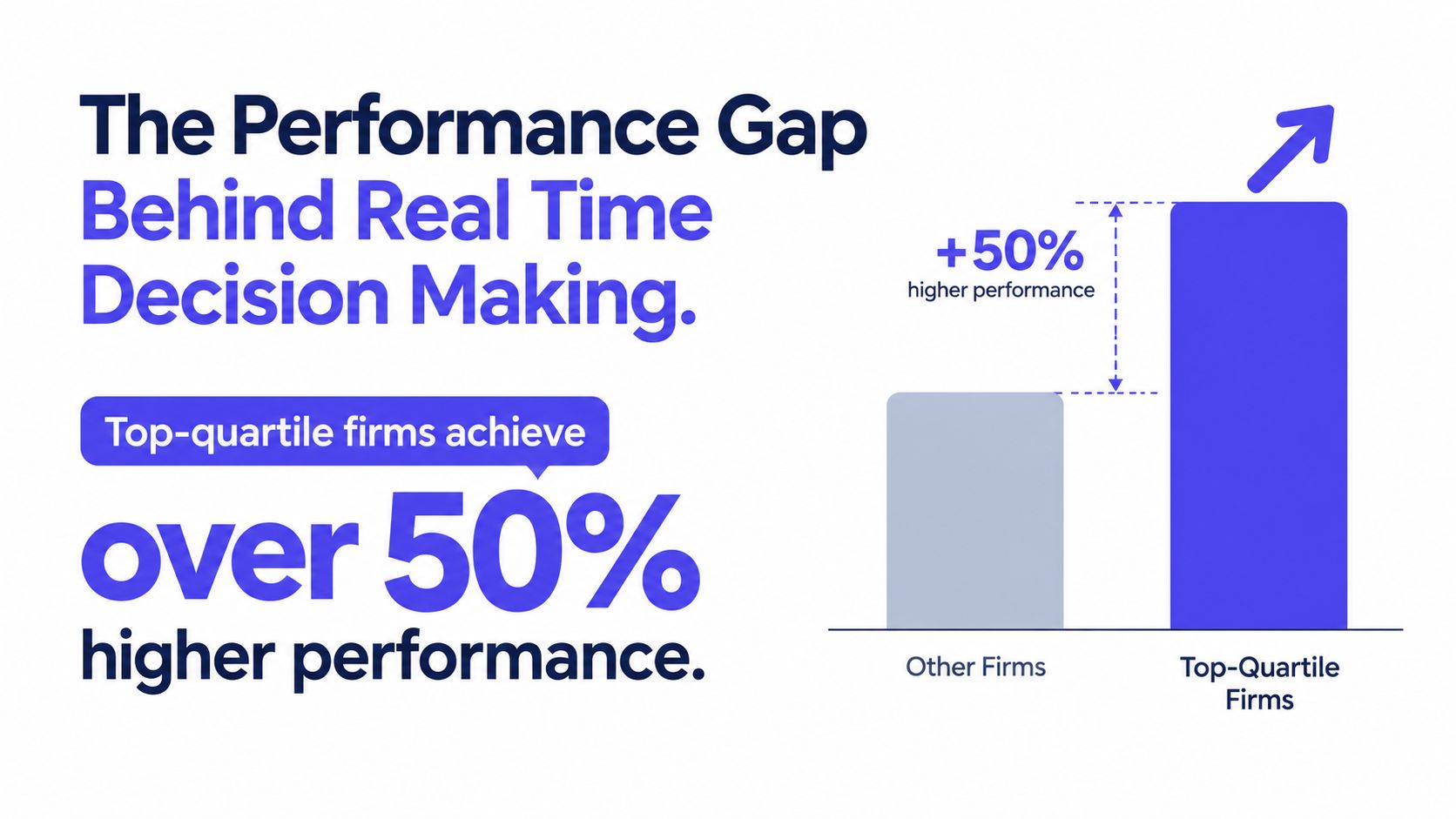
That finding doesn't mean speed automatically creates profit. It shows that organizations with live access to important data, motivated employees, business agility, and integrated customer experiences can convert changing conditions into action more effectively. Technology supports those capabilities, but it doesn't create them by itself.
Measure the gap, not the dashboard
Product leaders should treat decision latency as an operating constraint. For each recurring decision, record:
- Decision-ready time: When did the team have enough information to make a responsible call?
- Decision time: When did an authorized person finally decide?
- Action time: When did the first downstream action begin?
- Context loss: Which rationale, assumptions, or open questions disappeared between those moments?
A team might discover that analytics are available quickly, while approval takes several days. In that case, a faster data pipeline won't solve the main bottleneck. Bottleneck identification should include ownership, handoffs, and artifact creation, not just system latency.
Practical rule: Don't optimize the time to insight until you've measured the time from insight to action.
The harder constraint is governance. A 2026 global survey of 203 senior decision-makers across 22 countries found that 97% reported implementation barriers, while only 33% had fully implemented responsible AI frameworks. The same survey found that 52% were using hybrid approaches, rather than fully static or fully real-time models, according to Simwell's analysis of decision latency and friction.
That pattern is sensible. A reversible interface change can move through an automated path. A compliance decision, pricing policy, or cross-functional product commitment may need review, attribution, and a record of why the decision was made. Sustainable real time decision making reduces delay selectively while keeping those controls intact.
Foundational Mental Models for Faster Decisions
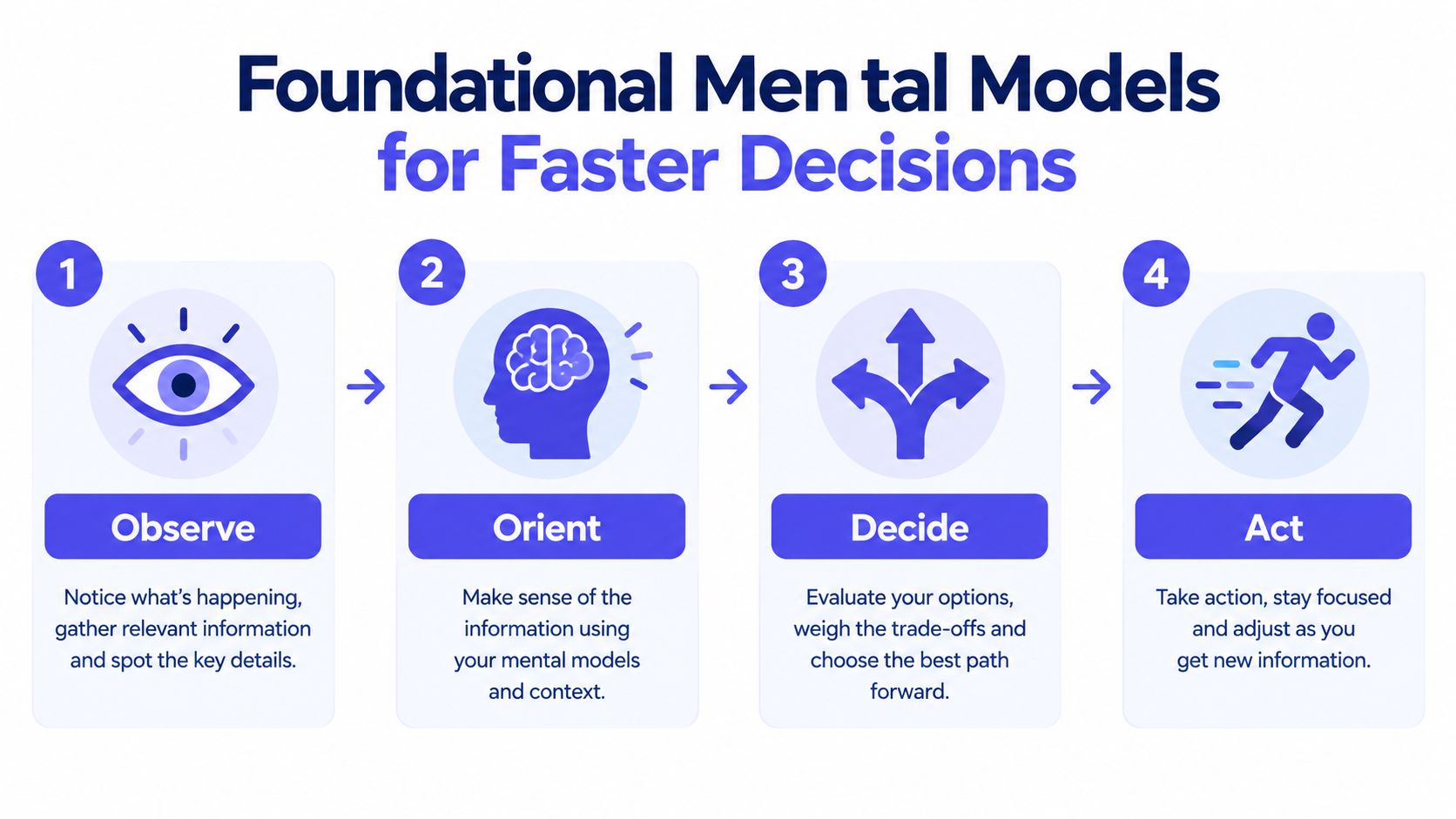
The OODA loop remains a useful starting point because it describes decision making as a cycle rather than a single event:
- Observe: Collect signals from customers, systems, research, and the team.
- Orient: Combine those signals with goals, constraints, history, and context.
- Decide: Choose a course of action and assign ownership.
- Act: Change the product, process, or system, then observe the result.
Product teams usually don't struggle with observation. They have event analytics, support conversations, experiment results, session recordings, and engineering telemetry. Orientation is more often the bottleneck. Someone has to determine which signals matter, reconcile conflicting evidence, and explain what the team should do next.
Streaming extends the loop
Streaming analytics changes the first stage from periodic inspection to continuous signal ingestion. A new event can update context, trigger a rule, or notify an owner while the situation is still actionable. That doesn't eliminate the product manager, designer, or engineer. It gives them a more current starting point and can reserve their attention for ambiguous decisions.
The distinction matters. A dashboard tells a person what may be happening. A decision workflow connects the signal to a defined owner, a permitted action, and a feedback loop. If the alert doesn't identify what changed or what someone should do, it may increase awareness without reducing latency.
A recent benchmark study on latency-sensitive decision tasks found that lowering latency while sacrificing some quality could improve downstream performance in particular tasks. It reported gains of up to 80% higher win rate in a game benchmark and up to 26.52% higher daily yield in a trading benchmark.
Those results don't justify making every product decision faster at any cost. They establish a more useful engineering principle: evaluate latency and quality together. A slightly less perfect answer may be preferable when the decision is frequent, reversible, and time-sensitive. A slower, more carefully reviewed answer may be right when the cost of error is high.
The OODA loop therefore needs a product-specific policy. Decide where automated observation ends, where human orientation begins, and what evidence must be preserved when the team acts.
A useful operating habit is to turn the final step, action, into an explicit artifact. Meeting notes and action items should identify the decision, owner, next action, unresolved questions, and the evidence behind the call. That record lets the next OODA cycle begin with context instead of reconstruction.
Automated vs Human-in-the-Loop vs Hybrid Patterns
Automation isn't a maturity ladder where every team should end at full autonomy. The right pattern depends on the decision's reversibility, variance, consequence, and need for context.
A fully automated system works well when inputs are structured, the desired action is clear, and mistakes can be detected and reversed. Human review works better when the system lacks important context or when the consequences extend beyond one team. Hybrid workflows combine both by automating routine paths and escalating exceptions.
A 2026 Sprout Social study found that 86% of organizations missed opportunities because of delayed or siloed insights, only 10% could act on real-time data within hours, and 36% said social intelligence informs decisions in product development or customer experience, according to the study's published findings. The problem isn't only that teams lack signals. Insight often stops at the reporting layer.
| Pattern | Best For | Speed | Governance | Implementation Complexity |
|---|---|---|---|---|
| Fully automated | High-volume, low-variance, reversible actions | Highest | Requires strong rules, monitoring, and rollback | High upfront design, lower ongoing handling |
| Human-in-the-loop | Ambiguous, novel, or high-consequence decisions | Moderate | Strong review and accountability | Moderate workflow and staffing effort |
| Hybrid | Routine decisions with defined exception paths | High for normal cases | Escalation preserves human control | Highest coordination, but broadest fit |
Use reversibility as the first filter
A system can automatically route a support ticket, refresh a recommendation, or flag an experiment when the action is easy to undo. It should escalate a decision that changes contractual terms, affects compliance, or commits several teams to a costly direction.
The hybrid pattern needs more than an escalation button. It needs a clear threshold, a named reviewer, enough context to review quickly, and a safe default if no one responds. Without those elements, “human in the loop” becomes a queue that recreates the original delay.
Automation should remove waiting from routine decisions, not remove accountability from consequential ones.
Teams can use AI workflow automation to draft recommendations, extract decisions, or prepare the next action while keeping approval with the person who owns the outcome. The design question is not whether a human appears somewhere in the process. It's whether that human can exercise meaningful judgment without searching across disconnected systems.
Real-World Examples That Reveal the Trade-Offs
A field study of emergency physicians shows why raw speed can produce worse decisions. Researchers found that higher situational cognitive load increased total diagnostic orders, reduced the use of targeted uncommon tests, increased common-test use, and raised uncertainty in diagnostic beliefs, as described in the National Bureau of Economic Research study.

The lesson for product teams isn't to avoid urgent work. It's to recognize what pressure does to attention. When people have too many unresolved signals and too little context, they often choose familiar, generic actions instead of targeted ones. A fast workflow that floods a team with alerts can therefore increase activity while lowering decision quality.
Context changes the result
Consider a product discussion about a new onboarding flow. The conversation produces a user problem, a design constraint, a technical dependency, and an unresolved question about measurement. If those details remain in a recording or disappear into a chat thread, the engineer who starts implementation must reconstruct the reasoning before writing the first commit.
A shared workspace can capture the decision, transcript, design artifact, and open questions while the conversation is happening. Collaborative agents can then draft a PRD or prepare code in a sandbox, with the output connected to the originating discussion. The benefit isn't just faster note taking. It is reducing intent-to-commit latency, the time between agreement and a concrete implementation artifact.
That pattern differs from full automation. The team still decides what to build and can challenge the recommendation. The system handles the mechanical work of preserving context and preparing the next step.
Design for attention, not just response time
The benchmark evidence from latency-sensitive tasks points to a similar trade-off. Lower latency can improve outcomes in some environments, but only when the quality loss remains acceptable. In product work, that means separating quick, reversible decisions from decisions that require research, accessibility review, security input, or customer validation.
A good real-time workflow makes the urgent path narrower, not noisier. It sends fewer alerts, includes the relevant context, and makes the next responsible action obvious.
Implementation Patterns for Product Teams
Start with the decision that is currently too slow, not with a platform purchase. Choose a recurring product decision, map the path from signal to action, and mark every point where the team waits, repeats context, or loses ownership.
Change the process before changing the stack
Capture decisions at the moment they form. A post-meeting summary is useful, but it arrives after assumptions have already started to drift. During the discussion, record:
- The decision: What did the team agree to do?
- The rationale: Which evidence or constraint drove the choice?
- The owner: Who can move the decision into execution?
- The boundary: What remains undecided?
- The review trigger: What new evidence would reopen the call?
A living plan is more useful than a static document because it can carry unresolved questions into design, engineering, and planning. It also gives someone a place to verify whether the decision produced the expected result.
Assign decision rights
Define which role can decide without approval, which role must be consulted, and which role can stop execution. Product managers often own customer and prioritization calls, engineering leads own implementation constraints, and designers own interaction quality, but the exact boundaries should match the team.
Write escalation rules in plain language. “Escalate if customer data, security, compliance, or another team's contract is affected” gives people a usable path. “Escalate anything important” creates hesitation.
Choose tools that preserve context
Streaming platforms are appropriate for operational events that need continuous processing. Product collaboration tools serve a different purpose, they preserve reasoning, attribution, artifacts, and open questions around a decision.
Stoa, from SpecStory, Inc., is one example of a collaborative workspace that captures live conversations, decisions, transcripts, and artifacts as plain files, while agents can draft Markdown PRDs and run code in shared sandboxes. Its published pricing is $5 per meeting hour, with no seats, free guest access, and a $50 credit to start, according to the product site.
Track operating metrics
Don't measure only dashboard freshness or pipeline latency. Track:
- Intent lead time: Time from a stated problem to a decision-ready proposal.
- Decision latency: Time from decision-ready evidence to an authorized decision.
- Intent-to-commit latency: Time from agreement to the first implementation artifact.
- Traceability: Whether a shipped change links back to its decision and rationale.
- Escalation quality: Whether exceptions reach the right reviewer with enough context.
Run this audit on one workflow first. Fix the largest delay, observe the effect, and then expand to another decision path.
Common Pitfalls and How to Avoid Them
The dashboard is not the decision. A 2024 industry survey found that 97% of companies were investing in or planning real-time dashboards, while business leaders still reported difficulty accessing usable real-time insight, according to Technology Magazine's coverage of the survey. A screen can show a live metric without giving anyone authority, context, or a defined next action.
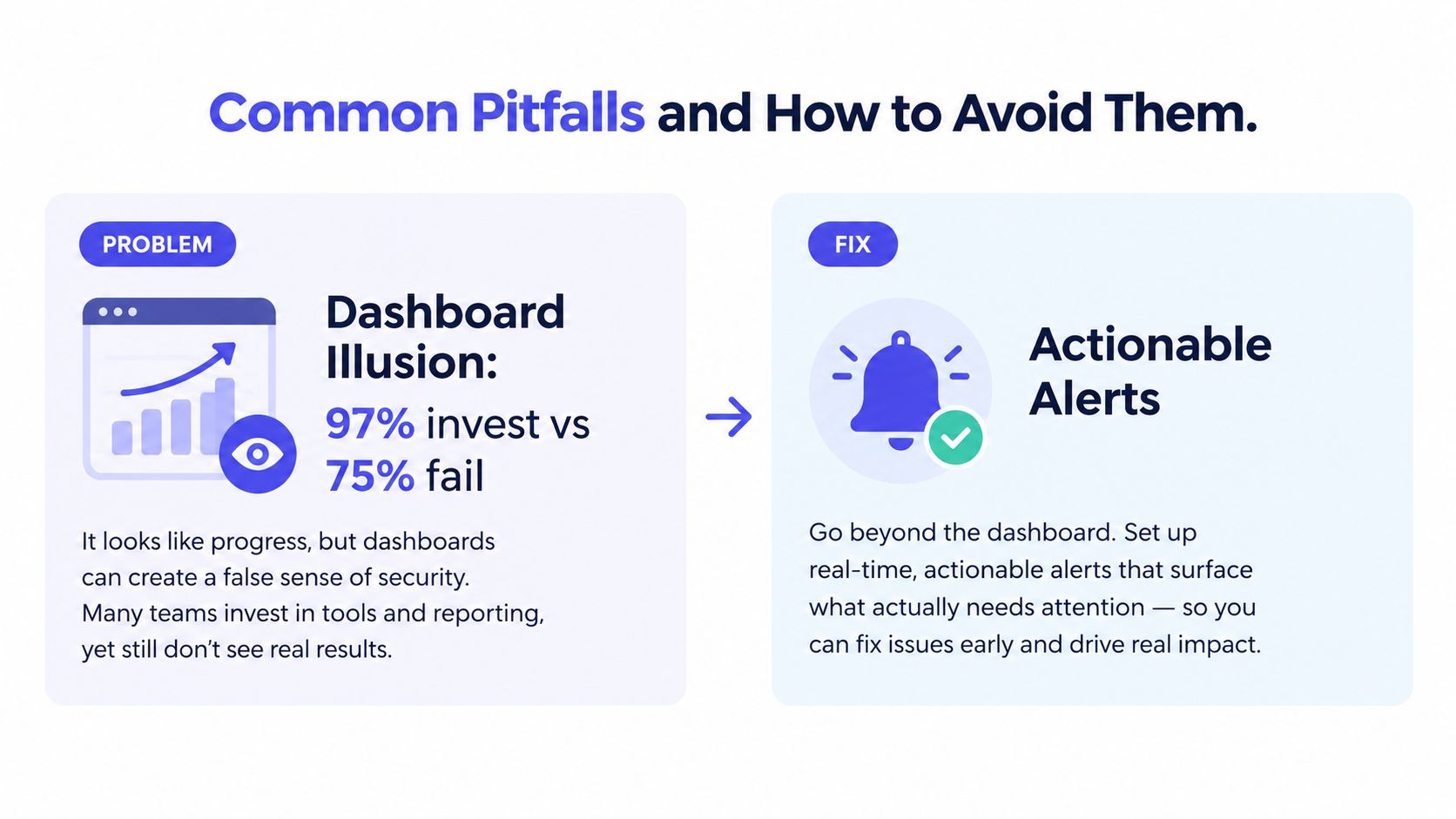
Pitfall one is the dashboard illusion
Teams often add charts when the issue is unresolved ownership. Replace passive monitoring with actionable alerts that state what changed, why it matters, who owns the response, and what safe action is available. If no action follows, the signal belongs in periodic analysis rather than an always-on channel.
Pitfall two is the governance gap
The global survey of senior decision-makers found that 97% reported implementation barriers and only 33% had fully implemented responsible AI frameworks. Those findings make governance part of implementation, not a later compliance exercise.
Create an audit trail for automated decisions. Store the input context, rule or model version, action taken, reviewer where applicable, and reversal path. Test the kill switch before production, not after an incident.
Pitfall three is treating every decision as real time
Some decisions benefit from immediate action. Others need a slower review because they affect safety, legal exposure, customer commitments, or several teams. A single speed target forces the wrong behavior.
The right question isn't “How do we make every decision faster?” It is “Which delay creates avoidable cost, and which delay protects the business?”
Route high-frequency and reversible actions through automation. Give ambiguous or high-stakes work a human review path. The strongest teams don't eliminate friction indiscriminately. They remove accidental waiting and retain deliberate scrutiny.
Bringing It Together - A Sustainable Real-Time Framework
Real time decision making works when a team treats latency as a design variable. The objective isn't constant urgency. It's a deliberate system that moves the right decisions quickly, keeps the reasoning visible, and gives people a safe way to challenge or reverse an action.
Three operating principles bring the pieces together.
Increase speed with a closed loop
Use the OODA model to make the flow explicit. Collect signals continuously where freshness matters, orient around shared context, assign a decision owner, and connect the decision to an observable action. Streaming infrastructure can reduce the time between event and awareness, but the team still needs a path from awareness to execution.
Protect accuracy with selective human judgment
Automate stable, repeatable decisions when the consequences are limited and reversibility is clear. Keep people involved when context is incomplete, the decision is novel, or the cost of error is high. A hybrid pattern usually offers the most practical balance because it removes routine waiting without pretending that every situation can be reduced to a rule.
Preserve traceability through living artifacts
A decision that exists only in a meeting, chat thread, or individual memory will eventually be recreated. Capture the rationale, owner, open questions, supporting evidence, and resulting artifact close to the moment of agreement. That record lets engineers, designers, agents, and future reviewers work from the same context.
As AI agents become more capable, the differentiator won't be who produces the fastest answer. It will be who can decide quickly without losing accountability, context, or the ability to learn from the result. Product teams should measure the distance between knowing and acting, then remove the delays that don't add judgment.
The bottleneck is no longer information access alone. It is the gap between a team reaching agreement and the first responsible action.
SpecStory, Inc. offers a shared workspace where product teams capture live decisions, transcripts, open questions, and artifacts, then carry that context into PRDs and code. Visit SpecStory, Inc. to see how your team can reduce the distance between agreement and execution.
Newsletter
Get new posts in your inbox
Bring your team together to build better products. Fresh takes on remote collaboration and AI-driven development.