
Putting a product manager, designer, and engineer in the same Slack channel doesn't create a cross-functional product team. It creates a channel.
A real team owns an outcome from problem definition through shipped change and observed result. Its members share context, make decisions with visible ownership, and leave behind artifacts that let someone else understand why the work exists. The useful unit isn't the meeting, the squad, or the org chart. It's the path from conversation to committed change.
That distinction matters because 78% of senior leaders report collaboration drag, including excessive meetings, unclear ownership, and stakeholder-alignment overhead. Organizations experiencing high collaboration drag are 37% less likely to hit targets, according to research on cross-functional product development. Cutting meetings without fixing decision context only moves the same cost into chat threads, documents, and repeated explanations.
Table of Contents
- What a Cross Functional Product Team Actually Is
- The Origin Story and Why It Still Matters
- Roles, Ownership, and the Work That Has to Get Done
- Benefits That Hold Up and Failure Modes to Design Around
- Meetings, Decisions, and Handoffs That Actually Move Work
- Tooling and Workflow Choices for Small Teams
- AI in the Team Without Fragmenting Context
- A 30-60-90 Day Plan to Ship Like a Bigger Team
What a Cross Functional Product Team Actually Is
A cross-functional product team is a small, durable unit with end-to-end responsibility for a customer or business outcome. Product, design, engineering, and customer or operational knowledge sit close enough to make trade-offs together. The team doesn't wait for each department to finish its part before the next department starts.
The difference is operational, not decorative. A designer doesn't merely deliver screens, an engineer doesn't merely implement tickets, and a product manager doesn't merely maintain a roadmap. Each person contributes to discovering the problem, shaping the decision, exposing constraints, and validating the result.
The operating system matters more than the seating chart
A team becomes cross-functional when it has:
- A shared outcome: One measurable product problem takes priority over separate functional scorecards.
- Visible decision rights: Everyone knows who recommends, who decides, who must be consulted, and who executes.
- Durable context: Decisions include the problem, assumptions, alternatives considered, owner, and next action.
- End-to-end accountability: The team follows the work through release and feedback instead of treating deployment as the finish line.
- A common language: Technical, customer, design, and commercial terms are translated into a decision the whole team can act on.
Without those conditions, the PM becomes a request router, the designer becomes a service desk, and engineers receive implementation work stripped of its rationale. The team may communicate constantly while still failing to converge.
Practical rule: Optimize the time and quality of the path from agreement to first committed change, not the number of meetings your team attends.
A useful test is simple. Ask any member why the team made its most recent important decision. They should be able to identify the customer problem, the chosen approach, the person who decided, the unresolved risk, and the artifact or code change that follows. If they need to search five tools or ask someone who wasn't in the room, your team has a context problem.
That's the operating model this article defends. Roles matter, but roles only create value when conversations produce durable decisions and decisions produce coordinated execution.
The Origin Story and Why It Still Matters
Cross-functional product work didn't begin with modern squad diagrams. It became a foundational idea in software development through the Agile movement. On February 11–13, 2001, 17 software practitioners met at The Lodge at Snowbird in Utah and produced the Manifesto for Agile Software Development.
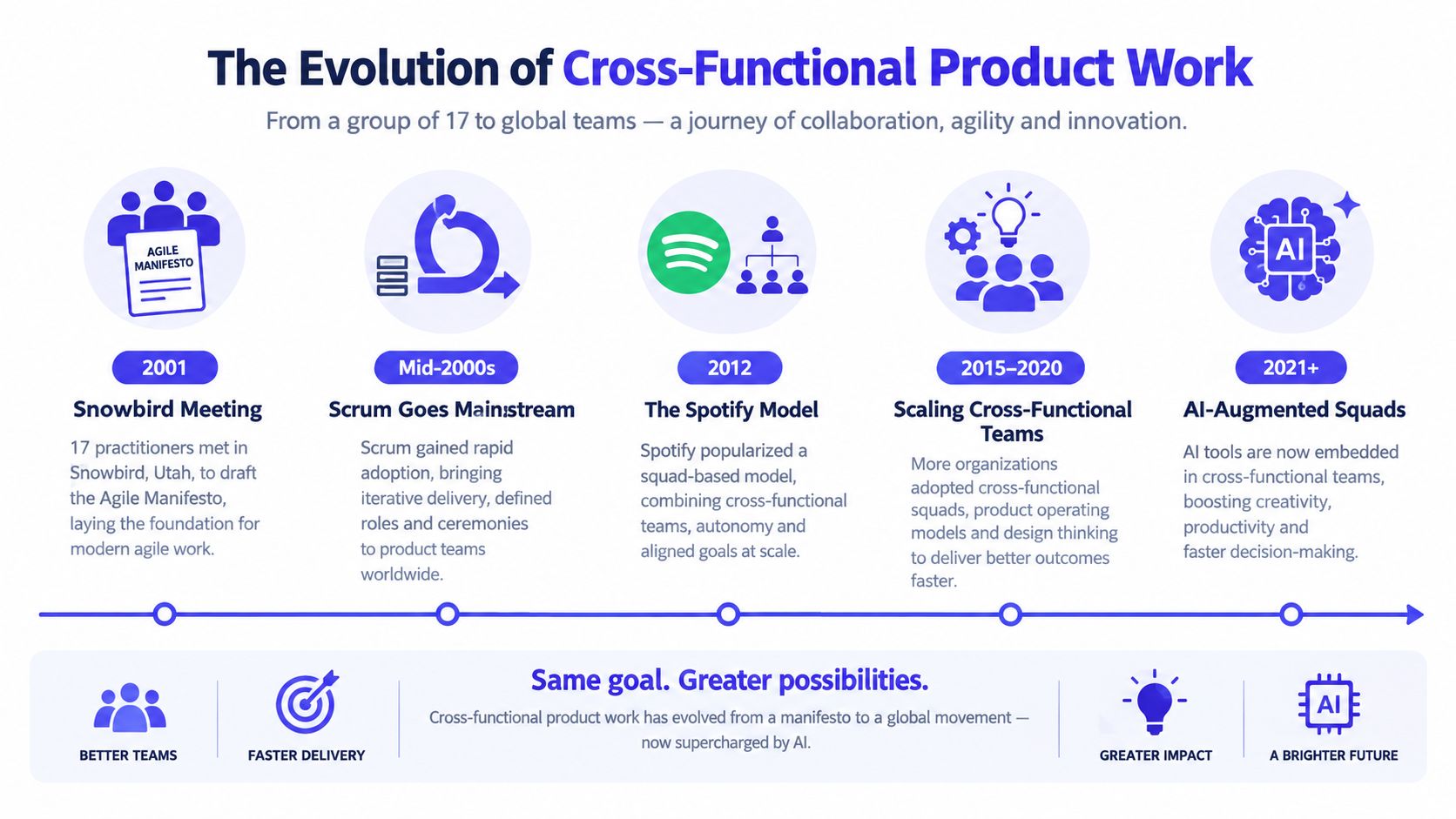
The important shift wasn't a new meeting format. The manifesto made collaboration, frequent delivery, customer involvement, and adaptive planning more central than rigid sequential processes. It gave teams a shared argument for combining business, design, and engineering expertise around working software instead of passing work through isolated departments. Later that year, participants helped establish the Agile Alliance, supporting the spread of those methods.
Consider a feature request in a typical software company several years after Snowbird. A stakeholder asks for a new checkout option. Product writes a requirements document, design interprets it, engineering estimates the resulting screens, and QA checks the implementation after the handoffs. Each function can perform its role competently while the original customer problem becomes diluted.
A mature team treats the same request differently. Product brings evidence and a desired outcome, design explores the customer interaction, engineering surfaces technical and operational constraints, and the group chooses a testable approach. The decision is captured with its assumptions, the design and implementation remain connected to it, and feedback can change the plan without triggering a chain of departmental negotiations.
From agile collaboration to AI-assisted execution
The historical lesson still applies in an AI-assisted environment. Tools can draft requirements, generate code, summarize discussions, and propose alternatives. They can also make local work faster while scattering the reasoning across private prompts, chat threads, pull requests, and design files.
Cross-functional product teams therefore need more than shared access. They need traceable context. The team should be able to move from customer evidence to decision, from decision to artifact, and from artifact to implementation without losing the assumptions that connect them.
That's why the lineage matters. Cross-functional collaboration is a two-decade shift toward continuous alignment around value, not a trend in team naming. AI changes the speed and surface area of the work, but it doesn't remove the need for a shared operating model.
Roles, Ownership, and the Work That Has to Get Done
The core team usually needs four lenses: product, design, engineering, and customer or operations. One person can hold more than one lens at seed stage, but the responsibility still has to exist. If nobody represents support, sales, implementation, or real customer behavior, the team will optimize for internal logic.
Research on UK and German manufacturing plants found that an effective configuration of cross-functional teamwork increased the share of new sales by 29.5% in the UK relative to a reference group, with the strongest combination connecting product design and development with production engineering, as summarized in this research on cross-functional team composition. The point for software teams isn't to copy a manufacturing structure. It's to combine expertise around real dependencies rather than maximize the number of people invited.
Suppose the team is changing checkout to reduce abandonment.
- Product defines the target outcome, frames the customer problem, and records the decision.
- Design owns the interaction model, content, accessibility considerations, and usability risks.
- Engineering owns the technical approach, reliability constraints, instrumentation, and deployment.
- Customer or operations representatives expose recurring objections, payment failures, support burden, and process impact.
A practical team roles framework can help founders make those responsibilities explicit. For a more detailed view of the product manager's working rhythm, use this guide to the product manager workflow.
Core roles and the decisions each one owns
| Role | Primary Decisions | Owned Artifacts |
|---|---|---|
| Product | Problem priority, outcome, scope boundary, final product trade-off | Problem brief, decision record, success signal |
| Design | User flow, interaction behavior, content, accessibility risks | Flows, prototypes, design rationale |
| Engineering | Architecture, implementation approach, technical risk, release readiness | Technical plan, code, tests, instrumentation |
| Customer or operations | Real-world constraints, workflow impact, recurring failure modes | Customer evidence, operational checklist, feedback |
The handoff breaks when ownership ends at the artifact. A designer can deliver a prototype that doesn't explain edge cases. An engineer can implement the happy path without knowing which assumption matters most. A product manager can approve scope without naming what the team will learn after launch.
Assign one owner to each decision, not just each deliverable. Product may decide whether the checkout problem deserves investment. Design decides how the experience should behave within the agreed problem. Engineering decides how to implement it safely. The team then shares accountability for whether the change improves the outcome.
Benefits That Hold Up and Failure Modes to Design Around
Cross-functional teams can improve innovation, novelty, implementability, and synthesis of ideas. They can also create slower decisions, more stress, and weaker cohesion when leaders assemble diverse specialists without changing how decisions get made.
Research on 93 cross-functional research and new-product-development groups across four companies found that functional diversity improved technical quality and schedule-and-budget performance, while group cohesiveness declined and job stress rose, according to the study of functional diversity and team outcomes. That trade-off should change how founders talk about collaboration. More communication isn't automatically better. The team needs communication at the boundaries where one function's decision changes another function's work.
What well-designed teams gain
A strong team combines specialized knowledge early, when changing direction is relatively cheap. Engineering can challenge an interaction that creates operational risk. Design can expose a workflow problem before it becomes a backlog of support tickets. Product can keep both groups focused on the customer outcome instead of local optimization.
The gains usually come from complementary dependencies, not from putting every department into every conversation. A product designer and production engineer, for example, may have a more useful working relationship than a broad group that includes functions with little connection to the decision.
Failure modes worth designing out
- Decision diffusion: Everyone contributes, but nobody has authority to close the question.
- Context loss: A ticket records the task but not the reasoning, so the team reopens settled debates.
- Cohesion decline: Specialists defend functional standards because the team has no shared outcome.
- Stress accumulation: Ambiguous priorities force people to negotiate the same boundaries repeatedly.
- Coordination displacement: Meetings fall while Slack threads, side documents, and clarification calls increase.
Hiring distributed technical talent can widen the team's capability, but the operating model still has to make ownership and context visible. Teams exploring that route may find this practical guide to hire developers in Latin America useful as a hiring reference.
A founder should watch for one diagnostic pattern: people say communication has improved because more messages exist, while delivery decisions remain difficult to locate. That isn't collaboration. It's coordination debt with a better notification system.
Meetings, Decisions, and Handoffs That Actually Move Work
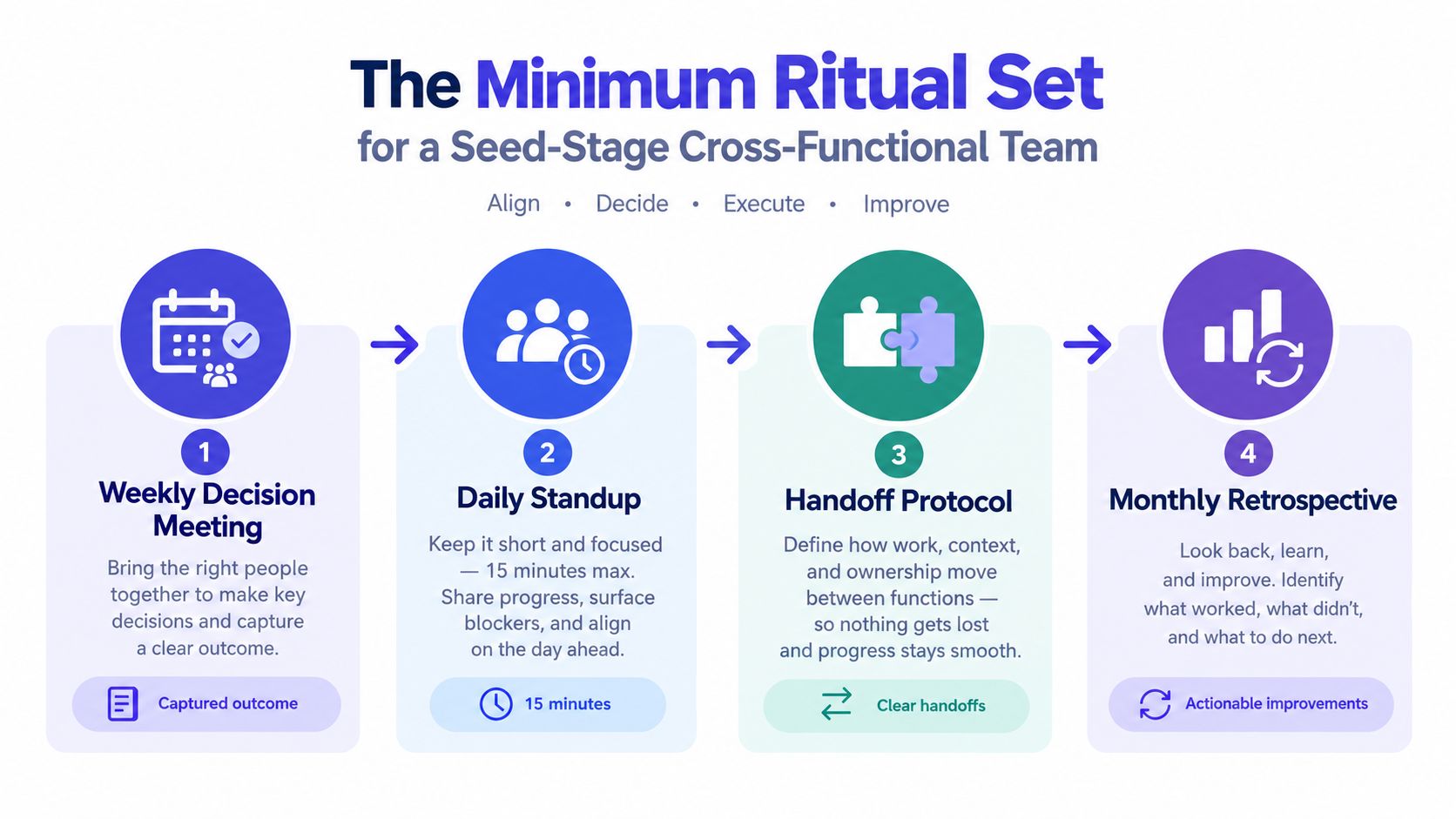
Seed-stage teams don't need a calendar full of ceremonies. They need a small set of rituals that turn uncertainty into decisions and decisions into evidence.
The minimum operating cadence
Weekly decision meeting. Bring only questions that need collective judgment. Each question enters with a short problem statement, evidence, options, and a named decision owner. It leaves with a decision, rationale, next artifact, and unresolved risks.
Daily build check. Keep this focused on dependencies and blocked execution. Don't turn it into a status recital. If a designer needs an engineering answer or an engineer needs a product clarification, record the question and assign it immediately.
Design-to-engineering handoff. A handoff is complete when engineering understands behavior, edge cases, states, content, accessibility requirements, analytics, and what remains intentionally out of scope. The designer should walk through the intent, while the engineer confirms implementation constraints and open questions.
Monthly retrospective. Review decisions that took too long, assumptions that failed, and work that had to be re-explained. Change one part of the system at a time. A retrospective that produces only emotional release is not enough. It should update a template, ownership rule, or review trigger.
Use a decision record with five fields:
- Question: What must the team decide?
- Context: What evidence and constraints matter?
- Decision: What will happen?
- Owner: Who is accountable for closing it?
- Follow-through: Which artifact, commit, test, or metric proves movement?
A study of 206 new-product-development teams in U.S. high-technology companies found that cross-functional integration contributes positively to new-product performance. The reinforcing conditions included social cohesion, a shared superordinate identity, market-oriented rewards, explicit planning, and managerial encouragement to take risks, as described in this research on cross-functional integration.
The practical implication is blunt: let the product manager decide product priority, the designer decide interaction details, and the engineer decide implementation details, while making escalation rules explicit. If disagreement remains, the decision owner closes it by a stated deadline. Escalation should resolve a trade-off, not transfer responsibility upward.
For teams improving their alignment practice, this guide to cross-functional alignment offers useful language for connecting shared goals to execution.
Here's a concise visual explanation of how shared product context can support this operating model:
Tooling and Workflow Choices for Small Teams
Tools should reduce the distance between intent and implementation. They shouldn't become another place where decisions disappear.
A generalist collaboration suite such as Slack, Google Docs, or Microsoft Teams works well for fast discussion and broad access. Its weakness is retrieval. A decision can live in a thread, its supporting file can change later, and the resulting code can land in a repository with no durable connection to the original reasoning. The warning signal is repeated questions that begin with, “Why did we decide this?”
A product-specification or roadmap tool gives structure to problems, requirements, priorities, and delivery status. It's useful when a team needs a stable planning surface. It falls short when the meeting produces an important nuance that nobody transfers into the formal record. The warning signal is a polished roadmap that doesn't help an engineer understand the trade-off behind the next ticket.
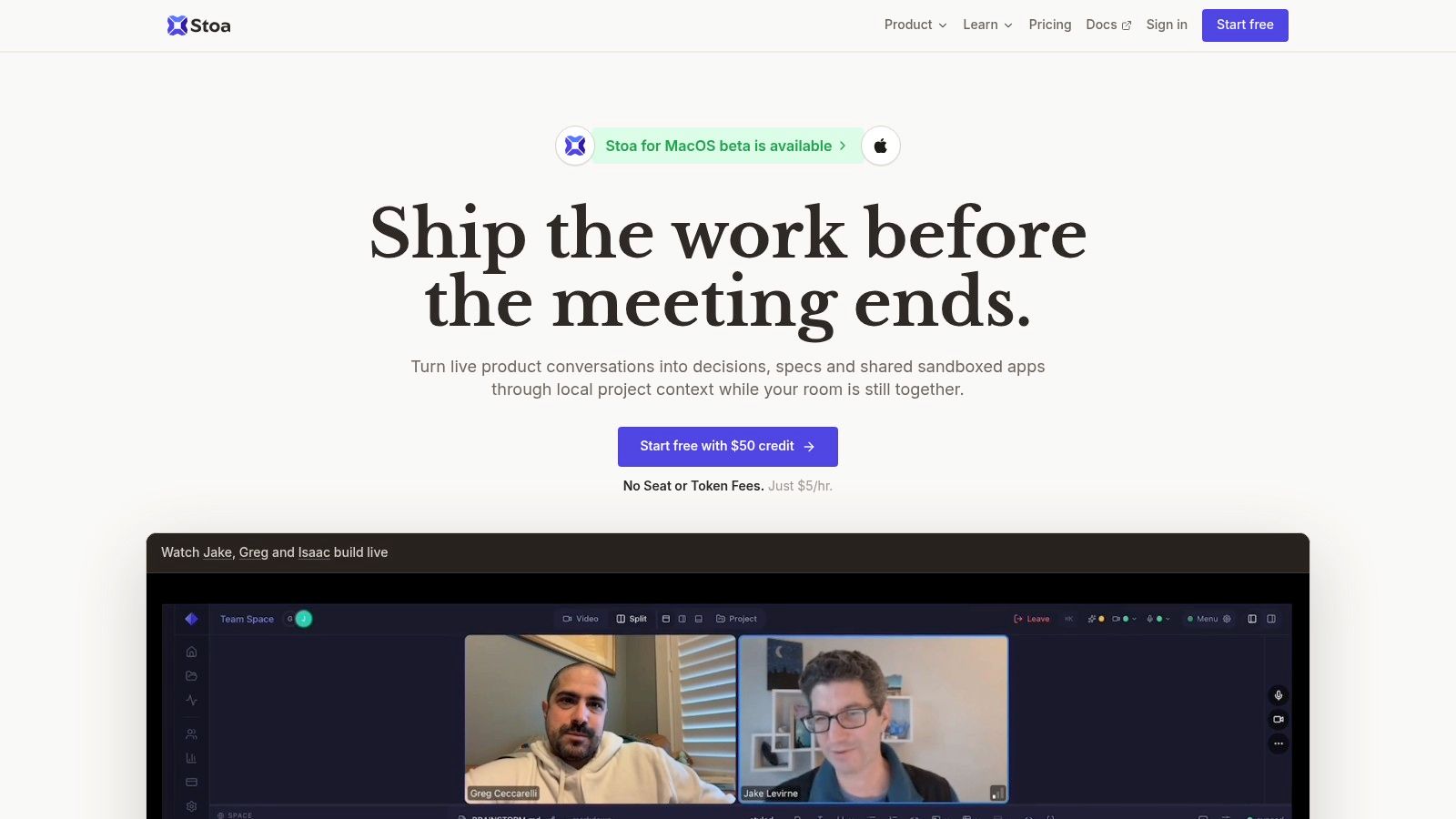
An AI-native shared workspace, such as Stoa, built by SpecStory, Inc., takes a different approach. It can capture live conversations, decisions, designs, and open questions, then turn them into traceable artifacts such as Markdown product requirements documents and shared coding sandboxes. The evaluation question isn't whether AI can produce a draft. It's whether the draft preserves provenance and gives the team a practical route to inspect, edit, approve, and implement it.
A useful tool test
Before adopting another platform, run one real feature through it and inspect four signals:
- Intent capture: Can the team record the reason for the decision at the moment agreement occurs?
- Artifact connection: Can the decision link to the design, requirement, code, test, and outcome?
- Context portability: Can people take the information into their preferred editor and workflow?
- Failure visibility: Can the team see unresolved questions instead of burying them in a summary?
The wrong tool creates a second backlog of administrative maintenance. The right tool makes the team's reasoning easier to inspect than the scattered trail it replaces.
AI in the Team Without Fragmenting Context
AI is becoming a collaboration concern, not just a personal productivity feature. A 2025 survey of more than 500 developers and product managers found that AI-assisted collaboration was the most anticipated collaborative-editing feature for the next five years, selected by 42% of respondents. Tracked changes followed at 40%, and revision history at 37%, according to the survey on AI for collaboration.
The risk is context fragmentation. An engineer asks an agent to generate code from a private prompt, a PM summarizes the requirement elsewhere, and a designer reviews a result without seeing the assumptions that shaped it. Each person becomes faster while the team's shared understanding gets weaker.
Use three controls:
- Provenance: Link every AI-generated requirement, design suggestion, or code change to its source conversation and inputs.
- Visible uncertainty: Mark assumptions, missing evidence, and unresolved questions in the artifact itself.
- Human approval: Name the person who approves the requirement, design behavior, implementation, and release decision.
Non-engineers should be able to inspect why an implementation choice exists without reading every line of code. Engineers should be able to challenge a product assumption without reconstructing the original discussion. Collaborative agents can help when they work in a shared room where outputs remain editable, attributable, and connected to decisions.
Teams exploring this pattern can review the AI agents workflow for ideas on keeping agent output inside a human-owned execution loop. AI should accelerate the team's reasoning, not replace the team's responsibility for it.
A 30-60-90 Day Plan to Ship Like a Bigger Team
Don't begin with a reorg. Begin with one product outcome and one complete loop from discussion to committed code.
Days 1 to 30
The founder or product lead should name the outcome, decision owner, and evidence that will show progress. Create one decision log, define the minimum fields, and establish the weekly decision meeting, build check, handoff review, and retrospective.
By the end of this phase, the team should be able to answer:
- What outcome are we pursuing?
- Who closes each open decision?
- Where is the current rationale?
- Which artifact proves that implementation has started?
- Which assumption will we test first?
A structured 30/60/90 onboarding plan for managers can provide a useful reference for sequencing ownership and expectations, but adapt it to product decisions rather than employee orientation.
Days 31 to 60
Make the workflow real on one meaningful feature. Product writes the decision record, design connects the interaction to the problem, engineering links implementation choices to the approved behavior, and the team records what changed after review.
At the end of this phase, inspect failure signals rather than asking whether everyone enjoyed the meetings. Count how often decisions had no owner, how often engineers needed missing context, and how often the team reopened a question because the original rationale was unavailable.
Days 61 to 90
Introduce AI only after the human workflow is clear. Use an agent to draft a requirement, explore implementation options, or prepare a test plan, but preserve source context and require explicit approval. Then compare the first conversation-to-commit loop with later loops qualitatively. The question is whether the team spends less time reconstructing intent and more time making informed changes.
A healthy team should produce these artifacts on demand:
- A current outcome and success signal
- A decision record with owner and rationale
- A design or workflow artifact tied to the decision
- An implementation plan with known risks
- A code change or test connected to the agreed behavior
- A list of unresolved questions
- A post-release observation that informs the next decision
If those artifacts don't connect, adding another ceremony won't rescue the team. Fix the path between them.
SpecStory, Inc. offers Stoa, a multiplayer AI workspace that captures live product conversations and turns them into traceable plans, artifacts, and code across product, design, and engineering. If your team is losing decisions between meetings and commits, visit SpecStory, Inc. and test whether a shared, context-preserving workflow fits your next feature.
Newsletter
Get new posts in your inbox
Bring your team together to build better products. Fresh takes on remote collaboration and AI-driven development.