


Your team has a roadmap, but nobody can explain why the next feature deserves its place on it. Sales is repeating requests from prospects, support is forwarding painful tickets, analytics shows users abandoning a workflow, and a survey has produced a handful of contradictory answers. Everyone has evidence. Nobody has a shared decision.
That's the situation a practical customer needs assessment should fix. For a small product team, it isn't a research report that sits in a folder. It's a living system for identifying the problems customers need solved, testing how widespread and urgent those problems are, and turning the strongest signals into clear product requirements.
Table of Contents
- What a Customer Needs Assessment Actually Does for Small Teams
- Setting Clear Goals and Guardrails Before You Talk to Customers
- Choosing the Right Research Mix of Interviews Surveys and Analytics
- Making Sense of What You Heard and Deciding What Matters Most
- Turning Prioritized Needs Into Product Decisions Metrics and PRDs
- Keeping Assessment Continuous and Avoiding Costly Mistakes
What a Customer Needs Assessment Actually Does for Small Teams
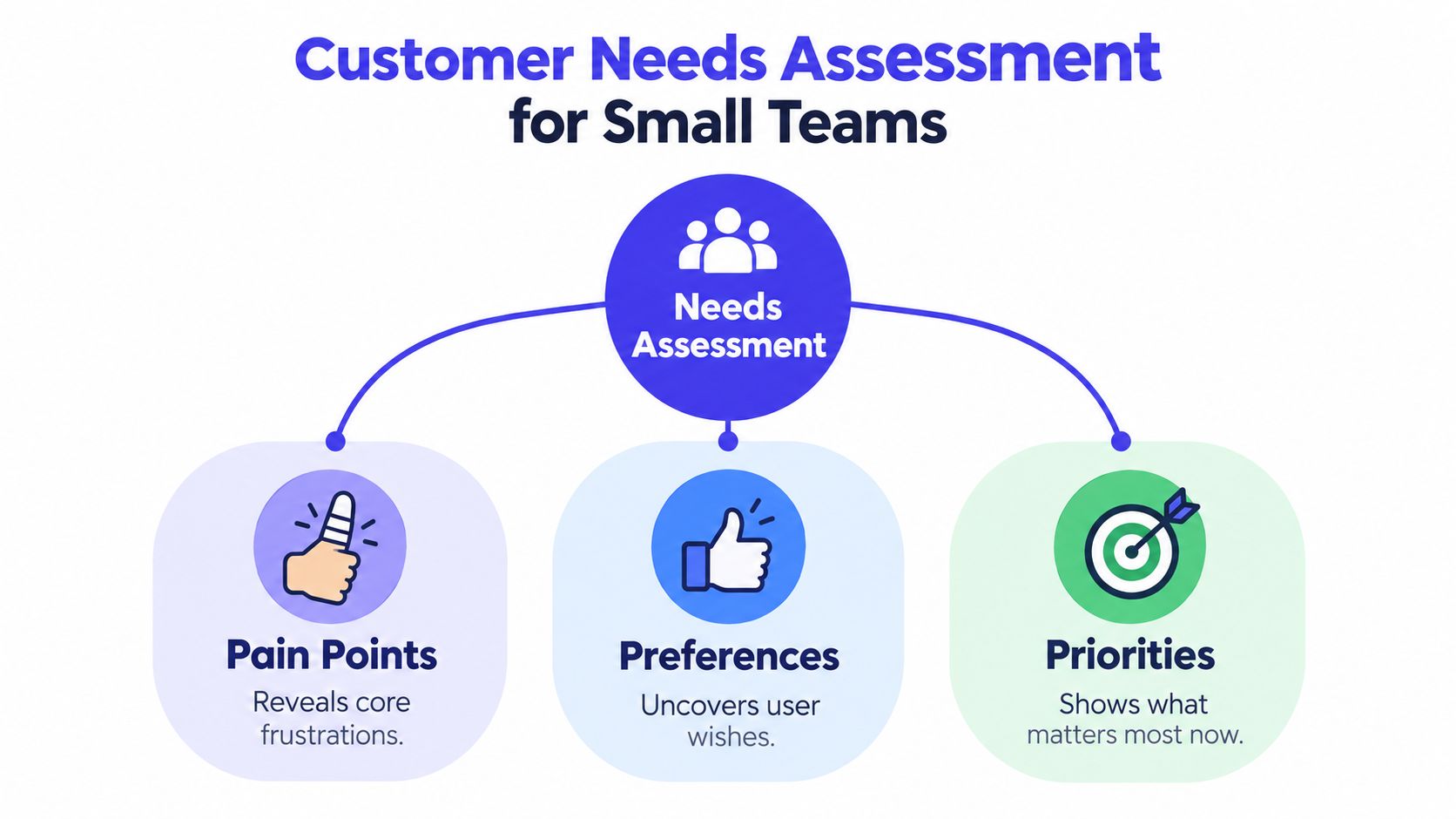
A small team can't afford to build whatever request arrives most recently. It also can't spend months conducting research before making a decision. The useful middle ground is a focused assessment that connects customer pain points, preferences, and decision criteria to a specific product choice.
Consider a team building an expense-management product for small businesses. A few customers ask for more export formats. Support reports that users struggle to reconcile transactions. Product analytics shows that people repeatedly leave the reconciliation screen before finishing. The feature request is “add exports,” but the underlying need may be confidence that the records are complete and ready for accounting. Those are different problems, with different PRD implications.
Customer needs include more than requested functionality. They can involve usability, reliability, convenience, support, transparency, control, and personalization, as described in the background guidance on customer needs analysis. A needs assessment separates the requested solution from the outcome customers are trying to achieve.
From occasional research to continuous signals
Customer feedback systems evolved from manual records toward structured research. The 1987 launch of ACT! is widely described as an early CRM milestone, followed by the shift to internet-enabled feedback collection and email surveys during the 1990s. Online and mobile research later made it possible to capture expectations continuously rather than relying only on periodic interviews or telephone studies, as this history of customer surveys explains.
That history matters for small teams because the modern assessment should combine several sources. Interviews reveal context and motivations. Surveys help validate whether a pattern extends beyond a few conversations. Usage analytics, support tickets, sales notes, and journey data show what customers do.
Practical takeaway: A customer need is not a feature request. It's a recurring problem or desired outcome supported by enough evidence to influence a product decision.
The business case is also clear. 66% of customers expect companies to understand their unique needs and expectations, and 80% are more likely to buy from brands offering personalized experiences, according to the cited customer-needs research from Koji. The same source reports that companies strong at customer needs analysis have outperformed their markets by 85% in sales growth and generated more than double shareholder returns. Treat those figures as directional evidence for the strategic importance of understanding customers, not as a promise for every small team.
A strong assessment leaves your team with a ranked set of needs, the evidence behind each one, the affected segment, and a decision such as build, improve, explain, measure further, or defer. That makes the work useful in a PRD instead of merely interesting in a research repository. For a broader perspective on turning customer understanding into product decisions, the SigOS customer needs analysis is a useful complementary resource.
Setting Clear Goals and Guardrails Before You Talk to Customers
Research without a decision attached creates activity, not clarity. Before scheduling calls or writing survey questions, define what your team might change as a result.
Start with a one-sentence assessment brief:
We need to understand why [specific segment] struggles with [specific job] so we can decide whether to [product decision].
For example: “We need to understand why first-time team admins abandon workspace setup so we can decide whether to simplify onboarding, improve guidance, or change the setup flow.”
That sentence does several jobs. It names the audience, limits the job under investigation, and makes the possible product response visible. If a question doesn't help distinguish between those responses, it probably doesn't belong in the research.
Set the scope before the scope sets you
Choose one segment with a meaningful reason to behave differently. “All users” is rarely a useful starting point. A better segment might be new administrators, customers who activated a particular workflow, or prospects who evaluated the product but didn't buy.
Define the job in observable terms. “Improve collaboration” is too broad. “Help a remote product team turn a meeting decision into an assigned engineering task” gives you something to investigate through conversations, behavior, and outcomes.
Write down the guardrails with stakeholders:
- Decision owner: One person decides how findings affect the roadmap.
- Non-negotiable constraints: Record technical, regulatory, timing, or staffing limits.
- Evidence threshold: Agree what would justify a build decision versus more discovery.
- Out-of-scope questions: Park adjacent ideas instead of allowing them to expand the work.
- Customer promise: Decide how the team will close the loop with participants.
Use importance and satisfaction as leading indicators, but don't confuse them with complete truth. A customer may rate a capability as important because it supports a critical job, while their dissatisfaction reflects poor discoverability rather than a missing feature.
For a concise way to frame the underlying problem before research begins, use this problem statement format. Every research question should map to a future PRD choice:
| Research question | Decision it supports |
|---|---|
| What makes the current workflow difficult? | Remove friction or redesign the flow |
| Which outcome matters most during evaluation? | Prioritize positioning and product proof |
| What workaround do customers use today? | Assess urgency and replacement value |
| What prevents adoption of the existing capability? | Improve awareness, education, or usability |
Keep the brief visible while collecting evidence. It's easier to reject interesting but irrelevant data when everyone can see the decision the assessment is meant to support.
Choosing the Right Research Mix of Interviews Surveys and Analytics
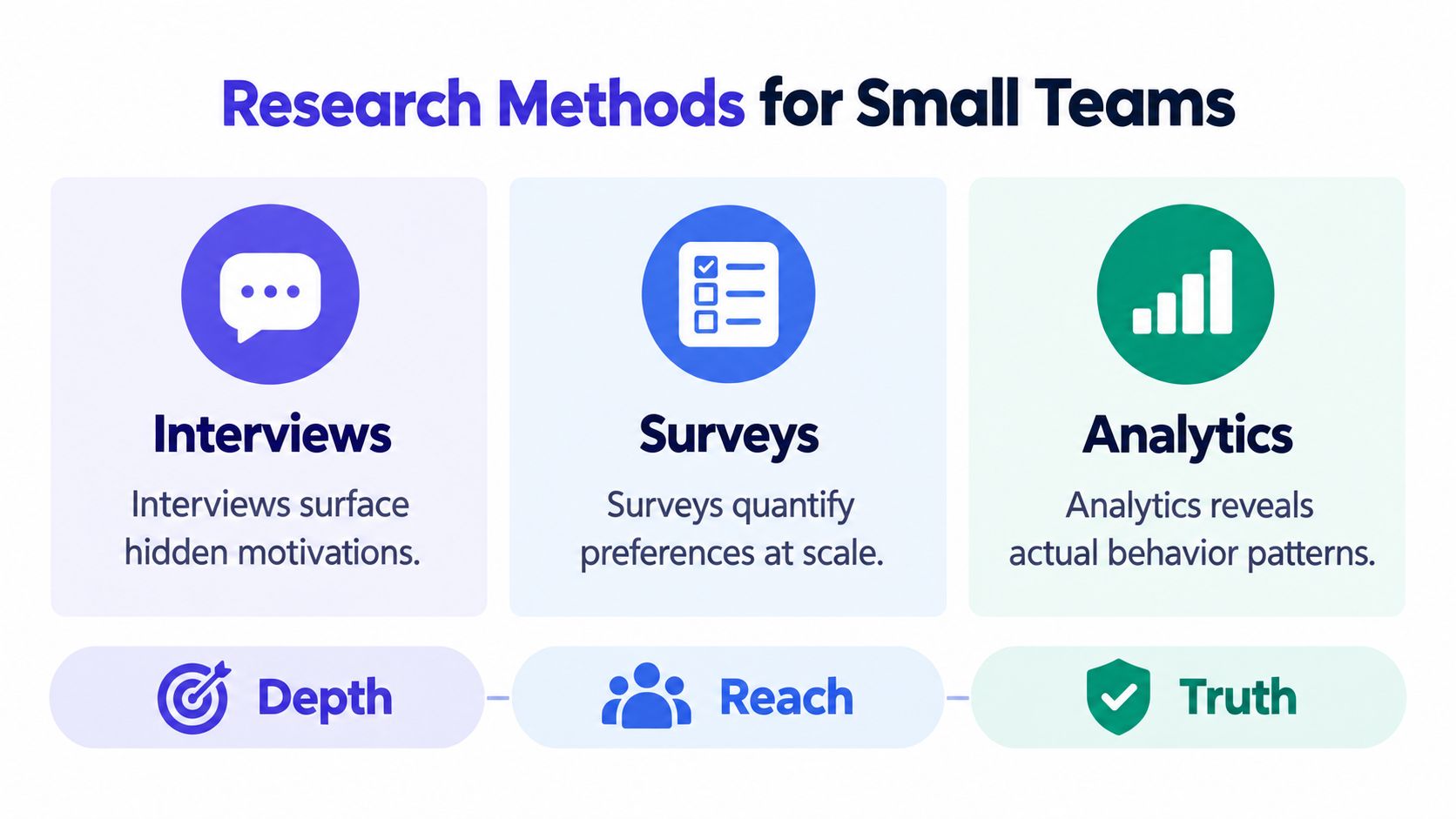
No single method gives a reliable picture of customer needs. Interviews are strong at explaining why. Surveys are useful for measuring how commonly a view appears. Analytics and operational records show what people do.
The practical workflow recommended in needs-assessment guidance combines qualitative discovery, quantitative validation, and internal data. Teams identify candidate needs, inspect existing evidence, add interviews or surveys where uncertainty remains, then analyze and prioritize the results while checking survey reliability and validity. Direct feedback should sit beside contact-center logs, product usage, and other behavioral evidence, because customers often explain motivations that their activity alone can't reveal, while systems expose patterns customers may not articulate.
Interviews reveal the story behind the signal
Use interviews when you don't yet understand the problem or suspect customers are using language that hides the job. Ask about a recent event, not a hypothetical preference.
Useful prompts include:
- “Walk me through the last time you tried to complete this task.”
- “Where did you slow down or change direction?”
- “What did you do instead?”
- “Who else was involved in the decision?”
- “What would have happened if you hadn't solved it?”
- “What do you currently use to handle this?”
Avoid pitching the feature you already want to build. If you ask, “Would an automated dashboard help?” you'll collect polite reactions to your framing rather than evidence about the customer's situation.
Recruit from several sources, such as active customers, recent trials, support contacts, and lost opportunities. Even a small set of well-chosen conversations can expose vocabulary, workarounds, and hidden constraints, but don't treat a few interviews as proof of market-wide prevalence.
A customer interview template can help keep the conversation consistent without turning it into a rigid questionnaire.
Surveys test reach, not context
Use a survey after interviews have helped you form plausible hypotheses. Ask respondents to rank problems, rate importance and satisfaction, select current workarounds, and explain a recent experience in an open-text field.
A compact survey might ask:
- Which task is hardest today?
- How important is solving it?
- How satisfied are you with your current approach?
- What do you use instead?
- What would make the biggest practical difference?
- Which role or workflow best describes your situation?
Keep the audience and trigger precise. A post-action survey can capture context that a generic broadcast misses. For ideas on structuring a future-facing customer experience questionnaire, review this customer experience survey for 2026, then adapt the prompts to your own decision.
Survey response quality deserves explicit monitoring. Reported average B2B survey response rates sit around 12.4%, with observed ranges from 4.5% to 39.3%, while broader external online surveys often fall around 20% to 30% and some email-based customer surveys around 20% to 25%, according to CustomerGauge's voice-of-customer benchmarks. The figures vary by audience and method, so track response rate, coverage, and who didn't respond.
Analytics and support records expose repeated behavior
Start with the systems you already have:
- Product analytics: Completion, abandonment, repeated errors, feature discovery, and return behavior.
- Support data: Ticket themes, escalation language, time-to-resolution, and repeated workarounds.
- Sales notes: Objections, evaluation criteria, competitor comparisons, and disqualification reasons.
- Journey data: Where customers pause between acquisition, activation, adoption, and renewal.
Analytics can tell you that users abandon a step. It can't reliably tell you whether the cause is confusing copy, missing permission, low trust, or an unavailable capability. Pair the behavioral signal with a targeted conversation.
| Method | Best for | Effort and scale | Watch out for |
|---|---|---|---|
| Interviews | Motivations, context, workarounds, unspoken needs | High attention, limited reach | Small samples can overrepresent vocal customers |
| Surveys | Comparing preferences and importance across a segment | Efficient reach, structured analysis | Low or uneven response can bias priorities |
| Analytics and logs | Actual behavior, recurring friction, operational patterns | Ongoing collection, broad coverage | Behavior often needs qualitative explanation |
The best mix depends on uncertainty. If the problem is unclear, begin with interviews and existing records. If the problem is understood but prevalence is uncertain, add a survey. If stated preferences conflict with observed behavior, investigate the conflict instead of averaging it away.
Making Sense of What You Heard and Deciding What Matters Most
Collection produces fragments. Synthesis turns those fragments into decisions.
Begin with raw evidence, not conclusions. Put interview notes, survey open text, support excerpts, and relevant behavioral observations into one working space. Preserve the customer's wording, but remove identifying details and separate direct observations from your interpretation.
Cluster problems before naming solutions
Affinity mapping works well for small teams because it makes disagreement visible. Create cards for individual observations, then cluster cards that describe the same underlying struggle. “I couldn't tell whether it saved,” “I refreshed twice,” and “I sent a screenshot to support” might belong to a trust-and-confirmation theme, not three separate feature requests.
Name each cluster as a problem statement:
- “Users can't confirm whether a critical action succeeded.”
- “New administrators don't know which setup information is required.”
- “Buyers can't compare the product with their existing workflow.”
Don't let the loudest customer define the theme. Look for recurrence across sources, severity of consequence, relevance to the target segment, and evidence of an existing workaround.
Test for a real gap, not just dissatisfaction
A dissatisfied customer may be missing a capability, but they may also be unable to find, understand, or successfully use an existing one. Gap-model guidance distinguishes knowledge, policy, delivery, communication, and customer gaps, while opportunity-scoring guidance warns that an awareness gap can look like an unmet need even when an adequate solution already exists. That distinction protects a small roadmap from unnecessary construction.
Ask three diagnostic questions:
- Is the solution absent?
- Is it present but hard to use or unreliable?
- Is it present and adequate, but poorly explained or difficult to discover?
The third answer calls for messaging, onboarding, navigation, documentation, or sales enablement rather than a new feature. A product team that misclassifies awareness as absence may spend a sprint rebuilding something customers already have.
Rank opportunities with a transparent decision matrix
A lightweight scoring model can combine importance, satisfaction, evidence strength, reach, and effort. Keep the numbers internal to the team if the data is sparse. The point isn't mathematical precision. It's to expose assumptions and make trade-offs discussable.
In a short prioritization workshop:
- First, state the need: Use one sentence that describes the customer problem.
- Then, review evidence: Attach interview excerpts, survey patterns, and behavioral signals.
- Next, test the gap type: Mark it as product, usability, delivery, communication, or unknown.
- Finally, choose an action: Build, prototype, explain, measure, or defer.
Avoid recency bias by reviewing all evidence together. The latest support escalation may be urgent, but it shouldn't automatically outrank a quieter problem affecting the target segment's core job.
For teams deciding which satisfaction measures belong in the evidence set, this practical guide to satisfaction analysis offers useful context on measures such as NPS, CSAT, and CES.
Before a need enters the PRD, check that it is:
- Real: More than one evidence type supports it, or the uncertainty is explicitly recorded.
- Valuable: The problem affects a meaningful customer outcome or business decision.
- Specific: The target segment and situation are clear.
- Buildable: The team can identify a testable intervention.
- Traceable: Someone can find the evidence behind the prioritization.
Turning Prioritized Needs Into Product Decisions Metrics and PRDs
A ranked need becomes useful only when it changes what the team will build, measure, or deliberately avoid building. Write the decision around the customer outcome first, then choose the smallest intervention that can test it.
Suppose the evidence shows that team administrators abandon workspace setup because they can't tell which invitations and permissions are required before launch. A weak PRD says:
Build a guided onboarding wizard with progress indicators, permission recommendations, and automated invitations.
That solution may be too large. A stronger version says:
Problem: New team administrators lack confidence that workspace setup is complete.
Evidence: Setup abandonment, repeated support questions, and interview reports of manual checking.
Hypothesis: Clear completion criteria and contextual permission guidance will help administrators finish setup without assistance.
First test: Add a completion checklist and explain the next required action at the point of confusion.
Success signal: More users complete setup and fewer contact support about setup status.
This format preserves the need while leaving room to learn. A product requirements document template can provide structure, but the evidence trail matters more than the template.
Choose metrics that match the need
Use a small set of measures with distinct jobs:
- NPS: Indicates willingness to recommend and can reveal broad relationship changes.
- CSAT: Captures satisfaction with a particular interaction or outcome.
- CES: Measures perceived effort during a task.
- Closing-the-loop rate: Tracks whether the team responded to customers whose feedback influenced investigation or action.
- Behavioral metrics: Show whether the target workflow becomes easier or more complete.
Don't use a satisfaction score as a substitute for product behavior. A customer may give a positive rating while still relying on a manual workaround. Conversely, a frustrated comment may describe a one-off incident rather than a product-wide need.
Low survey response requires restraint. Medallia reports that customer survey response rates have declined year over year, and over half of consumers believe companies should infer satisfaction from behavior and signals rather than surveys alone, according to its 2026 State of Customer Experience report. When responses are sparse, combine support interactions, usage telemetry, in-product signals, and targeted conversations. Record what remains unknown instead of presenting weak evidence as certainty.
A fast prototype can close the loop before implementation. Share a clickable flow, a local prototype, or a sandbox experiment with the customers who described the problem. Ask them to complete the relevant job, observe where they hesitate, and compare their behavior with what they said in the interview.
Keep the PRD connected to the assessment record. Each major requirement should point to the need it serves, the evidence supporting it, the assumption it tests, and the signal that will determine whether the team continues, changes direction, or stops.
Keeping Assessment Continuous and Avoiding Costly Mistakes
Customer needs assessment works best as a habit, not a quarterly ceremony. Small teams can maintain it with lightweight routines: capture feedback during sales and support conversations, review key behavioral signals regularly, and revisit unresolved questions during product planning.
Assign ownership without making one person the only source of truth. Product can maintain the opportunity backlog, engineering can add implementation constraints, design can preserve usability observations, and customer-facing teammates can contribute verbatim context. A shared room, voice memo, or linked conversation often preserves intent better than a polished summary written long after the decision.
Common failure modes
Treating every complaint as a roadmap item creates a product shaped by whoever speaks most recently or most forcefully. Log the complaint, identify the need behind it, and check whether it belongs to the target segment and current strategy.
Relying on surveys alone hides nonresponse and removes the context needed to interpret ratings. Use surveys for structured validation, then compare results with behavior and support evidence.
Confusing awareness with absence sends engineers toward unnecessary features. Test whether customers can find, understand, and successfully use what already exists before adding more surface area.
Letting findings die in documents disconnects discovery from execution. Put the evidence in the PRD, link decisions to source conversations, and record why attractive alternatives were deferred.
Close the loop with customers who contributed. Tell them what you learned, what you're changing, and what you're not changing yet. That response builds trust and improves the next round of participation because customers can see that their time affected a real decision.
Start this week with one narrow workflow. Write the assessment brief, review existing support and usage data, conduct focused interviews, validate the clearest pattern, and turn one prioritized need into a testable PRD. Continuous listening doesn't slow a small team down. It reduces the amount of work spent building the wrong thing.
SpecStory, Inc. offers a shared AI workspace where product teams capture conversations, decisions, open questions, and artifacts as living context instead of reconstructing them later. Use it to turn customer discovery into traceable Markdown PRDs, prototype reviews, and faster handoffs, then visit SpecStory, Inc. to help your team move from customer signal to shipped product.
Older
What Is an Iterative Process and How Teams Use It
Newer
Story Point Estimation Made Simple for Agile Teams
Newsletter
Get new posts in your inbox
Bring your team together to build better products. Fresh takes on remote collaboration and AI-driven development.