


You're in sprint planning, and a seemingly simple story has already produced three different estimates. One person sees a quick interface change. Another remembers the test coverage and integration work. A third knows the data behind the screen is inconsistent. The discussion turns into a negotiation over hours, even though nobody has enough information to predict the calendar accurately.
Story point estimation gives the team a different conversation. Instead of asking who can finish the work fastest or how many hours it should take, the team compares the item with work it already understands. The result isn't a promise of duration. It's a shared signal about effort, complexity, risk, and uncertainty.
That distinction matters for small product teams, where one unclear assumption can change a sprint plan quickly. It also matters for stakeholder conversations, because a relative estimate can support tradeoffs without pretending that uncertain work has exact timing. Teams that want stronger shared understanding can pair estimation with practices for stakeholder alignment.
This guide starts with the idea behind points, then compares common techniques, shows how to facilitate a useful session, and explains what to do when estimates drift. You'll also see how velocity turns relative sizing into a practical forecast and how to build a lightweight workflow your team can use immediately.
Table of Contents
- Why Story Point Estimation Still Matters for Agile Teams
- What Story Points Are and Why Teams Use Relative Sizing
- Comparing the Most Common Estimation Techniques
- How to Run a Story Point Estimation Session That Works
- Calibration Tips and Biases That Skew Your Estimates
- Turning Story Points Into Velocity and Release Forecasts
- Sample Workflows Templates and Checklists to Get Started
Why Story Point Estimation Still Matters for Agile Teams
The problem with hour-based estimation usually appears before the sprint starts. A product manager asks whether a story will take a day or three days. The engineer gives a cautious answer because the acceptance criteria are incomplete. The tester adds regression work. Someone converts the discussion into a date and presents it as though the team made a commitment.
Nobody has necessarily made a bad-faith estimate. The team is trying to make a decision with incomplete information. Hours create pressure because they look precise, and that precision can hide uncertainty rather than resolve it.
Story points move attention back to comparison. A team might say, “This story is larger than our reference item because it includes an external integration and an unclear migration path.” That statement is more useful than a forced duration because it identifies what makes the work difficult. The team can then split the story, clarify the dependency, or accept that the forecast needs a wider range.
Practical rule: Use points to discuss the size of work. Use evidence from completed iterations to discuss likely timing.
Story points remain relevant because agile teams need a common language across product, design, engineering, and quality work. The Product Owner can compare value against relative effort. Developers can surface hidden technical work. Designers and testers can make their contribution visible without turning every task into an individual time negotiation.
The method also fits the reality that teams learn while they build. A story that looked small during refinement may reveal a security constraint or legacy-system dependency later. A useful estimation practice doesn't punish the team for learning. It makes assumptions visible and gives the team a way to recalibrate.
The rest of this article focuses on that practical use. You'll learn what points represent, how to choose an estimation technique, how to run the conversation, how to recognize drift and bias, and how to connect points to velocity without turning them into disguised hours.
What Story Points Are and Why Teams Use Relative Sizing
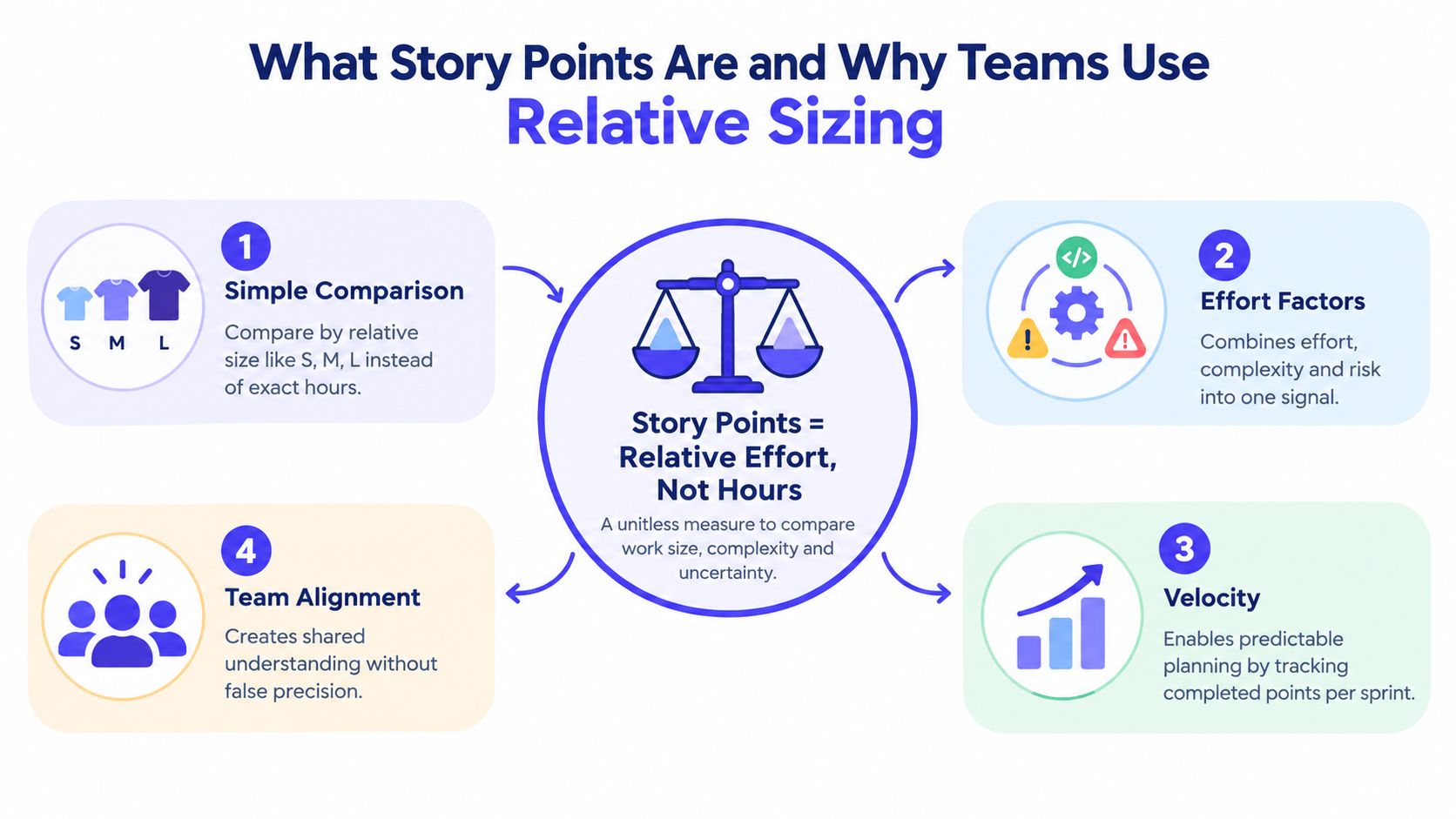
A story point is a unitless, relative measure of effort. It answers a narrow question: how large does this backlog item look compared with other items the team understands?
Suppose you're packing for a move. You may not know the exact weight of every box, but you can compare them. A box containing folded clothes feels smaller than one containing books. A box with fragile glassware may require more care even if it isn't heavier. The comparison combines amount of work, difficulty, risk, and uncertainty.
Story points work in a similar way. The team chooses a known reference story, then asks whether the new item is smaller, similar, or larger. The number records the comparison. It doesn't measure a universal quantity that another team can interpret in the same way.
What the number includes
Teams commonly consider several dimensions together:
- Amount of work: How much implementation, design, testing, documentation, or coordination is required?
- Complexity: How difficult is the behavior, architecture, data model, or integration?
- Risk: What could fail or force rework?
- Uncertainty: Which assumptions remain unverified?
A small code change with an uncertain third-party API may deserve a larger estimate than a longer but familiar internal change. Points aren't just a complexity score, and they aren't a measure of how impressive the technical solution sounds.
The historical origin reinforces this purpose. Story point estimation emerged from Extreme Programming in the late 1990s and became popular shortly before 2000 as an alternative to time-based estimates. Agile practitioners also used names such as “Gummi Bears” and “Nebulous Units of Time” for the same relative-sizing idea, as described in this historical account of story points. Those milestones show that points developed as a coordination tool, not as a mathematically exact measurement system.
Why points stay team-specific
Your team's points belong to your team. A five-point story for a group familiar with a mature service may be a much larger undertaking for a new group working in an unfamiliar codebase. Both estimates can be reasonable because each reflects a different reference frame.
That team-specific quality is useful. It keeps the conversation focused on shared understanding instead of encouraging managers to compare raw numbers across teams. The point scale helps a group build a local planning language, then velocity gives that language practical meaning over time.
Comparing the Most Common Estimation Techniques
Teams often combine a scale with a voting method. Fibonacci sizing supplies numbers that become more spread out as work gets larger and less certain. Planning Poker creates a structured discussion and simultaneous reveal. T-shirt sizing uses broad buckets when detailed numbers would suggest more confidence than the team has.
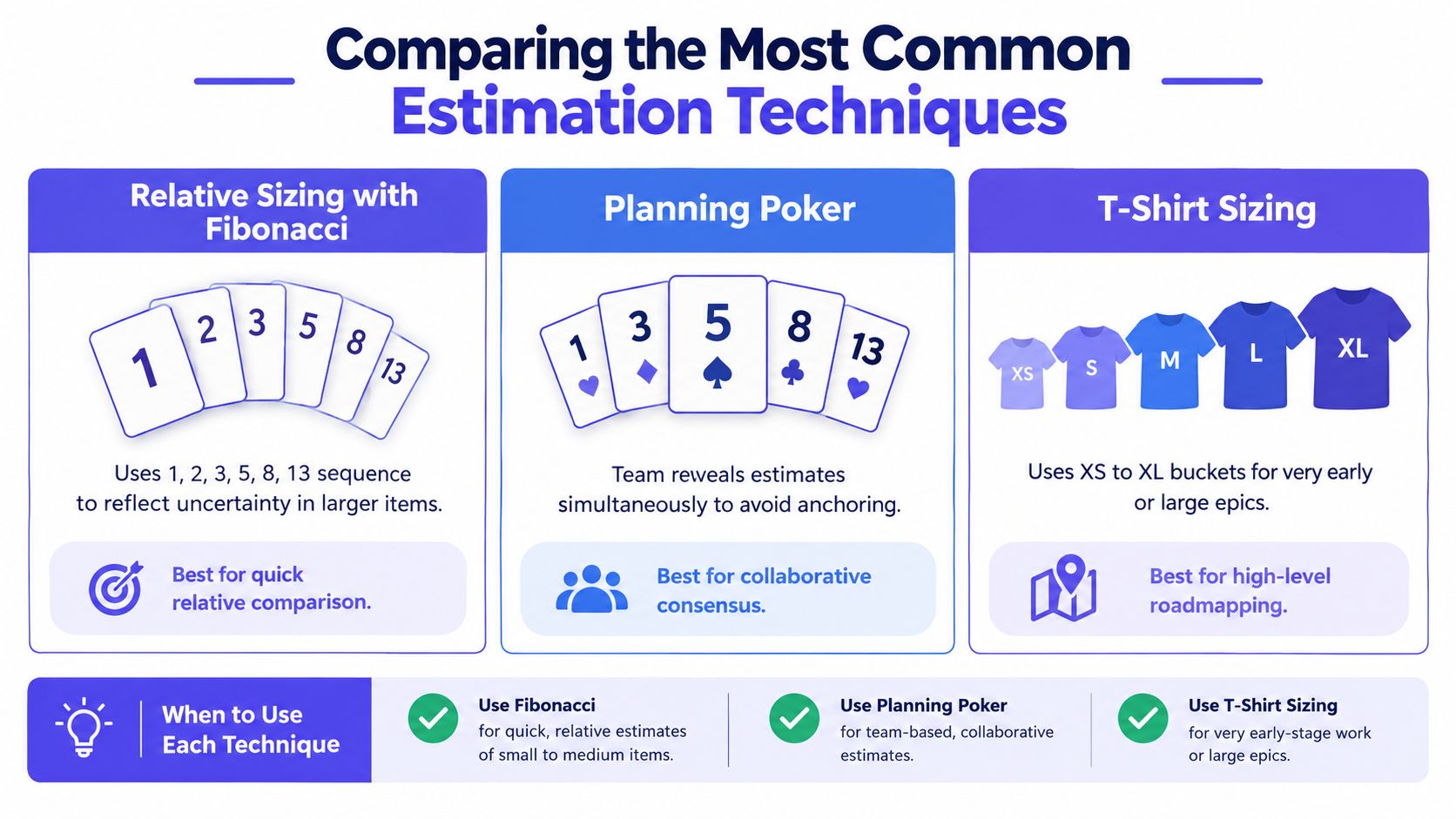
Fibonacci scales commonly use 1, 2, 3, 5, 8, and 13. The widening gaps make it harder to pretend that a large, uncertain item can be distinguished precisely from a slightly smaller one. Planning Poker can use that scale, but its main contribution is process. Each participant selects a card privately, then everyone reveals at once. The team discusses the highest and lowest estimates before voting again.
T-shirt sizing uses categories such as XS, S, M, L, and XL. It works well for early product discovery, large epics, and roadmapping, when the team needs a rough comparison before the backlog contains testable stories. A team can later translate those buckets into its own point scale, but it shouldn't treat that translation as a universal conversion.
| Technique | How It Works | Best For | Watch Out For |
|---|---|---|---|
| Relative sizing with Fibonacci | Compare an item with reference stories using a widening numerical scale | Quick backlog comparison and items with increasing uncertainty | Debating exact differences between large values |
| Planning Poker | Participants estimate privately, reveal together, and discuss meaningful outliers | Collaborative consensus and cross-functional discovery | Letting the first explanation anchor the group |
| T-shirt sizing | Place work into broad size buckets such as XS through XL | Early epics, product discovery, and high-level roadmaps | Treating a broad bucket as a precise forecast |
Choosing the right level of detail
Use T-shirt sizes when the question is, “Which initiative looks larger?” Use Fibonacci points when the team is preparing stories for delivery and can compare them with concrete reference items. Use Planning Poker when disagreement is valuable because it reveals different assumptions.
These choices aren't mutually exclusive. A team might size an initiative with T-shirt categories, split it into slices, then estimate the slices with Planning Poker and a Fibonacci scale. The important decision is not which technique sounds most agile. It's whether the technique produces enough shared understanding for the decision at hand.
How to Run a Story Point Estimation Session That Works
A productive session begins before anyone displays a card. The backlog item needs a clear user outcome, understandable acceptance criteria, and enough context for the team to identify likely work. If the item is still an idea, don't force detailed points onto it. Use a broad size or leave it for discovery.
Prepare the reference frame
Start by selecting a few completed or well-understood stories as references. Explain what made each one that size, including testing, design, data work, and release considerations. The reference doesn't need to be perfect. It needs to be familiar enough that the team can compare new work against it.
Then ask the Product Owner to explain the outcome and acceptance criteria. The people doing the work should estimate, while the Product Owner answers questions about intent and scope. Invite design, quality, data, and platform perspectives when those roles affect completion.
Keep the discussion about assumptions
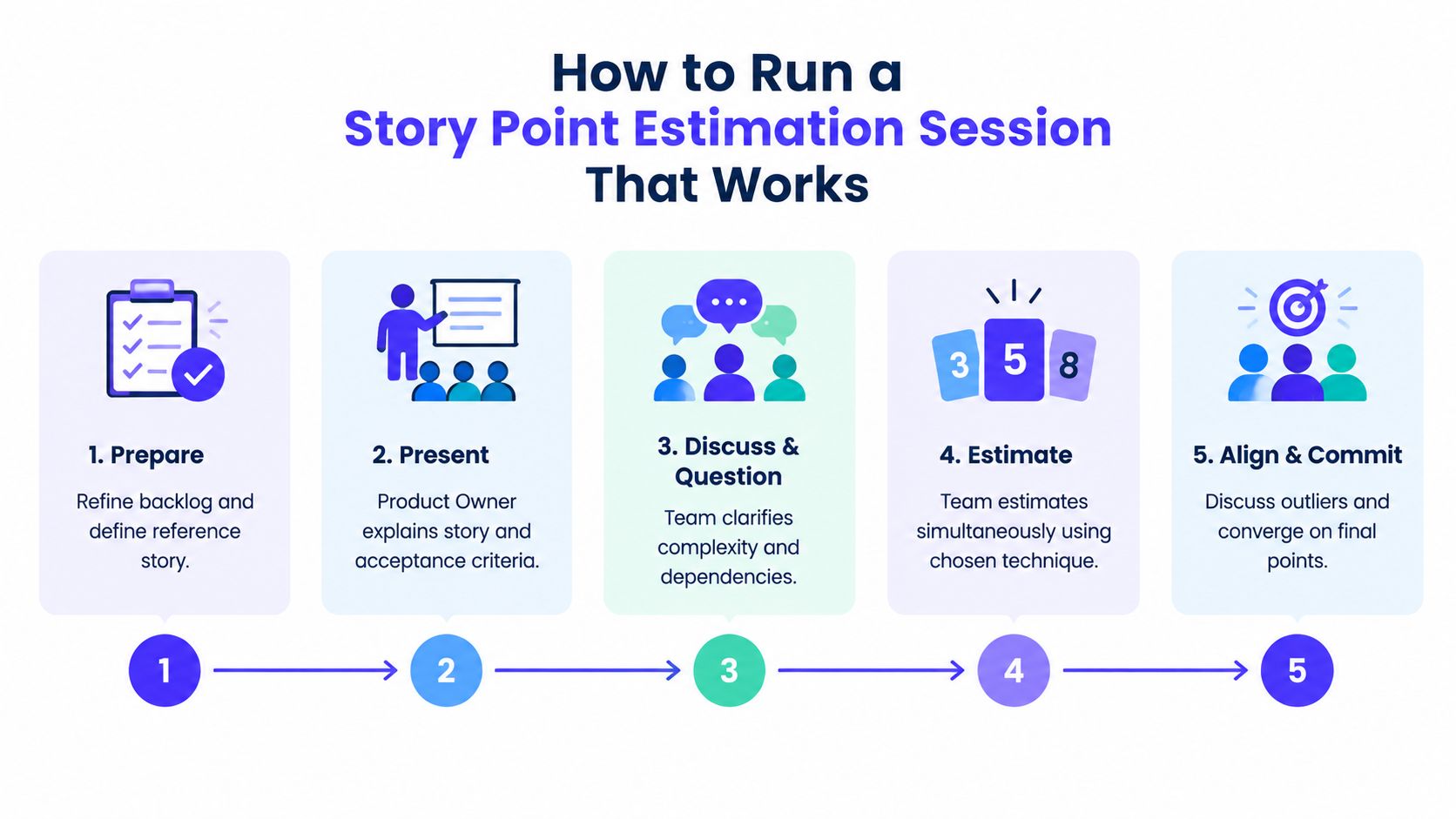
Run the conversation in a simple sequence:
- Present the item: State the user outcome and completion conditions.
- Clarify the work: Ask what is missing, uncertain, or dependent on another system.
- Estimate privately: Have everyone choose a value before hearing other estimates.
- Discuss outliers: Ask the highest and lowest estimators to explain their assumptions.
- Converge: Vote again or record a value that's good enough for the planning decision.
The facilitator should interrupt solution design when it becomes too detailed. A useful prompt is, “What assumption is driving that estimate?” That question turns disagreement into information without requiring the team to resolve every implementation choice immediately.
A disagreement is useful when it exposes different pictures of the work. It becomes wasteful when the team is arguing over a number without naming the assumption behind it.
Know when to split the story
If the team can't estimate an item because it contains several outcomes, hidden dependencies, or a research problem, split it or create a short discovery activity. Don't average uncertainty into a comfortable number. A smaller, clearer slice usually gives the team a better planning signal than a large story that everyone estimates differently.
For a practical companion to this workflow, teams can use a rapid planning method to turn clarified decisions into actionable work. A short estimation session should leave behind more than a point. It should leave behind the assumptions that make the point understandable.
This video offers another visual walkthrough of collaborative estimation:
Calibration Tips and Biases That Skew Your Estimates
A story point isn't permanent. The team's understanding changes, the codebase changes, and the people doing the work change. A longitudinal study of story-point changes found that values can shift over time, while broader research has found that expert-estimated points don't strongly correlate with actual development time. The same research reports that estimator consistency drops for items above 5 points, making large items especially poor candidates for confident, fine-grained sizing. See the empirical thesis on story-point stability and estimation.
That doesn't make points useless. It tells you what they are good for. Treat them as a local planning signal that needs periodic calibration, not as a fixed property attached to a story forever.
Notice the forces that distort discussion
Anchoring happens when the first number spoken pulls later estimates toward it. Planning Poker reduces that effect by keeping choices private until the reveal, but the facilitator still needs to prevent a confident speaker from defining the entire conversation.
Groupthink appears when people agree to avoid friction. Ask quieter participants to explain their estimate before the group settles. Optimism bias shows up when familiar work feels easier than it is, especially when the team forgets testing, rollout, migration, or support work.
Recalibrate without rewriting history
A study of 19,349 work items across seven open-source projects found that about 10% of work items had story-point changes, as reported in this research on changing agile work-item estimates. That finding supports a practical habit: points changing isn't automatically evidence that the original session failed.
Use these calibration practices:
- Refresh reference stories: Revisit the examples when the team's composition, product area, or technical context changes.
- Triangulate: Compare a new item with several known items, not just the last story discussed.
- Record the reason: Note whether a point changed because of new scope, discovered risk, a split, or a revised understanding.
- Review patterns: Discuss estimate surprises in retrospectives without turning them into individual performance judgments.
Re-estimate when new information changes the work or when the original item no longer represents a coherent slice. Leave history alone when the work is complete and the point only feels different because the team's scale has matured. Changing old numbers can erase useful evidence about what the team knew at the time.
Turning Story Points Into Velocity and Release Forecasts
Points become useful for forecasting only after the team observes completed work across iterations. Velocity is the number of stories or completed story points delivered in an iteration. It connects a team's local sizing language with a planning horizon, as described in this academic overview of agile estimation and planning methods.
The arithmetic is straightforward. If a backlog contains 200 story points and the team's average velocity is 20 points per iteration, the forecast is 10 iterations. If the workload is 400 points at the same velocity, the forecast is 20 iterations. Those examples show the correct order of operations. The team sizes relatively first, then uses observed delivery history to estimate how many iterations the work may require.
Velocity isn't a conversion rate. One point doesn't represent a fixed amount of calendar time, and velocity shouldn't become a target. If a team tries to increase its point total to look faster, the scale loses meaning and the forecast becomes less trustworthy.
Velocity is a planning aid, not a scoreboard.
Use completed points consistently enough that the trend is interpretable, then communicate forecasts as expectations rather than guarantees. Explain the backlog size, the observed velocity, and the assumptions that could change either one. Keep the forecast attached to the team that created the estimates. Raw velocity shouldn't be used to compare teams, because different groups use different reference frames.
A lightweight capacity planning template can help you record availability, planned work, and forecast assumptions alongside velocity. That context matters when holidays, incidents, onboarding, or discovery work affect what the team can complete.
Sample Workflows Templates and Checklists to Get Started
A team doesn't need a complicated estimation program. It needs a repeatable loop that connects backlog clarity, relative sizing, delivery evidence, and reflection.
A practical weekly workflow
During backlog refinement, the Product Owner explains the outcome and acceptance criteria. The team identifies missing information, splits oversized items, and estimates only the work that's clear enough to support an upcoming decision. Capture the reference stories and any assumptions directly beside the estimate.
Before sprint planning, review the top candidate items and check whether their size still reflects the current understanding. If a dependency or scope change has appeared, discuss whether to re-estimate, split the item, or remove it from consideration. Don't carry an obsolete estimate into a new plan.
During the sprint, treat scope changes explicitly. If acceptance criteria expand, record the change and decide whether the team should re-estimate the remaining work, create a new item, or renegotiate scope. Avoid changing points merely because implementation took longer. The purpose is to preserve an honest record of what the team believed before work began.
A one-page session checklist
- Backlog readiness: Is the user outcome clear?
- Completion conditions: Can the team explain what “done” means?
- Dependencies: Has anyone identified external systems, data, design, or security constraints?
- Reference stories: Does the team have familiar examples for comparison?
- Private estimates: Did everyone choose before hearing the group's numbers?
- Outlier discussion: Did the highest and lowest estimates explain their assumptions?
- Decision quality: Is the estimate sufficient for the decision, or should the item be split?
- Change record: If points changed, did the team document why?
Keep the checklist lightweight enough to use without turning refinement into administration. The best sign of maturity isn't that points never change. It's that the team can explain why they changed and can adjust its reference frame without blame.
SpecStory, Inc. offers Stoa, a multiplayer AI workspace that captures product conversations, decisions, open questions, and implementation context in real time. Visit SpecStory, Inc. to help your team turn estimation discussions into traceable plans and executable work.
Older
Customer Needs Assessment Playbook for Small Teams
Newer
GUI vs Command Line Productivity Guide for Teams
Newsletter
Get new posts in your inbox
Bring your team together to build better products. Fresh takes on remote collaboration and AI-driven development.