


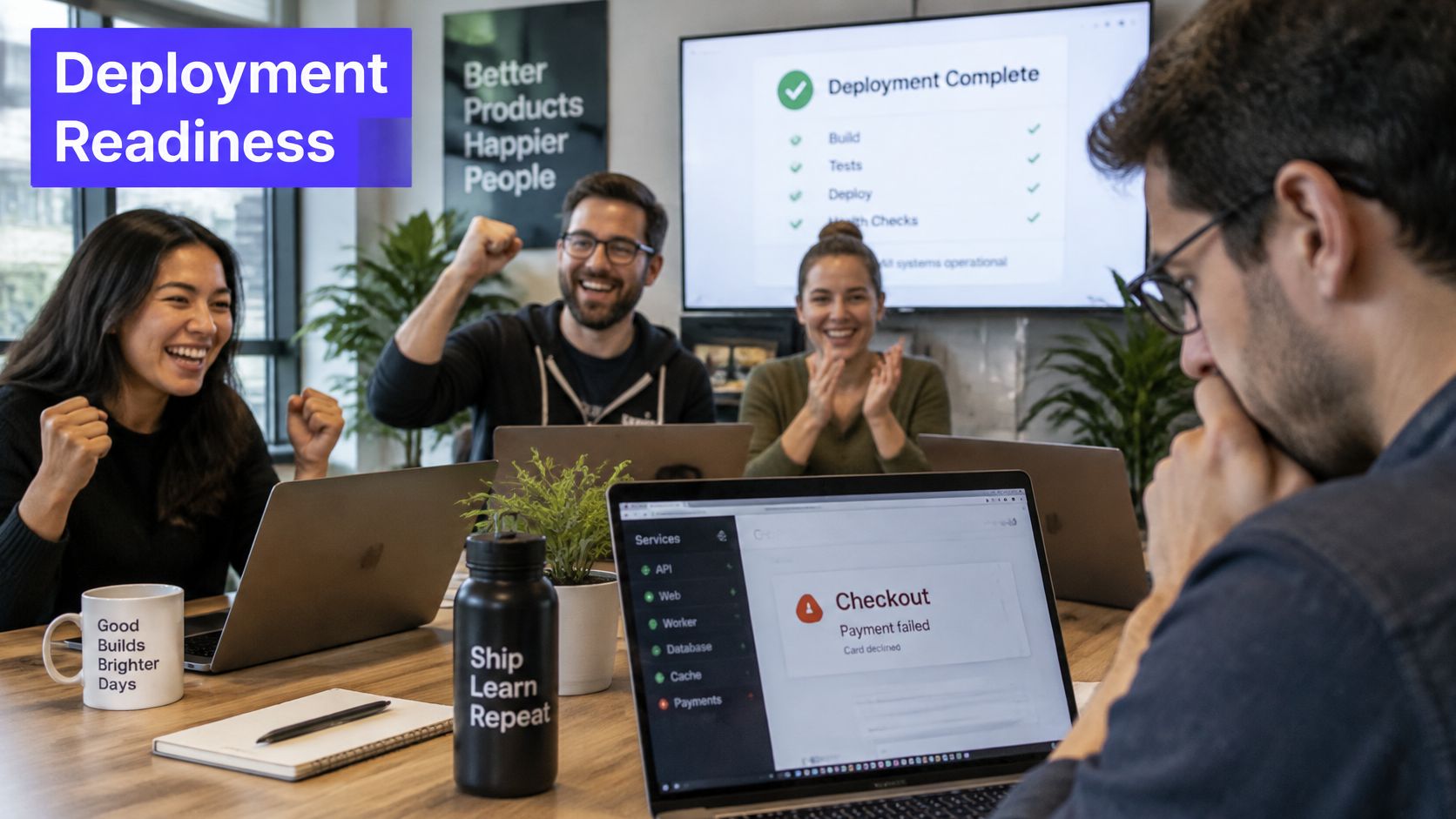
It's Friday afternoon. Your pipeline is green, the release is live, and everyone's ready to sign off. Say checkout then stops working for customers in one region, but nobody notices until support forwards a complaint. The build passed. The team had not established whether it could detect and reverse that particular failure.
Table of Contents
- What Deployment Readiness Really Means
- The Readiness Checklist and Pass Thresholds
- How Your Delivery Speed and Stability Compare
- Risk Gates That Stop a Risky Release
- Who Owns Each Decision on a Small Team
- How to Roll Out in Stages and Prove Rollback
- Validate AI-Generated Code Before You Ship
- Run Your First Readiness Review Before Your Next Release
What Deployment Readiness Really Means
Deployment readiness is the ability to move an agreed change into production at an appropriate speed while controlling risk and recovering quickly when assumptions fail. It's a decision about a specific change under current conditions, not a certificate your team earns once.
In the checkout scenario, another unit test might help, but it wouldn't settle the release decision. Someone also needs to verify regional transaction monitoring, decide what stops the rollout, and confirm who can restore the previous version. A working deployment pipeline answers whether you can ship. It doesn't establish whether you should.
Think preflight, not certification
A pilot doesn't rebuild the engine before takeoff. The crew checks whether the aircraft can make the intended journey and whether everyone knows what to do if something fails. Your release review should serve the same purpose.
Use these questions to keep that review concrete:
- Can we ship this? The implementation matches the agreed scope, and the relevant checks have evidence.
- Can we see it working? Production signals distinguish successful user activity from a process that merely stays alive.
- Can we undo it quickly? The recovery procedure accounts for application code, configuration, and any changed data.
The DORA metrics history describes a framework that balances delivery throughput with instability, rather than treating deployment frequency as sufficient evidence of performance. That distinction matters for small teams: releasing frequently is useful only when you can manage the consequences.
Readiness belongs to the change
A marketing copy edit and a billing migration shouldn't face identical review effort. The copy edit may need a preview and smoke test; the migration needs evidence about compatibility, recovery, and financial correctness.
Practical rule: Spend review effort in proportion to potential user harm and difficulty of recovery, not the size of the pull request.
You don't need a dedicated QA department to make that judgement. You need explicit pass conditions, accessible evidence, and someone accountable for the decision.
The Readiness Checklist and Pass Thresholds
Readiness criteria, pass signals and blocking conditions
| Criterion | Question it answers | Pass signal | Blocks release when |
|---|---|---|---|
| Impact and reversibility | What user harm is possible, and can we reverse it quickly? | Impact labeled low, medium or high, with rollback tested in staging | Impact is high and no rollback has been tested |
| Tests on critical paths | Do the flows users depend on still work? | Automated tests cover checkout, login and data writes that the change touches | Any critical path the change touches is untested |
| Secrets and dependencies | Did the change leak credentials or add a risky package? | Secrets scan is clean and new dependencies are reviewed | Scan flags a secret or an unreviewed new dependency |
| Observability | Can we tell normal behavior from failure? | Dashboards and alerts exist for latency, errors and a business transaction | No alert covers the changed path |
| Error budget | Is there budget left to absorb the risk? | Remaining error budget is above zero and known | Budget is exhausted or its status is unknown |
| Rollback owner | Who acts if the release breaks? | A named person has written rollback steps | No owner, or the owner hasn't read the steps |
| Product assumptions | Are the open decisions recorded? | Every open question has an owner and a date | An open question has no owner |
Passing tests clears only the tests row. It doesn't establish that credentials are safe, production failures are visible, or recovery will work.
Make evidence easy to inspect
Paste this table into your pull request or release template. Add a status and evidence field to each row, using pass, blocked, or unknown. Link to the actual test run, dashboard, scan result, or recovery procedure instead of writing “checked.”
An unknown counts as blocked. A blocked row stops the release unless the release owner explicitly accepts the named risk in writing, and that exception must stay within the team's security and reliability policy. An acceptance note doesn't make leaked credentials safe or restore an exhausted error budget.
For public-facing releases, UpTime Web Hosting's guide to check your website before going live provides a useful companion to the application-level review. Keep hosting and site checks alongside, rather than in place of, evidence about the changed user journey.
Match the review to the harm
Consider a payments change that alters refunds. Label it high impact because an incorrect result can move money or leave accounting records inconsistent. Require a staging recovery exercise and an alert on refund failures, not merely confirmation that the refund endpoint returns a successful response.
Inspect what “rollback” means in this case. Reverting application code won't necessarily reverse a refund already submitted to a payment processor. The recovery plan may need to stop further processing, reconcile affected records, and use a controlled corrective operation.
A marketing-page copy change can take a lighter route. Label it low impact, verify the rendered page and relevant links, and confirm the previous artifact can be restored. Don't demand a billing-level investigation for a wording edit.
The checklist should make a small release easy to approve and a dangerous unknown difficult to hide.
Before review starts, require the author to mark every row. That turns the meeting into a decision about evidence rather than a search for missing information.
How Your Delivery Speed and Stability Compare
DORA 2024 delivery performance tiers
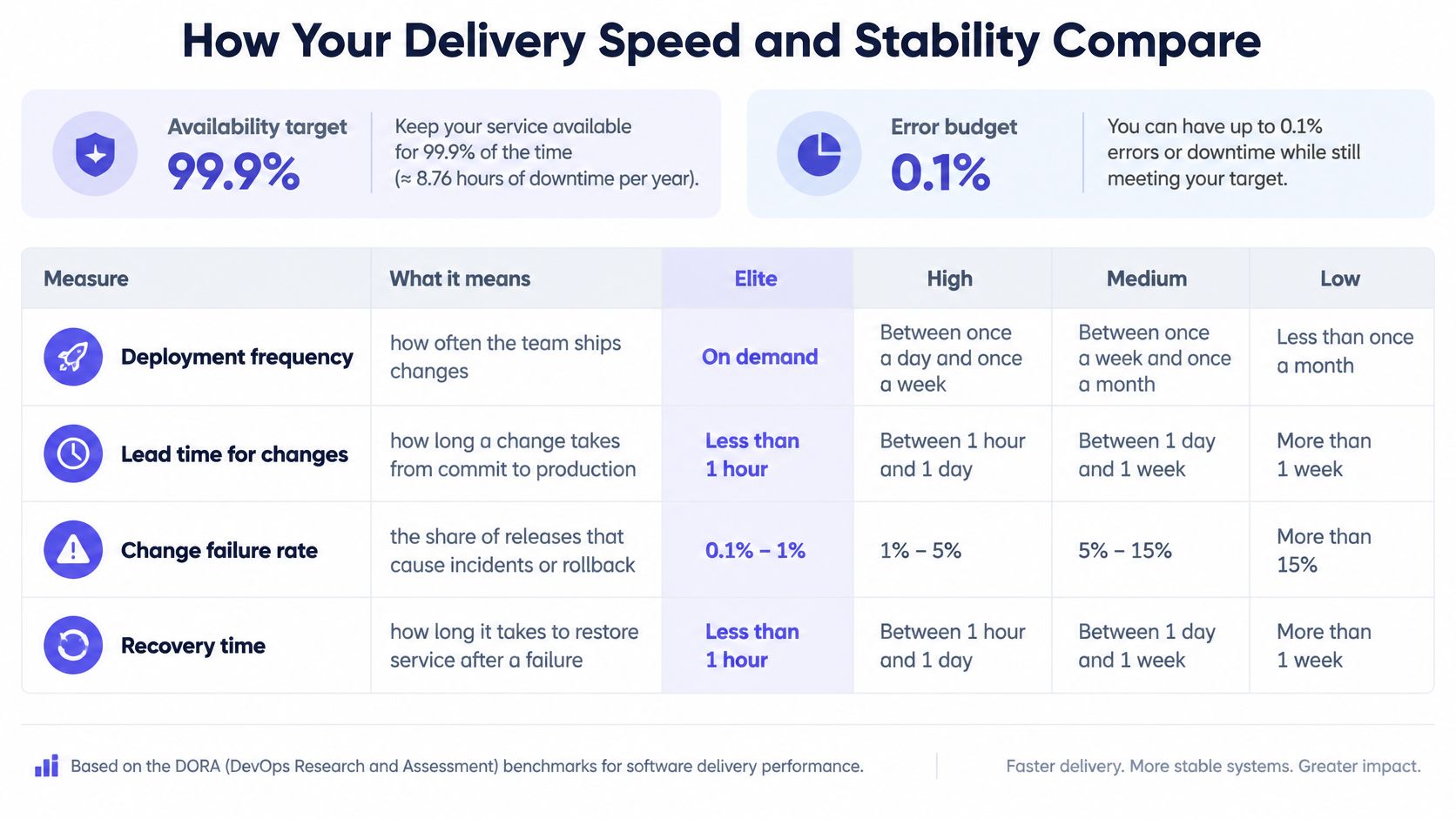
The following benchmark values and respondent shares come from the 2024 DORA report.
| Tier | Deployment frequency | Lead time for changes | Change failure rate | Recovery time | Share of respondents |
|---|---|---|---|---|---|
| Elite | On demand, multiple times per day | Less than one day | About 5% | Less than one hour | 19% |
| High | Once per day to once per week | One day to one week | About 20% | Less than one day | 22% |
| Medium | Once per week to once per month | One week to one month | 10% | Less than one day | 35% |
| Low | Once per month to once every six months | One month to six months | 40% | One week to one month | 25% |
Read the elite row across, not down the frequency column. Those respondents combined on-demand delivery with short lead times, comparatively few failed changes, and fast recovery. Shipping more often without improving the stability columns doesn't reproduce that profile.
Measure the same thing consistently
Use operational definitions your team can apply without debating each release:
- Deployment frequency measures how often changes reach production.
- Lead time for changes measures elapsed time from commit to production.
- Change failure rate measures the share of deployments requiring remediation.
- Recovery time measures how long service restoration takes after a failed deployment.
Notice that the high tier's failure rate isn't lower than the medium tier's. These are observed performance profiles, not a ladder where every cell improves uniformly. Don't force a mixed team profile into a flattering label.
Say your team ships daily but frequently needs emergency fixes. Its next readiness investment should be failure prevention and recovery, not another deployment-frequency target. Inspect failed releases for missing authorization tests, bundled migrations, or alerts that triggered too late.
Use benchmarks to choose work
Compare a service with its own history before comparing unrelated services. A static site and a stateful payment service have different consequences when something goes wrong.
For a public website, Agentable's guide to implementing DEM on public websites can help frame the user-experience signals to watch alongside backend health. Successful server responses don't necessarily establish that a browser user completed checkout.
Treat improving team velocity as reducing waiting, rework, and recovery effort, not increasing release count. Use the weakest speed and stability columns to choose the next readiness improvements, then check whether those changes help.
Risk Gates That Stop a Risky Release
Confidence isn't a release gate. Neither is the absence of complaints.
For an availability-based example, a 99.9% availability objective permits a 0.1% error budget; Google SRE's error-budget policy provides the basis for pausing ordinary changes when the budget is exhausted. Your team should agree on the policy before a deadline makes everyone eager to reinterpret it.
An error budget expresses how much unreliability the service can tolerate within its measurement window. It isn't spare capacity that a release owner can casually allocate. You can't predict a deployment's exact impact, but you can decide whether the current service condition permits taking additional risk.

Expose the signals before approval
Put these signals directly in the release record:
- Current SLO attainment: Identify the user-facing objective and the measurement window.
- Rolling error-budget consumption: Show the current balance and whether failures are accelerating.
- Active incidents: Name unresolved incidents affecting the changed service or its dependencies.
- Rollback ownership: Record who has access and authority to act.
Unknown signals block the deployment. So does a release whose expected risk conflicts with the remaining reliability allowance. If the budget is exhausted, pause feature releases except urgent security or corrective changes permitted by the policy.
Apply the gate to the actual plan
Say a seed-stage team has consumed most of its reliability allowance by Tuesday and wants to perform a large billing migration on Thursday. The release owner shouldn't approve it just because staging looks healthy.
The team can postpone the migration or split it into independently reversible changes, then reassess the narrower release against current conditions. Splitting work isn't permission to bypass an exhausted budget. It's a way to reduce risk when policy still allows deployment.
A gate without a named decision owner is a suggestion that people can ignore under deadline pressure.
Record the decision, the service condition, and the reason. When working on improving product quality, keep these records alongside defect analysis so the team can distinguish a missed check from a consciously accepted risk.
Don't turn every release into a committee meeting. Let low-impact changes proceed when the evidence is complete, while requiring explicit review for degraded service conditions and difficult-to-reverse operations.
Who Owns Each Decision on a Small Team
Automation coverage is uneven. Among 361 respondents in a 2025 platform-engineering and DevOps survey, 6.1% reported no automated testing, while only 2.2% reported that all testing was automated, according to TechTarget's reporting.
That doesn't tell you whether your particular release is safe. It does reinforce why a green pipeline can't replace an accountable readiness decision.
Release roles and what each one signs off
| Role | Owns | Signs off on |
|---|---|---|
| Release owner | Timing, checklist completion and the go or no-go call | The final go or no-go decision |
| Change author | Impact classification and test evidence | The impact label and the tests row |
| Reviewer | Code review, including AI-generated changes, against the original product decision | The review record in the pull request |
| On-call responder | Watching dashboards during the rollout window | Promote or revert within the observation window |
| Product owner | Requirements and open product assumptions | Scope match to the original decision and closed questions |
Assign hats, not departments
A small team can distribute these responsibilities without hiring a person for every role. The engineering lead might own the release and respond to incidents; a founder might own product scope. Write names beside the roles for each release rather than assuming job titles settle responsibility.
The change author must not be the sole approver of a high-impact release. Another person should inspect the evidence and challenge the recovery assumptions. If nobody available can competently review a sensitive authorization or cryptographic change, narrow the scope or arrange qualified review instead of treating staffing constraints as approval.
For distributed teams, use an asynchronous handoff with the deployed artifact, dashboard, recovery steps, and responder availability. Don't launch a high-impact change just as the only person with production access goes offline.
Make sign-off mean something
The reviewer checks the diff against the intended behavior, including data handling and authorization. The product owner resolves scope questions, while any nonblocking follow-up retains an owner and deadline.
The release owner records accepted risks but cannot rewrite policy without notice. The responder must have working access before rollout starts. Being named in a document isn't enough if they can't execute the recovery procedure.
How to Roll Out in Stages and Prove Rollback
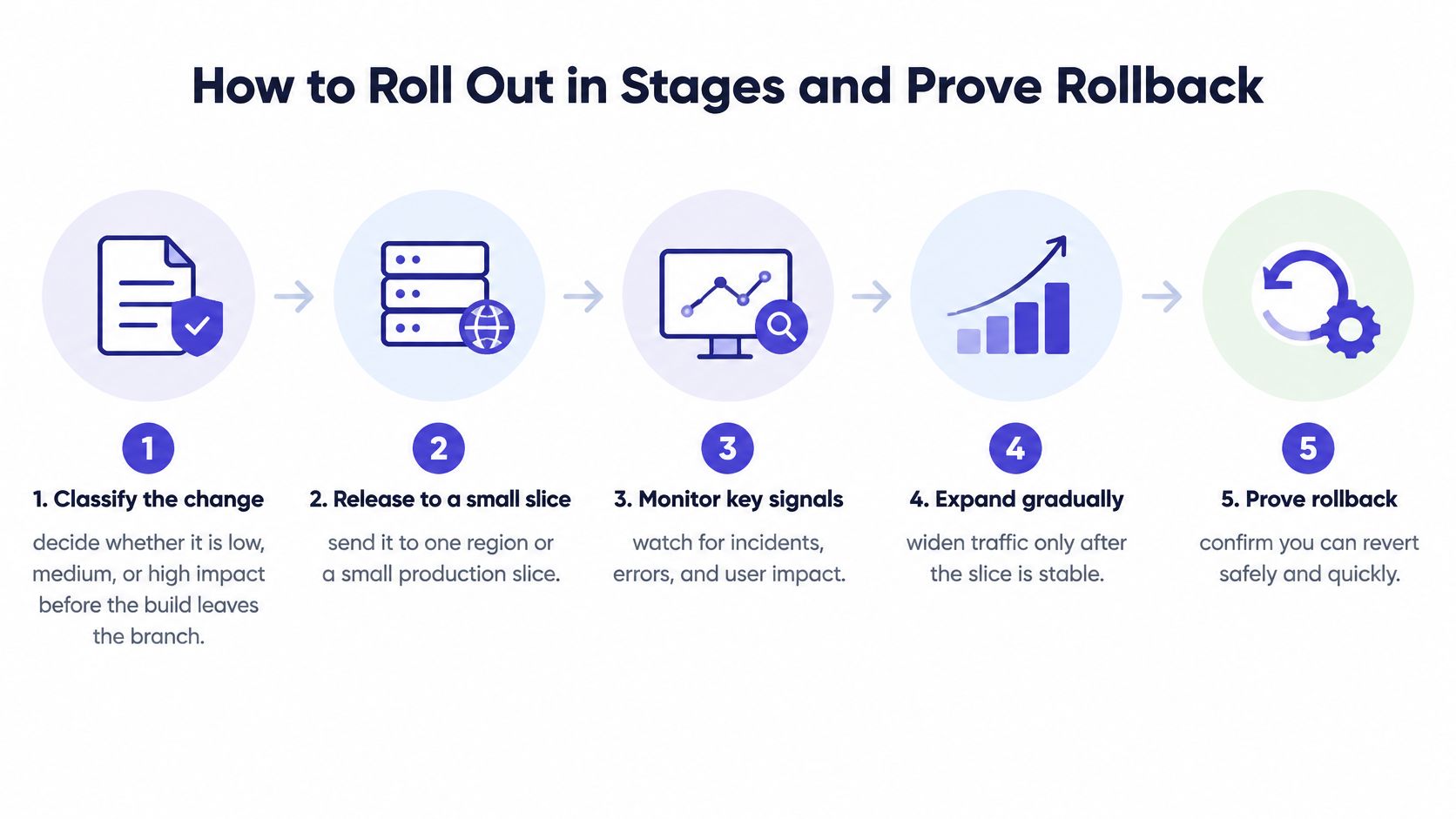
A staging pass doesn't prove how a change behaves under production traffic. Use a controlled production exposure with explicit promotion conditions, following the staged-release approach described in Google SRE's canarying guidance.
Run a supervised rollout
-
Classify the change before building the release. Label its impact and identify irreversible operations. Authentication, money movement, and destructive data changes need more scrutiny than presentation edits.
-
Release to a small production slice. Choose a controlled traffic segment or region that can exercise the affected behavior. Don't choose an inactive slice merely because it's unlikely to produce an alert.
-
Write promotion thresholds before exposure. Specify permitted latency, error rate, saturation, and business-transaction behavior using the service's baseline and objectives. Include the exact dashboard queries so the responder won't have to improvise them.
-
Hold for an agreed observation window. Choose a window that captures representative activity for the changed path. When traffic is too sparse to evaluate, hold the rollout or supplement observation with a safe synthetic transaction.
-
Promote only when every threshold holds. Otherwise stop expansion and revert using the prepared procedure. Restore service before pursuing a detailed diagnosis, preserving logs, traces, and deployment metadata for investigation.
-
Prove recovery in staging before production. Although it's listed here as a final readiness check, perform the exercise before the rollout begins. Verify access, artifact availability, configuration restoration, and compatibility with data written by the new version.
Rollback comes before diagnosis because an investigation can continue while users are still experiencing failures. Don't prolong exposure merely to understand the defect, unless reverting would itself create greater harm and the recovery plan specifies another action.
Test the recovery you actually need
A common failure is assuming the revert script works because it exists. Run it against representative state and confirm the restored version can read records created during the attempted deployment.
Keep artifacts small and self-contained so restoring a previous version doesn't also unwind unrelated work. For database changes, prefer additive schema evolution and delay destructive cleanup until older code no longer depends on the previous structure.
Feature flags can separate deployment from user exposure, but a flag won't undo corrupted data. Kogifi's feature flag governance best practices are useful when defining flag ownership, lifecycle, and removal responsibilities.
A healthy canary has metrics inside agreed bounds, no unexplained errors in logs or traces, and successful business transactions. The responder should know which recovery action to take and have its exact command documented, not rely on memory during an incident.
Validate AI-Generated Code Before You Ship
Passing tests doesn't establish that generated code is ready for production. Based on nearly 5,000 technology professionals worldwide, DORA's 2025 AI-assisted development report associates higher AI adoption with improved throughput but greater software-delivery instability, describing AI as an amplifier of the existing delivery system.
Review the implementation, not its explanation
Add these checks to AI-assisted changes:
- Trace the intent. Identify generated portions and compare the diff with the original product decision. Test rejected inputs, authorization boundaries, and failure behavior, not just the happy path.
- Inspect security and dependencies. Run secret checks, review new packages, and inspect where user data travels. A convincing generated explanation isn't evidence that a dependency is appropriate.
- Preserve operational control. Keep the release narrow, instrument the changed transaction, and require the responder to evaluate it before expanding exposure.
- Limit adoption when review capacity is strained. If reviewers can't explain the implementation or recovery procedure, reduce the batch rather than generating more code for the queue.
Use a repeatable approach to testing AI-generated code, and retain the reviewer's findings in the pull request. Include enough context for a teammate to maintain the implementation without reconstructing the original prompting session.
Functional correctness, security, observability, and maintainability are separate review concerns. Faster authorship doesn't justify collapsing them into a test-suite result.
Run Your First Readiness Review Before Your Next Release
Fit the review into the workflow your team already uses:
- Update the pull request template. Paste in the criteria table and require status plus evidence before requesting approval.
- Use the release meeting for decisions. Have the release owner read blocked and unknown items aloud, assign remediation, and record the outcome.
- Circulate high-impact changes early. Send a brief naming user impact, recovery steps, observation conditions, and the responder. Our Feature Kickoff process recommends sharing the brief at least 48 hours before the meeting.
Say Monday's review finds that the refund recovery procedure hasn't been exercised and nobody owns the rollout. Move the billing migration from Tuesday to Thursday, contingent on fixing those gaps. The author demonstrates recovery in staging; the release owner records the responder and verifies availability.
Close with a decision record
If the service's error budget is exhausted, the same meeting pauses ordinary feature releases and considers only permitted urgent security or corrective work. A revised calendar doesn't override that gate.
Before your next release, copy the table into the template, run the review, and record the go, no-go, or accepted risk in writing. Keep the record attached to the deployed change so the next responder can find it.
SpecStory, Inc. offers Stoa, a shared workspace that captures product decisions and open questions while drafting a Markdown PRD live during the meeting. Use it to preserve the intent and unresolved assumptions your release reviewer needs to inspect. Visit SpecStory, Inc., create a Space, invite a teammate, and run your next release-planning meeting there.
Newsletter
Get new posts in your inbox
Bring your team together to build better products. Fresh takes on remote collaboration and AI-driven development.