


You're reviewing a feature that looks reasonable, but it isn't what the team agreed to build. The designer remembers a change from the discovery call. The engineer followed the ticket. The product manager has a different version in the PRD, and nobody wants to search the recording to settle it.
Product specification software helps teams preserve the connection between an agreement and the work that follows. Its value isn't how polished the document looks. It's whether someone joining the project can recover what was decided, why, and which implementation reflects that decision.
Table of Contents
- What Product Specification Software Does for a Team
- Where It Fits Beside PRDs, Trackers and Design Systems
- Core Features That Keep Specifications Connected
- Real Team Use Cases From Seed Stage to Scale-Up
- Evaluation Criteria Before You Commit to a Tool
- How to Migrate Specs Without Losing Context
- Confirm the Pilot Before You Switch Tools
What Product Specification Software Does for a Team
Say a seed-stage team agrees during a call that customers can preview an export before upgrading. The decision stays in the transcript, the PRD still says exports require payment, and an engineer implements the older rule. Everyone acted on information they believed was current.
Product specification software is a shared workspace for requirements, decisions with named owners, acceptance criteria, open questions, and links to implementation and tests. Instead of leaving those records scattered across chat, documents, and tickets, it connects them around the feature they describe.
The workflow below shows where the disconnect happens and where a shared specification helps.
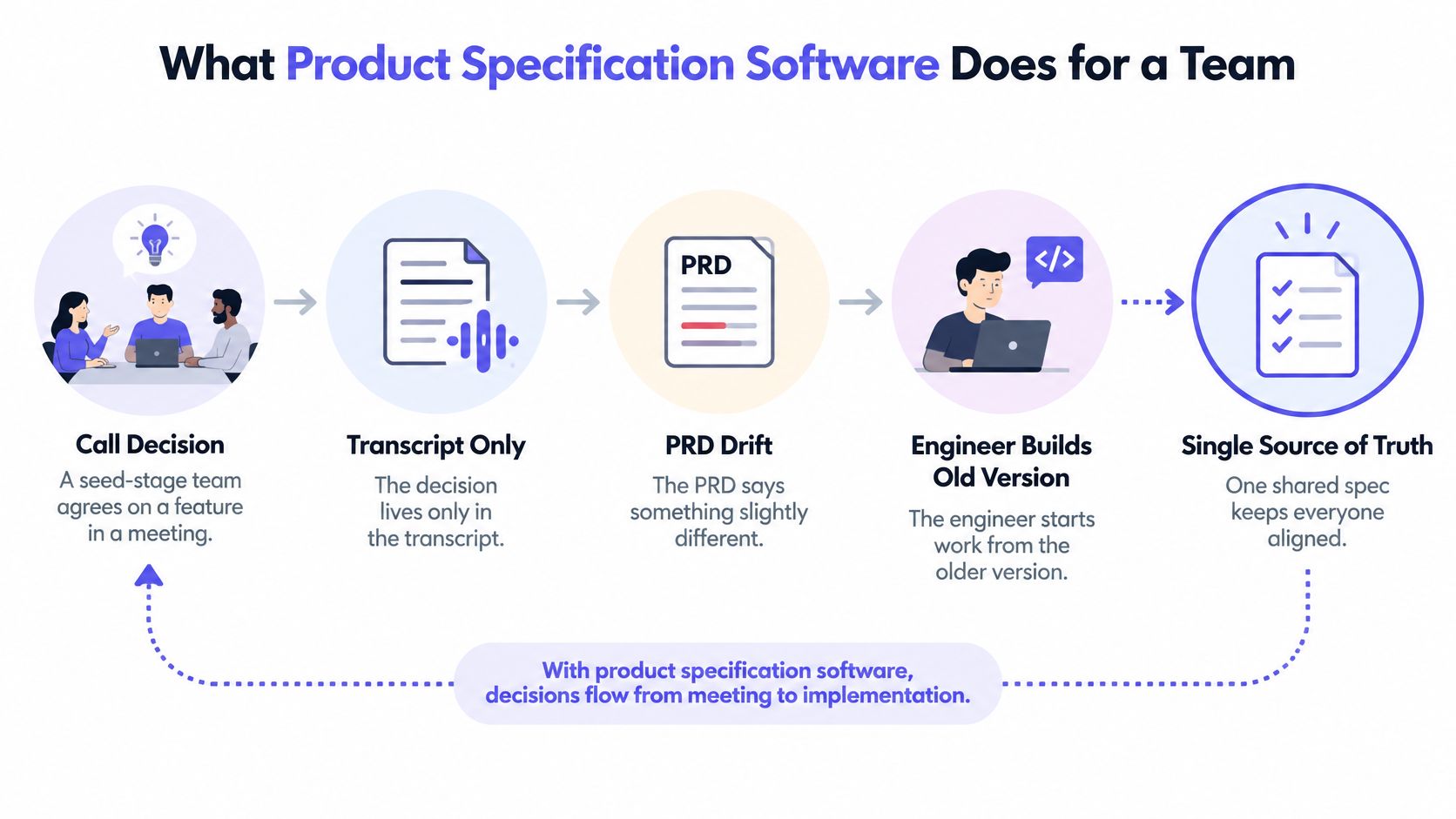
A shared blueprint, not another write-up
Think of a building site. The electrician and plumber need the same approved drawings, not separate sketches kept at different desks. Software teams need a comparable reference, with enough history to distinguish an approved change from somebody's suggestion.
The underlying problem predates today's tools. A historical requirements-engineering overview describes a 1995 survey of more than 8,000 software projects in which 50% of project managers cited poor requirements as a principal cause of failure.
The economic stakes concern when teams discover mistakes. A Software Engineering Institute business-case review summarized estimates that 42% to 64% of software defects originate during requirements and design, and that correcting a requirements defect after deployment can cost 50 to 200 times more than correcting it during requirements work.
Keep responsibility visible
Capturing a decision doesn't establish who can approve it. Name the product owner, involve engineering in feasibility, and record unresolved constraints before treating a requirement as ready. Otter A/B's explanation of how product managers shape the backlog offers useful context for separating product direction from delivery responsibilities.
Our view is that the specification will become a new source of truth in software development. That only works when people maintain its authority, not merely its formatting.
Practical test: Can we name the decision that authorized this change?
Where It Fits Beside PRDs, Trackers and Design Systems
How product specification software compares with adjacent tools
| Tool | What it holds | Usual owner | Best fit |
|---|---|---|---|
| Product specification software | Requirements, decisions, open questions and links to delivery | Product lead with engineering | Teams whose decisions are scattered |
| Product requirements document (PRD) | Goals, scope and acceptance criteria for one feature | Product manager | Aligning one feature before build |
| Issue tracker | Tasks, owners, status and sprint work | Engineering or delivery lead | Tracking execution |
| Design system | Reusable components, tokens and usage rules | Design and frontend teams | Consistent interfaces across products |
| Shared notes or docs | Free-form meeting notes and drafts | Whoever writes them | Early thinking, not a source of truth |
A PRD explains a feature's purpose, scope, and expected behavior. It can remain useful throughout delivery, but someone must update it when decisions change. This guide to a product requirements document helps clarify what belongs in that artifact rather than in an implementation task.
An issue tracker, such as Linear or Jira, tells an engineer what needs doing and tells a delivery lead what's blocked. Teams can record rationale there, but it often gets buried among status updates. A completed ticket doesn't necessarily explain why the team rejected an alternative.
Different tools answer different questions
A design system defines reusable interface elements, tokens, and usage rules. It can tell a designer how an upgrade dialog should look, but not whether this particular feature should require an upgrade.
Shared meeting notes support exploration. They preserve suggestions, disagreement, and unfinished thinking, which makes them valuable evidence but a risky place to infer approval. Keep the discussion available while separating confirmed decisions from proposals.
Specification software adds a decision layer across these tools. Many teams should keep their PRD, tracker, and design system, then connect their contents rather than recreate everything in another workspace.
Consider a technical product whose engineers need to compare PDE solver methods, as explained by Zemith. The technical reference supports evaluating alternatives; the specification records the chosen method, relevant constraints, and the reason for choosing it. Reference material and an approved product decision serve different purposes.
Category growth isn't a buying recommendation
The Insight Partners valued the global specification management software market at USD 545.66 million in 2025 and projects it will reach USD 1.069 billion by 2034. That broader category indicates commercial interest, not proof that a dedicated tool fits your workflow.
If you need the why behind a ticket, consider a specification layer. If you only need a task list, keep the tracker.
Core Features That Keep Specifications Connected
Evaluate features by the connections they preserve, not by how much text they generate. A useful specification lets someone move from a requirement to its authorizing decision, implementation, and validation without reconstructing the project's history.
-
Decisions with owners and dates. Record who approved the choice, when, and what it supersedes. Attach the originating discussion so a reviewer can distinguish approval from a tentative suggestion.
-
Acceptance criteria on each requirement. Describe observable behavior rather than adjectives such as fast or intuitive. For an export preview, specify which records appear, how restricted fields are handled, and what happens when there's nothing to export.
-
An open-question queue. A question about pricing eligibility should appear when someone starts the affected requirement, not remain buried in meeting notes. Give it an owner and identify whether it blocks implementation.
-
Traceability to delivery artifacts. Connect each requirement to its implementation, executable tests, and related defects. Prefer identifiable relationships that the tool can search and inspect over pasted links with no defined meaning.
-
Revision history with rationale. A text diff shows that the eligibility rule changed. A decision-linked revision explains why it changed and which downstream work needs review.
-
Plain-file export. Preserve identifiers, relationships, and provenance alongside the prose. An export that drops the approval history isn't a complete exit path.
Measure connections, not page length
An empirical study of 24 medium- and large-scale open-source projects found that greater traceability completeness significantly reduced expected defect rates for three implementation-support activities. That finding supports inspecting delivery relationships rather than assuming a well-written document is complete.
Our explanation of why traceability is important provides further context for making those relationships useful during changes and reviews.
Metrics a small team can track for traceability
| Metric | How to calculate |
|---|---|
| Requirements linked to at least one artifact | Linked requirements divided by all requirements |
| Requirements linked to executable tests | Test-linked requirements divided by all requirements |
| Changed requirements with reviewed downstream links | Reviewed changed requirements divided by all changed requirements |
Define the denominator before comparing results. Exclude retired requirements consistently, and distinguish a test that exists from one that checks the requirement's acceptance criteria.
Automate capture, retain review
In Stoa, our AI listens to the meeting conversation and automatically extracts decisions, drafts specs, generates user stories, and flags open questions. That reduces manual write-up, but a product lead still needs to confirm that an extracted decision reflects what participants approved.
A feature earns its place when it creates a relationship you can query later, not merely another paragraph you can search.
Real Team Use Cases From Seed Stage to Scale-Up
These composite scenarios illustrate workflows, not named customer results. Each follows a different handoff where teams can lose the reason behind a feature.
The collaboration moment matters because that's where people clarify exceptions that rarely survive in a task title.

Composite scenario A, the founder-led startup
A founder narrows an export feature during a discovery call. The specification captures the approved preview behavior but marks pricing eligibility as unresolved, with the founder responsible for answering.
The engineer can implement the preview while leaving the commercial rule untouched. The useful outcome is a clear boundary between work that's authorized and work that still needs a decision, rather than an apparently complete document containing an unspoken assumption.
Composite scenario B, the distributed product team
A remote product manager and designer have been chasing approval through Slack threads. They attach the approved Figma design to the requirement and record why the team removed an optional setup step.
When an engineer asks whether that step was forgotten, the product manager can point to the decision and its design revision. In this scenario, the team replaces a thread hunt with a direct path to the relevant evidence.
The following video provides an additional reference alongside these team workflows.
Composite scenario C, the engineering team using agents
A Head of Engineering wants reviewers to verify generated changes against approved intent. The team attaches the governing requirement and test evidence to the code review, so a reviewer can inspect both behavior and authorization.
This distinction matters: Google's 2025 DORA findings report that 90% of technology professionals use AI at work, yet 30% report little or no trust in AI-generated code.
Our specstory-yak agent skill detects rabbit holes and scope creep, while specstory-session-summary generates standup-ready summaries. Those aids support oversight; they don't replace approval or test review.
How do you prove that AI-generated code still reflects the conversation that authorized it? The more people and agents touch a feature, the more important linked evidence becomes.
Evaluation Criteria Before You Commit to a Tool
Evaluation criteria, the test to run and the red flag
| Criterion | What to test | Red flag |
|---|---|---|
| Decision capture | Record a decision and confirm owner and date appear | Decisions only exist in chat history |
| Open questions | Flag a question, then confirm it resurfaces at the linked requirement | Questions disappear after the meeting |
| Traceability | Link one requirement to a commit and a test | Links are manual and go stale |
| Validation | Create a requirement with no acceptance criteria | The tool accepts it without warning |
| Export | Export a spec to plain Markdown or files | Records are locked in a proprietary format |
| Integration | Open the same context in an editor and a design tool | Context must be copied by hand |
| Cost at scale | Model the cost for your team size over six months | Per-seat fees grow faster than the team |
| Local or offline use | Disconnect and inspect locally available records | Essential context becomes inaccessible |
Score each criterion pass, partial, or fail, and require a demonstration using a real requirement from your backlog. A prepared example can hide the awkward cases, such as a reversed decision or an unresolved question that affects several tickets.
Treat red flags as reasons to pause purchasing, not invitations to accept a promised roadmap feature. For manual links, specifically inspect how the tool identifies stale relationships after a requirement changes.
Include the work around the tool
A useful integration carries identifiers, permissions, and current context, not just notifications. The distinction also matters when comparing team productivity software, because improving an individual task doesn't necessarily simplify a cross-functional handoff.
Apply the same standard to leadership reporting. The OKR Hub's discussion of scaling leadership reviews without extra admin offers a useful adjacent perspective: reporting should reuse operational records rather than require another manually maintained summary.
Compare the actual cost model
Build a six-month cost scenario using your expected team size and activity. For per-seat pricing, include collaborators who need occasional access; for hourly or credit-based pricing, estimate the activity that consumes the allowance and examine any usage limits.
Don't compare an entry price with another product's expected operating cost. Include migration work, ongoing administration, and any paid integration needed to meet a required criterion.
Our new Stoa users can start free with $50 in credit and invite as many people as they want. SpecStory Cloud also has a free tier. These provide starting points for evaluation, but a free option still needs to meet your requirements for access, portability, and delivery connections.
How to Migrate Specs Without Losing Context
Move the evidence behind requirements, not just their latest wording. A clean import that omits authors, unresolved questions, or superseded decisions can leave the new workspace less useful than the old folder.
Atlassian's 2025 developer-experience survey of 3,500 developers and managers across six countries identifies finding information and switching between tools among developers' major time-wasters. Centralizing documents won't solve that problem if teammates still have to copy context into each working environment.
Preserve authority and provenance
-
List every place context lives. Include PRDs, tickets, meeting notes, Figma files, chat decisions, and agent logs. Assign someone to identify which records remain relevant to active work.
-
Choose the authoritative system. Decide where approved requirements live and which files remain canonical. Write down how a change becomes approved so competing copies don't acquire equal authority.
-
Export carefully. Save existing PRDs and notes as plain files, preserving authors and dates in front matter. Keep original references and stable identifiers rather than replacing them with titles alone.
Use this migration flow to align the team before moving content.
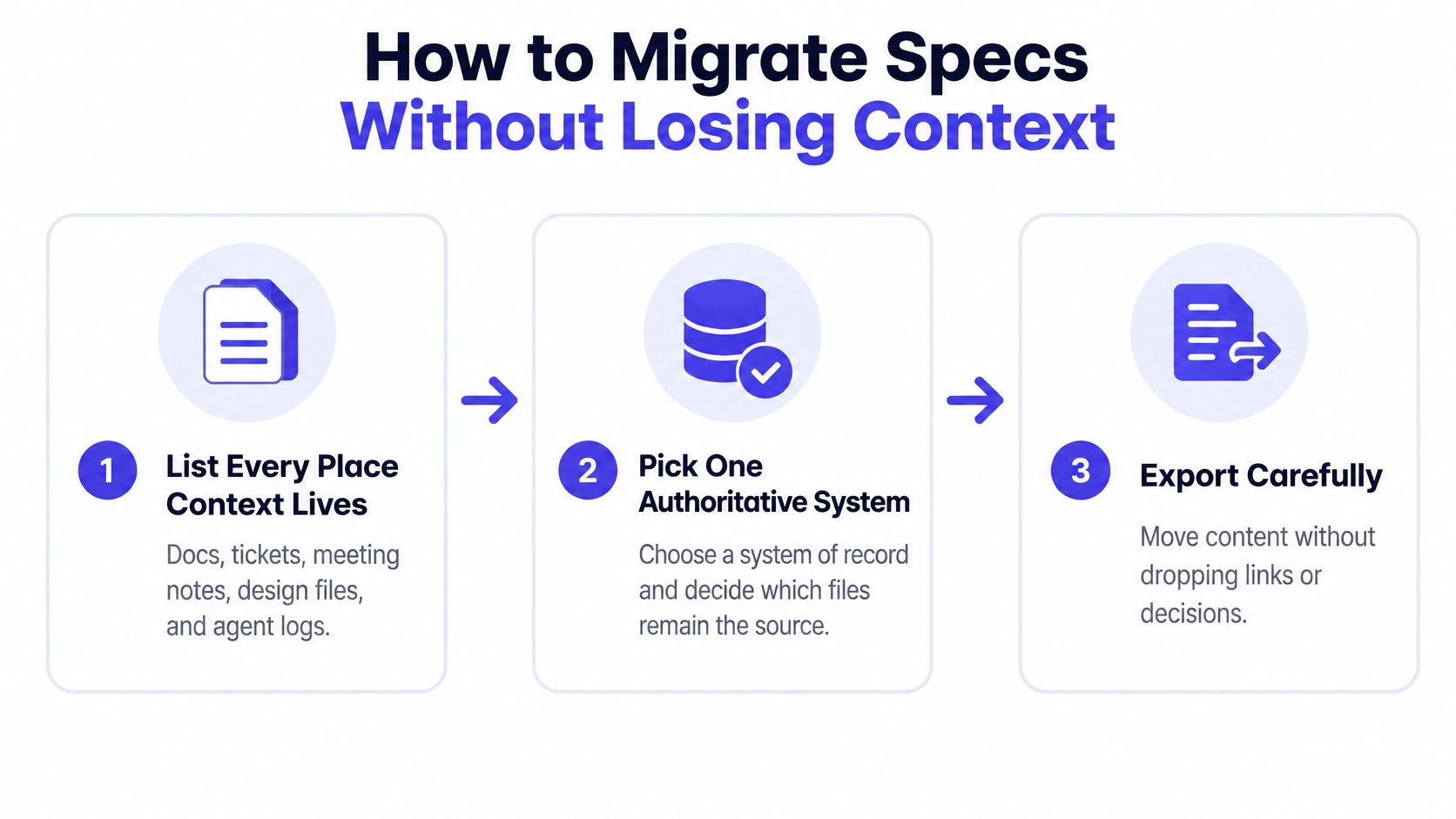
Move active relationships before retiring records
-
Import open questions as tracked items. Preserve their owners, blocking status, and affected requirements. A comment is insufficient if nobody will encounter it when implementation starts.
-
Link requirements to existing tickets. Don't duplicate ticket descriptions and create another synchronization problem. Verify that someone can move from the requirement to the current execution record.
-
Use a feature as the migration boundary. Keep its originating meeting, approved requirement, implementation, and merged change together. Reserve the adoption decision for the pilot, rather than treating a successful import as proof of workflow fit.
-
Retire duplicates after acceptance. Mark old records as superseded and point readers toward the authoritative version. Keep historical evidence accessible where it explains earlier behavior.
On SpecStory Cloud, our teams get shared context, project organization, and MCP integration. Before relying on a cloud workspace, verify that the local export preserves the information your team needs outside it.
Migration success check: Set a target for a new teammate to recover the decision behind a feature in under two minutes.
Treat that as your own acceptance target, not an industry benchmark. Test recovery without letting the original author explain where everything is.
Confirm the Pilot Before You Switch Tools
Run a two-week pilot on one feature with a live open question. Choose a feature with enough uncertainty to exercise the workflow, but not a release emergency that will tempt everyone to bypass it.
Our Product Discovery Meeting template can be opened in Stoa or downloaded. It includes sections for the problem statement, customer evidence, hypotheses, possible solutions, experiments, and follow-up, giving the team a practical starting point without dictating its conclusions.
Follow the evidence through delivery
Hold the discovery meeting, then compare extracted decisions against the transcript. Confirm that open questions reappear at the affected requirement, connect a requirement to its implementation and executable test, and record time spent manually transferring context.
Ask someone who missed the meeting to recover the reasoning behind the finished change. Compare that experience with your current process, including any help they needed from teammates.
Answer these questions with yes or no:
- Ownership: Did every decision have an owner?
- Question recovery: Did every open question resurface?
- Validation: Did every requirement link to a test?
- Portability: Could we export everything to plain files?
- Manual work: Did the tool remove manual steps without adding new ones?
Make the adoption decision explicit
Adopt the tool if teammates find decisions faster and no new manual step appears. Otherwise, keep the lighter combination of PRD, tracker, and notes while addressing the specific gap that caused the pilot to fail.
The PRD and tracker will usually stay. You're adding decision memory, not replacing the work of choosing scope, resolving disagreement, or reviewing implementation.
Start the next planning meeting with this question: What decided this, and where is it recorded?
SpecStory, Inc. offers Stoa, a multiplayer AI workspace that captures live product conversations and turns them into decisions, specifications, and shared implementation context. Visit SpecStory, Inc. to try your next discovery meeting in Stoa and test whether your team can carry an approved decision through to a reviewable change.
Older
How to Improve Team Velocity: A Practical Playbook
Newer
Deployment Readiness Checklist for Safe Releases
Newsletter
Get new posts in your inbox
Bring your team together to build better products. Fresh takes on remote collaboration and AI-driven development.