


The most popular advice about a product requirements document is also the advice that makes small teams stop using one: write everything down before development begins, secure approval, then hand the document to engineering. That turns a working decision record into a bureaucratic gate.
A useful PRD does something else. It gives a small team a shared understanding of the problem, the user behavior that matters, the constraints that cannot be ignored, and the decisions that should guide the first commit. It stays open to revision because customer evidence, technical discoveries, and delivery trade-offs will change the shape of the work.
That distinction matters. Requirements problems account for 50% of project rework, according to a figure cited in product requirements guidance from Productic. A PRD won't remove uncertainty, but it can expose uncertainty while the team can still act on it.
Table of Contents
- Why Small Teams Need a Living Product Requirements Document
- Essential Sections Every Modern PRD Must Include
- Writing Requirements from the User Perspective
- Collaboration Workflows That Replace Post-Meeting Write-Ups
- A Seed-Stage Startup PRD Example in Action
- Evolving the Document as Customer Signals Change
Why Small Teams Need a Living Product Requirements Document
A small team doesn't need a large document. It needs a document that prevents five people from carrying five different versions of the product in their heads.
Founders often skip the PRD because they associate it with slow approvals and elaborate templates. Engineers may resist it because they've seen requirements documents freeze implementation choices before anyone understands the problem. Both reactions are reasonable when the document is treated as a pre-build specification. They become costly when nobody records the decisions that shape scope, user behavior, and release readiness.
A focused product requirements document is an active risk-control mechanism. It gives the team one place to answer questions such as:
- Problem: Which user problem deserves attention now?
- Outcome: What should be different for the user after release?
- Scope: Which behaviors belong in this slice, and which don't?
- Evidence: What customer, product, or support signal supports the decision?
- Uncertainty: What still needs validation before implementation goes too far?
The document should help a designer choose between competing flows, help an engineer challenge an unclear requirement, and help a founder understand what the team is intentionally not building. That makes it a coordination instrument, not an administrative record.
Practical rule: If a requirement can't help someone make a product, design, engineering, or release decision, it probably doesn't belong in the PRD.
The cost of skipping shared context
Skipping documentation doesn't eliminate work. It moves the work into meetings, code reviews, support escalations, and Slack searches. The team reconstructs intent after a decision has already become expensive to change.
The economic case is serious. One requirements-engineering summary citing Carnegie Mellon Software Engineering Institute research says 60–80% of software development cost can go to rework, while effective requirements management can eliminate 50–80% of project defects. The same requirements management overview reports that developers spend about 35% of their time on non-coding clarification work. Those figures aren't a reason to produce more pages. They're a reason to make the right context available before clarification becomes interruption.
Small teams should also separate product ownership from delivery coordination. A useful explanation of product vs project manager responsibilities helps clarify the distinction. The product role protects user and business outcomes, while project coordination protects sequencing, dependencies, and execution visibility. A living PRD supports both without becoming either a roadmap or a task tracker.
What “living” means in practice
Living doesn't mean constantly rewriting the document. It means the team updates the parts that changed and preserves the reason for the change.
A practical version can contain a short decision log, open questions, evidence links, and a clear status for each requirement. It can live as Markdown beside the code, in a collaborative workspace, or in a product tool. The format matters less than the behavior: everyone works from the current version, and material decisions don't disappear into private notes.
For a useful distinction between a frozen specification and an evolving working artifact, see this guide to what a living document is. The small-team test is simple: can a new teammate understand the current intent without performing Slack archaeology?
Essential Sections Every Modern PRD Must Include
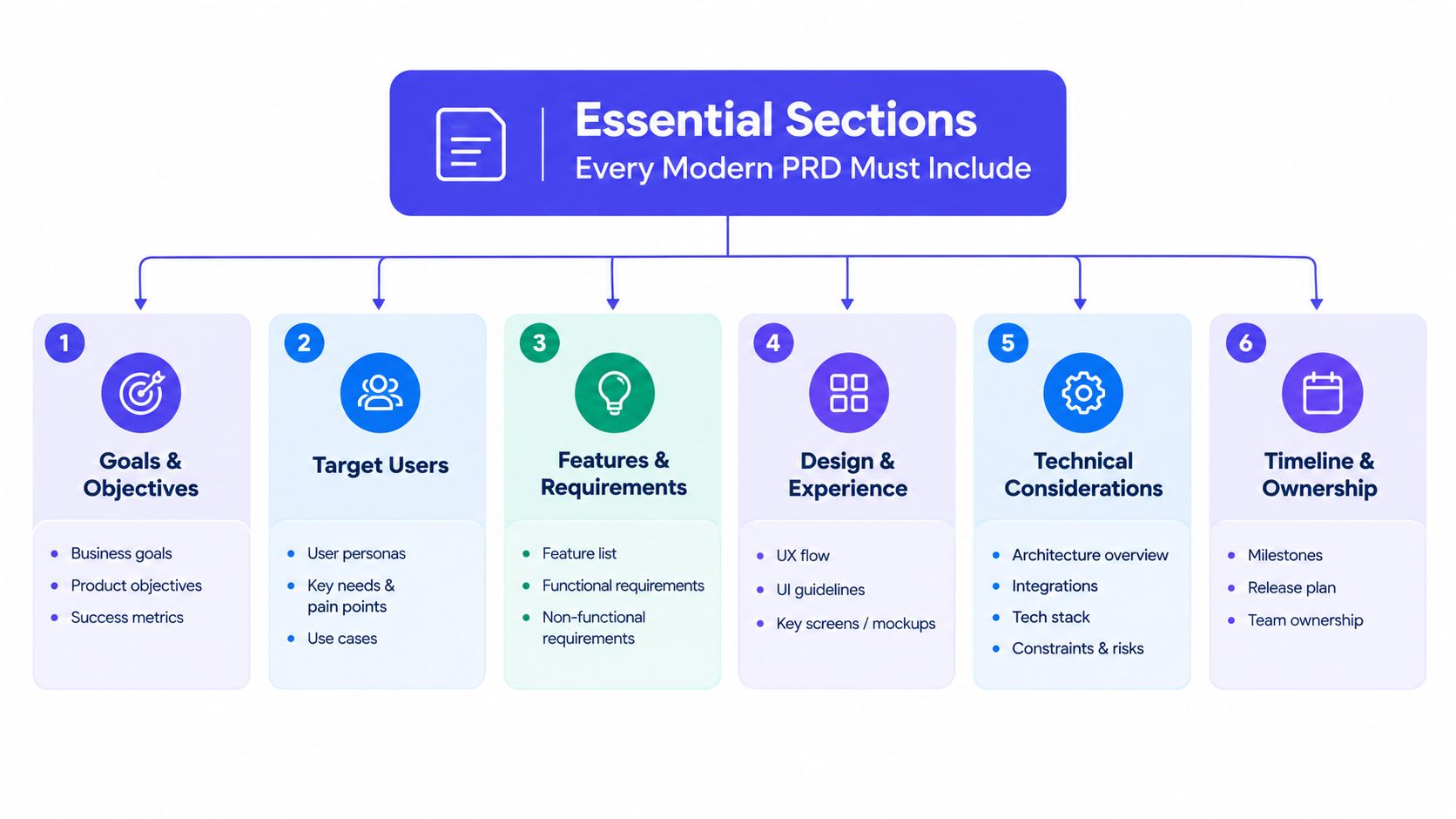
A modern PRD doesn't need every possible field from a template. It needs enough structure to connect intent to action. The core pattern is straightforward: context explains why, scenarios explain what, and milestones explain when.
Start with a concise problem statement. Name the user, the situation, and the consequence of leaving the problem unsolved. Avoid writing “users struggle with onboarding.” Write the observable condition instead: a new account owner can't complete the setup flow without asking support where to find the required configuration.
Build the document around decisions
Use the following anatomy as a practical minimum:
- Context and desired outcome. Explain the business need, the target user, the relevant evidence, and the outcome the team wants to create. Include assumptions that could invalidate the plan.
- Usage scenarios. Describe the important user situations in plain language. A scenario should show the trigger, the user's goal, the expected product behavior, and the result.
- Functional requirements. State what the product must allow or prevent. Keep each requirement testable, and separate must-have behavior from attractive additions.
- Non-functional requirements. Record constraints around security, reliability, accessibility, privacy, and performance when they affect the user or release decision. Don't leave these for an engineering footnote.
- Open questions, risks, and dependencies. Make uncertainty visible. Assign an owner when a question can block progress, and record the decision when it closes.
- Milestones and release criteria. Define the checkpoints that move the work from discovery to design, implementation, validation, and release. Specify what must be true at each checkpoint.
The product requirement document template guide can help teams create a starting structure, but a template should never dictate detail for its own sake.
Use milestones as coordination points
Milestones shouldn't pretend to predict every task. They should tell the team when a risk must be resolved. For example, an early checkpoint might confirm that the target workflow is understandable. A later checkpoint might confirm that the chosen data source supports the required behavior. The release checkpoint might require acceptance criteria, monitoring, support preparation, and a decision on rollout.
This is why milestones have historical importance in PRD practice. A commonly used PRD template organizes work around context, usage scenarios, and milestones, with milestones making timelines and delivery phases explicit. That structure turns the document into a bridge between product strategy and implementation.
A feature list tells the team what someone wants. A modern PRD tells the team why it matters, how a user will experience it, what constraints apply, and which evidence earns the next commitment.
Writing Requirements from the User Perspective
The sequence of drafting matters more than the sophistication of the template. Start with the business need, document expected user behavior, and only then translate the result into process flows or design work.
That sequence comes from a methodology described by the Project Management Institute. PMI's approach defines and analyzes the business need first, uses expected-user interviews to document the PRD, and prepares flow charts for design and development afterward. The ordering protects the team from selecting a solution before it understands the job the product must perform.
Step one starts with the need
Write the business need in language that a customer, founder, designer, and engineer can all understand. Include the user affected, the current behavior, the consequence, and the outcome worth pursuing.
Then distinguish facts from assumptions. “Customers abandon the setup process” is a claim that needs evidence. “We believe an unclear permissions step contributes to abandonment” is a hypothesis. The difference matters because hypotheses deserve validation, not automatic implementation.
Step two describes behavior, not screens
Interview users, review support conversations, inspect product analytics, and examine the workflow directly. Then write scenarios from the user's perspective.
A strong scenario answers four questions:
- Trigger: What situation causes the user to start?
- Goal: What are they trying to accomplish?
- Behavior: What should the product let them do?
- Result: How will the user know the task succeeded?
For example, “As an account administrator, I want to invite a teammate with the correct role so that the teammate can begin work without requesting access again” is more useful than “Build an invite modal.” The first expresses an outcome and leaves room for design and engineering judgment. The second jumps straight to an interface decision.
Step three turns behavior into testable requirements
After the scenarios are clear, define acceptance criteria. Write observable conditions such as:
- The administrator can select a role before sending the invitation.
- The recipient sees the organization and assigned role in the invitation.
- The system prevents an unauthorized user from assigning an administrative role.
- A failed invitation gives the sender a recoverable error state.
The requirements describe external behavior and services, not internal architecture. Don't prescribe a database schema or service boundary unless that constraint is part of the product need. Engineers should be free to choose an implementation that satisfies the behavior, security, reliability, and operational requirements.
A good PRD narrows the outcome without prematurely narrowing the solution.
Keep scope lean by labeling exclusions. “The first release supports invited users only” is stronger than leaving self-serve signup ambiguous without saying so. Also record non-functional needs early. Performance, security, reliability, and accessibility can change the design, so postponing them creates false confidence.
Collaboration Workflows That Replace Post-Meeting Write-Ups
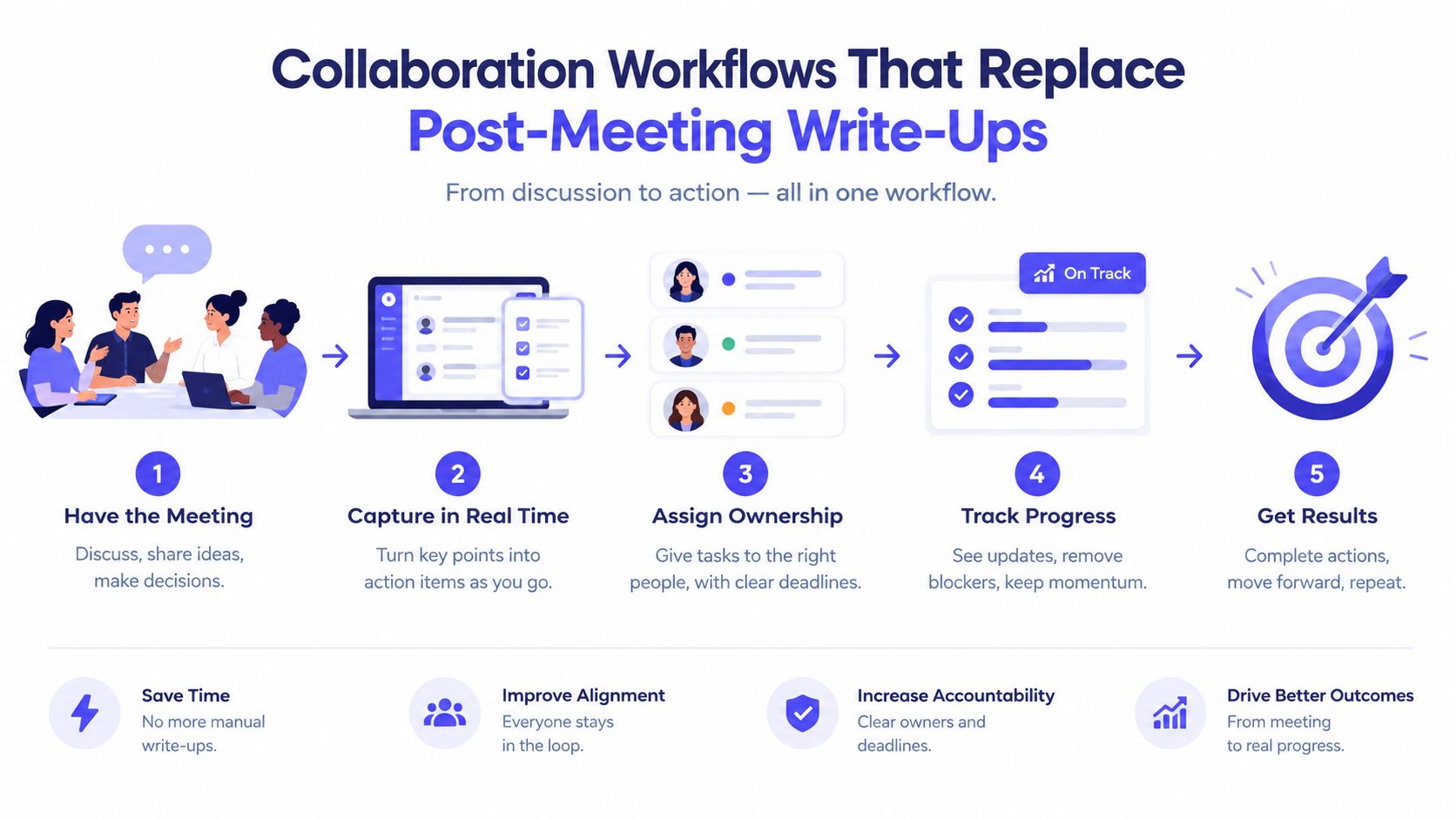
The traditional workflow is familiar: hold a meeting, take notes, promise to write the PRD, circulate a draft, gather corrections, and discover that the most important decision happened in a side conversation. Small teams can avoid that delay by making the working session itself part of the requirements process.
A multiplayer PRD starts with a shared conversation. The founder states the business concern, the designer tests the user flow, the engineer identifies constraints, and someone captures decisions as they happen. The document becomes a live surface for agreement rather than a polished summary written by one person after the fact.
Make the conversation traceable
A practical workflow has five movements:
- Frame the problem: Put the user, business need, and known evidence on the shared page before discussion expands.
- Explore alternatives: Capture competing interpretations and solutions, not just the final answer.
- Record decisions: Mark what the team decided, who owns follow-up, and which assumption made the decision reasonable.
- Draft executable context: Turn agreed behavior into Markdown requirements, scenarios, acceptance criteria, and open questions.
- Connect the output: Make the resulting plan available to design tools, issue trackers, repositories, and AI coding agents.
The key is traceability. A requirement should lead back to the conversation, research note, support pattern, analytics view, or decision that justified it. When an engineer challenges the scope, the team can inspect the underlying reasoning instead of restarting the meeting from memory.
This is the premise behind conversation-driven development, where team discussion becomes structured context for planning and implementation rather than disposable meeting content.
Ground claims in evidence
A data-grounded PRD doesn't need to turn every paragraph into an analytics report. It does need to replace vague assertions with specific evidence.
For each major claim, record the source type and what it demonstrates:
- Analytics: Shows where users stop, repeat an action, or fail to complete a workflow.
- User research: Explains the user's goal, language, workaround, or unmet need.
- Support patterns: Reveals recurring confusion, failure modes, and operational cost.
- Sales or customer conversations: Identifies buying objections and high-value use cases.
- Technical observation: Establishes a constraint, dependency, or reliability concern.
Separate evidence from interpretation. “Support tickets describe repeated confusion about role assignment” is evidence. “A redesigned role selector will solve the problem” is an interpretation. The PRD should preserve both, while making it clear which one still needs validation.
Tools that draft Markdown from live conversations can help, but they don't remove product judgment. An AI coding agent can use the PRD as context for implementation, test generation, and code review only when the requirements distinguish decisions from speculation. The team still owns scope, acceptance criteria, and the decision to ship.
A Seed-Stage Startup PRD Example in Action
Consider a small startup building a shared workspace for customer-facing teams. Users can invite colleagues, but the current invitation flow gives every new teammate the same default access. Administrators then spend time correcting permissions, and invited users sometimes reach a workspace without the access needed for their first task.

The team doesn't begin with a technical design. It writes a compact PRD that gives the problem enough shape for product, design, and engineering to work together.
The working PRD
Context: Workspace administrators need to invite teammates with an appropriate role. The current flow applies a default role, which creates correction work and can delay a new teammate's first task.
Target user: Workspace administrators inviting colleagues to an existing workspace.
Desired outcome: Administrators can select the intended role during invitation, and recipients understand the access they will receive before accepting.
Evidence: Support conversations and observed setup workflows indicate that role assignment is unclear during invitation. The team will validate the hypothesis with administrator interviews and product analytics before expanding the feature.
In scope: Role selection during invitation, role visibility in the invitation, permission validation, and recoverable error handling.
Out of scope: Redesigning the broader permissions model, changing existing roles, or adding automatic role recommendations.
Acceptance criteria: An authorized administrator can choose from the roles available to that workspace. The invitation displays the selected role. A user without permission to manage invitations can't assign roles. If the invitation fails, the sender can correct the issue or retry without losing the rest of the form.
Non-functional requirements: The flow must protect workspace access boundaries, provide a usable error state, and preserve the invitation data required for recovery. Engineering should define implementation-specific performance and reliability expectations before release.
Open questions: Which roles are appropriate for the first release? What should happen if a role is removed after an invitation is sent? Can an administrator change the role before the recipient accepts?
Milestones: Confirm the user problem and role vocabulary. Review the proposed interaction. Implement the narrowest complete flow. Validate permissions and error paths. Review support readiness and release criteria.
This example stays deliberately small. It gives engineers enough behavioral clarity to estimate and design, while avoiding a premature commitment to a particular framework, endpoint structure, or component library.
The team could commit this Markdown file beside the feature code, attach test cases to its acceptance criteria, and give an AI coding agent the document as bounded context. The agent may help draft implementation or tests, but the PRD must state what “done” means and which edge cases deserve attention.
An implementation session should then expose the assumptions. Perhaps the existing permission service can't distinguish pending invitations from active members. That discovery changes the open questions and possibly the milestone sequence. Updating the PRD at that moment is faster than allowing the engineer to build around an undocumented constraint.
Here is the kind of working loop that keeps the example honest:
- Product: Confirms the administrator's goal and release boundary.
- Design: Tests whether role language is understandable before invitation submission.
- Engineering: Identifies permission and invitation-state constraints.
- Support: Supplies recurring confusion patterns and drafts user-facing guidance.
- Team: Records decisions, unresolved questions, and acceptance updates in the same artifact.
The team doesn't need a perfect specification to start. It needs a shared boundary around the problem and a reliable way to update that boundary when implementation teaches it something new.
The strongest seed-stage PRDs are useful in the repository, during design critique, in code review, and after release. If a requirement can't survive those contexts, it probably describes a meeting outcome rather than a product decision.
Evolving the Document as Customer Signals Change
A PRD becomes dangerous when the team trusts it after it stops being true. The document may still look complete, but customer feedback, production edge cases, and technical discoveries have moved the product somewhere else.
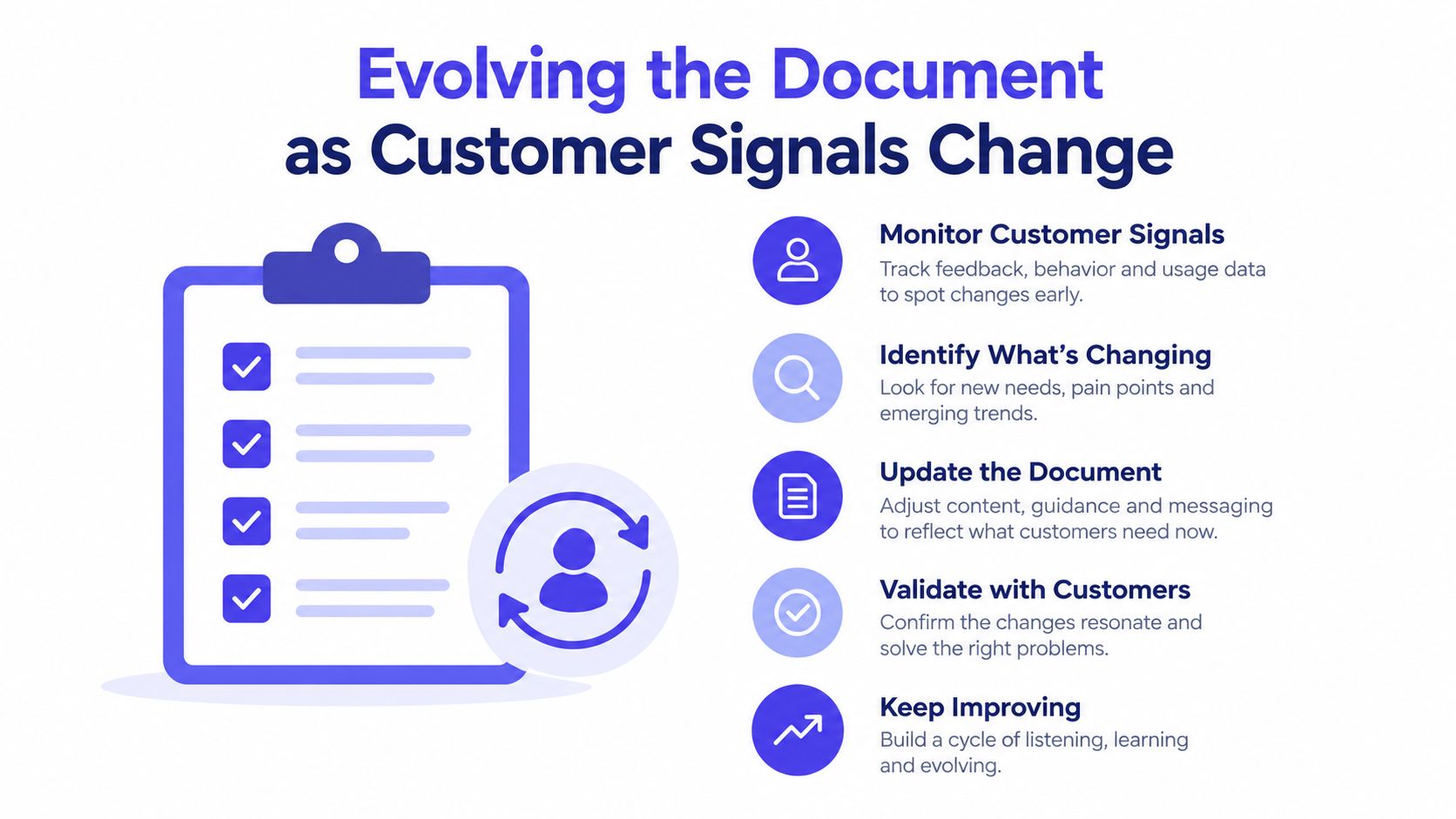
Treat updates as part of delivery, not as administrative cleanup. When a support issue exposes a missing requirement, add the scenario and link the decision to the evidence. When an engineer discovers a constraint, update the dependency or non-functional requirement. When customer research invalidates an assumption, mark the assumption as changed rather than deleting the original reasoning.
Keep the document operational
A lightweight maintenance loop works well:
- Capture signals: Bring support patterns, research notes, analytics observations, and production incidents into the product discussion.
- Map signals to requirements: Identify the scenario, assumption, or acceptance criterion affected.
- Record the decision: State whether the team will change scope, defer the issue, or reject the request.
- Preserve traceability: Keep the evidence and decision together so future teammates can reconstruct the reasoning.
- Review release truth: Confirm that the PRD still matches the shipped behavior, known limitations, and follow-up work.
Don't allow open questions to become a forgotten appendix. Give each question an owner, a condition that will bring it back, and a status. A question about invitation roles might remain open until user interviews finish. A question about permission boundaries might need resolution before implementation. Those are different kinds of uncertainty and should receive different attention.
Non-functional requirements deserve the same discipline. Security, reliability, accessibility, and performance failures often appear after a feature seems functionally complete. If the team records them only in an engineering ticket, product intent and technical execution can drift apart.
A living product requirements document also improves AI-assisted development. Coding agents produce more useful work when they can see current decisions, explicit exclusions, acceptance criteria, and unresolved questions. The PRD becomes a boundary for generation, review, and testing, while the conversation and decision history explain why that boundary exists.
The right measure of a PRD isn't its length or polish. It's whether the team can use it to make the next decision without reopening settled questions, while still noticing when new evidence requires a change.
SpecStory, Inc. offers a multiplayer AI workspace where live product conversations become traceable Markdown plans, decisions, and code context for product and engineering teams. Visit SpecStory, Inc. to explore a workflow that keeps the PRD connected to collaboration and the first implementation commit.
Newsletter
Get new posts in your inbox
Bring your team together to build better products. Fresh takes on remote collaboration and AI-driven development.