


Most advice about AI Driven Software Development still starts in the wrong place. It treats faster code generation as the win, then acts surprised when teams still miss deadlines because review, integration, and release are slower than the editor.
The better question is simpler, and more uncomfortable. If an agent can write code quickly, what slows the team down next? The answer is usually context capture, decision traceability, and release orchestration, not typing speed.
Table of Contents
- The Reality of AI Driven Software Development
- Core Components of an AI Native Workflow
- Solving the Context and Security Gap
- From Meeting to First Commit
- Building Your AI Tool Stack
- Common Pitfalls in Agentic Adoption
- Next Steps for Small Product Teams
The Reality of AI Driven Software Development
Teams keep buying into the idea that if code gets written faster, shipping automatically follows. The data says otherwise. In a matched event-study of more than 500,000 GitHub developers, autocomplete raised commits by 30%, interactive coding agents by 180%, and autonomous coding agents by 240% cumulatively, yet that same lift dropped to 80% for project counts and only 30% for actual releases, which means code production is outrunning the rest of the delivery system (NBER study).
Speed shifts the bottleneck, it doesn't remove it
That pattern matches what small teams feel in practice. AI can draft implementation work quickly, but the work still has to be merged, validated, and released by humans who understand the consequences. When the code arrives faster than the team can assess it, the bottleneck moves downstream into integration, QA, and release coordination.
Practical rule: measure the time from product decision to first production-safe commit, not just the time it takes to generate a patch.
The evidence on developer sentiment lines up with that shift. In Stack Overflow's 2024 Developer Survey, 76% of respondents said they are using or planning to use AI tools in development, 62% said they are currently using them, and 72% felt favorable or very favorable toward them, yet only 43% felt good about AI accuracy and 31% were skeptical (Stack Overflow 2024 survey). That mix captures the story of AI driven software development, enthusiasm without full trust.
The enterprise pattern is already visible
GitHub's 2024 survey found that more than 97% of enterprise respondents across the U.S., Brazil, India, and Germany had used AI coding tools at work at some point, based on a survey of 2,000 non-student enterprise employees at companies with 1,000+ workers (GitHub research). That doesn't mean every team has solved the operating model. It means the question has moved from whether to adopt to how to govern the flow of work.
The hidden failure mode is straightforward. Teams optimize authoring, then discover that release readiness still depends on shared understanding, test coverage, and clean decision trails. AI doesn't remove those constraints, it just exposes them faster.
Core Components of an AI Native Workflow
A real AI native workflow isn't a single assistant in the editor. It's a chain of artifacts and controls that carry intent from conversation to commit to release. The reasoning layer, usually a model or agent, handles drafting and synthesis. The execution layer runs in the editor, sandbox, or terminal. The governance layer sits in CI/CD and review gates, where it can reject brittle or unsafe changes before they land.
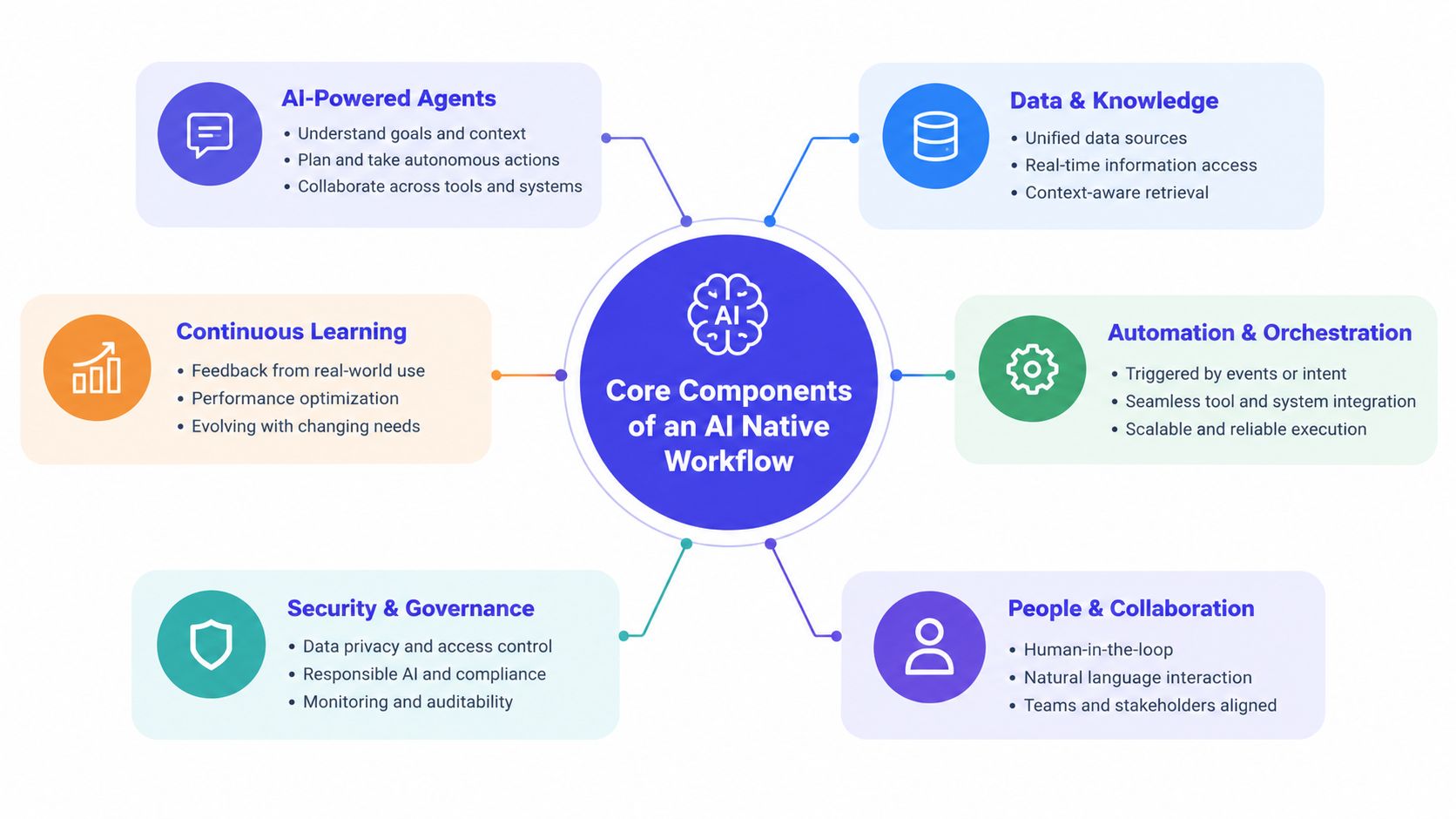
Intent has to survive the handoff
The important move is not “use AI everywhere.” It's to preserve the original decision as it moves across tools. A product discussion should become a written brief, that brief should become a task spec, the spec should become code and tests, and the tests should reflect the original intent. When that chain is broken, the team starts relying on memory, and memory doesn't scale.
Shared workspaces matter because they externalize the rationale before code exists. A live conversation captured as a plain file gives the agent something stable to work from, and it gives engineers something auditable to review later. That's much more useful than a scattered trail of chat messages and half-finished tickets.
If the decision can't be replayed later, it isn't really part of the workflow yet.
The components need distinct jobs
LLMs are good at synthesis and transformation. Agents are good at taking bounded actions. CI/CD is good at enforcing rules. Shared workspaces are good at keeping the human layer visible. When those jobs blur together, teams lose traceability and start debugging the process instead of the product.
For a useful reference on the context layer, see context engineering for AI agents. It's a good fit for teams that want their prompts, decisions, and artifacts to behave like durable project assets instead of disposable chat history.
The strongest AI workflows I've seen are not magical. They're boring in the right way. The same inputs produce traceable outputs, and every step leaves behind a file, a diff, or a decision log that the next person can inspect.
Solving the Context and Security Gap
The biggest problem in AI driven software development is not raw capability. It's missing context. In a survey focused on refactoring, testing, and review, 65% of developers said the assistant misses relevant context, and 76% said they still don't fully trust generated code (Qodo survey coverage). That lines up with what many teams feel on the ground, AI can write the thing, but it doesn't always understand the thing.
Treat generated code like a higher-risk input
A controlled study of 120 professional developers across Python, Java, JavaScript, and C++ found that AI-assisted code generation cut task time from 56.1 minutes to 38.4 minutes, a 31.4% productivity improvement, but also introduced 23.7% more security vulnerabilities (study PDF). That is the trade-off teams have to design for. Faster implementation is useful only if review, static analysis, and adversarial testing become stronger, not weaker.
The right response is not to ban AI-generated code. It's to change the gate. Every generated change should pass through the same review standards as any other risky input, with extra attention on secrets, injection paths, dependency use, and failure handling. If the code came from an agent, assume the reasoning was incomplete until proven otherwise.
Missing context creates review drag
There's a second cost that's easier to miss. When the assistant doesn't know the architectural constraints, the reviewer has to reconstruct them manually. That's where teams start burning time on interpretation instead of evaluation. The article conversation-driven development is useful here because it treats decisions as first-class artifacts, not private memory.
A practical workflow is simple:
- Capture the decision early: write down the constraint, the goal, and the non-goals while the meeting is still fresh.
- Store rationale with the code: keep the why alongside the implementation, not in a separate chat thread.
- Use automated checks first: let linting, tests, and security scans remove obvious failures before human review.
- Force unresolved questions to resurface: don't bury open items in chat, attach them to the task or spec.
That's also why traceability matters more than prompt cleverness. The team doesn't just need an answer. It needs to know which decision produced that answer, and whether that decision still holds.
From Meeting to First Commit
Small teams don't need a grand transformation to get value from AI. They need a cleaner bridge from agreement to implementation. The fastest path is to stop treating the meeting as a temporary event and start treating it as the source of executable context.
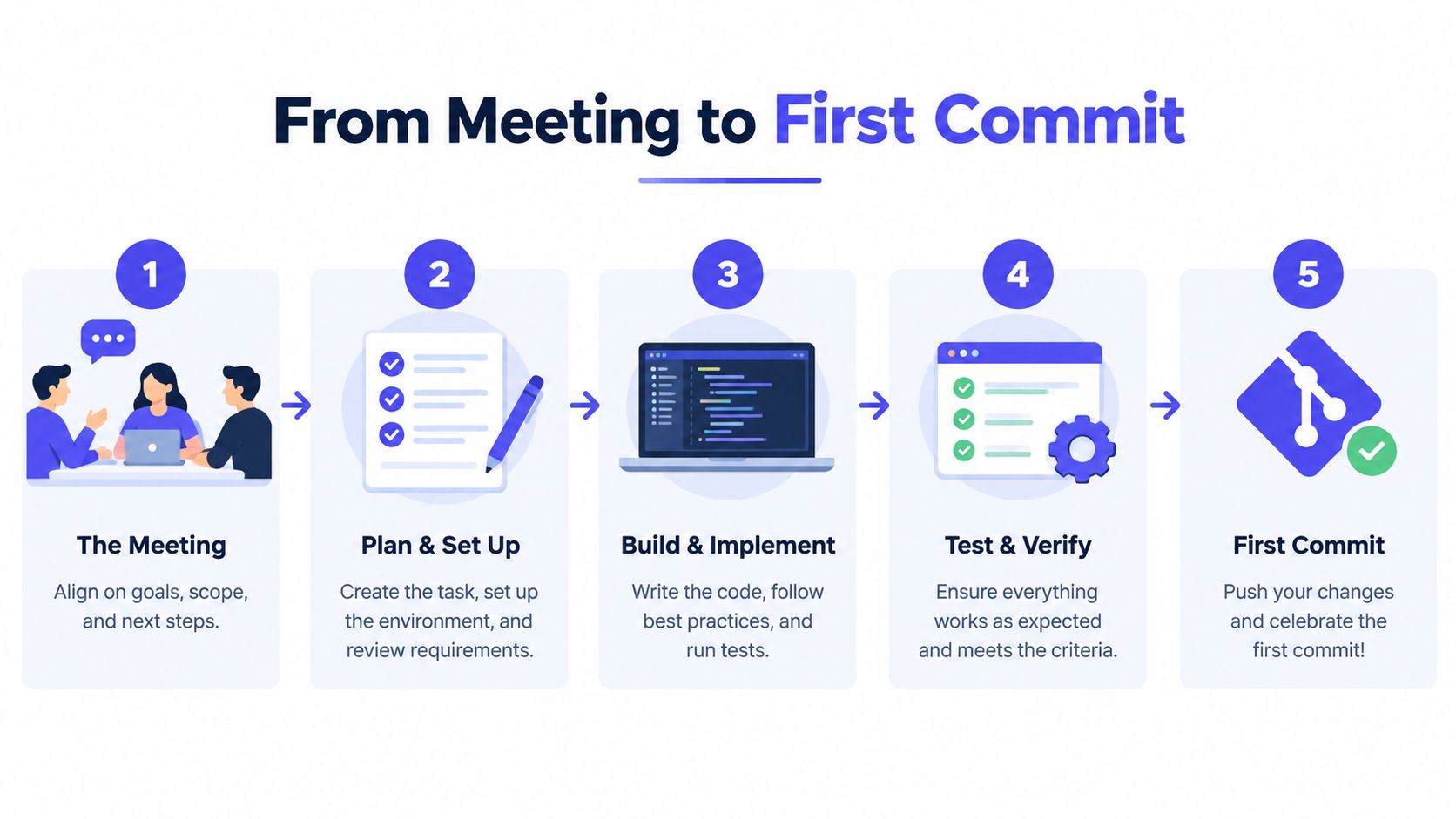
Step 1. Capture the live decision
Hold the product discussion in a shared room where intent, constraints, and open questions are visible as they're discussed. Don't wait for a retrospective summary. The goal is to keep the actual reasoning attached to the feature before anyone starts coding.
Step 2. Convert the discussion into a written plan
Turn the live discussion into a markdown PRD or task spec immediately. That file should include the objective, scope, edge cases, and unresolved questions. If a question can't be answered yet, mark it clearly so it comes back at the right time instead of disappearing into chat noise.
Step 3. Let the agent draft the first implementation
Ask the agent to work from the shared artifact, not from a vague prompt. The better the written context, the less time engineers spend translating intent into code. A small team gets efficiency, because the first pass no longer depends on someone reconstructing the meeting from memory.
Step 4. Sync the artifacts into local tools
The cleanest setup is one where decisions, transcripts, and outputs are stored as plain files and can sync into the team's preferred editor or design tool. That keeps the context portable, reduces vendor lock-in, and lets engineers work where they're already productive. For teams looking at agent-driven implementation patterns, AI agent for coding is a useful companion read.
Step 5. Share feedback from the actual environment
Give the team a way to inspect the feature on localhost, not just in screenshots or comments. When product, design, and engineering can test the same running build, the feedback loop stays short and specific. That's what collapses the gap between “we agreed” and “we shipped.”
One tool in this category is SpecStory, Inc., which turns live conversations into executable context and keeps artifacts traceable back to the source discussion. That matters most when the team wants the code to reflect the decision, not just the prompt.
Building Your AI Tool Stack
A useful stack for AI driven software development isn't a pile of disconnected tools. It needs a place to capture intent, a place to generate code, and a place to govern what ships. Teams that buy only an editor plugin usually end up with fast drafting and weak memory.
Compare tool categories by what they preserve
| Tool Category | Primary Function | Context Handling |
|---|---|---|
| AI code editor | Drafts and edits code inside the IDE | Good for local session context, weak for team-wide memory |
| Agent workspace | Captures meetings, decisions, and task intent | Strong for durable context and traceability |
| CI/CD and review gates | Tests, scans, and approves changes | Strong for enforcing quality, not for capturing intent |
| Terminal agent tools | Automate bounded engineering tasks | Good for execution, depends on upstream context quality |
The choice is not editor A versus editor B. It's whether the workflow preserves enough context for the next person to trust the output. If a tool can't retain decisions, rationale, and unresolved questions, it should stay in the execution layer, not become the source of truth.
Pick for traceability, not novelty
For product teams, three criteria matter more than flashy demos. First, the system should keep decisions as plain files or similarly portable artifacts. Second, it should preserve the chain from discussion to implementation. Third, it should fit into the existing engineering pipeline without forcing the whole team into a new operating system.
If you want a broader market view of coding-oriented tools, the roundup of AI tools for coding and APIs is a good way to compare categories without treating one editor as the answer to everything. The important thing is to separate capture, execution, and governance so each layer can do its job.
The strongest stacks are boring in the best sense. They don't rely on memory, and they don't make one tool carry all the weight.
Common Pitfalls in Agentic Adoption
A small product team I worked with made the classic mistake. They let agents touch implementation work, then expected deployment and monitoring to sort themselves out. The team moved faster for a week, then spent the next two weeks untangling inconsistent patterns, unclear ownership, and half-documented changes. That's what happens when the workflow changes faster than the governance.
The trap is measuring output instead of flow
Enterprise data already hints at the ceiling. Google's DORA reporting says only about 10% of functions are scaling agentic AI in any given business area, and developers still resist using AI for high-responsibility work like deployment, monitoring, and project planning (DORA report 2025). That's not a sign that the tools are useless. It's a sign that the operating model still needs work.
Teams also over-focus on code volume because it's easy to see. A bigger diff feels productive, but it can hide slow review cycles, weak merge confidence, and bad release timing. The better metric is whether the team can move intent into production with less confusion.
Governance has to move upstream
A better pattern is to make review and release-readiness part of the workflow, not an afterthought. Tools like how prevents errors are useful reading for teams that want to understand how guardrails fit into generated code workflows without pretending the model is the safety layer.
Practical rule: if the team can't explain why a generated change exists, it's not ready to merge.
The fix is usually organizational, not technical. Make one person own the intent, one person own the implementation, and the pipeline own the quality gates. When those roles blur, the agent ends up filling in gaps it can't verify.
Next Steps for Small Product Teams
Small teams should start with one narrow feature, one planning meeting, and one shared artifact. Avoid rewriting the entire engineering workflow at once. Measure the time from a product decision to the first implementation commit, then use that interval as a baseline for the next few cycles. Track where work stalls: missing context, unresolved decisions, review queues, or release coordination.
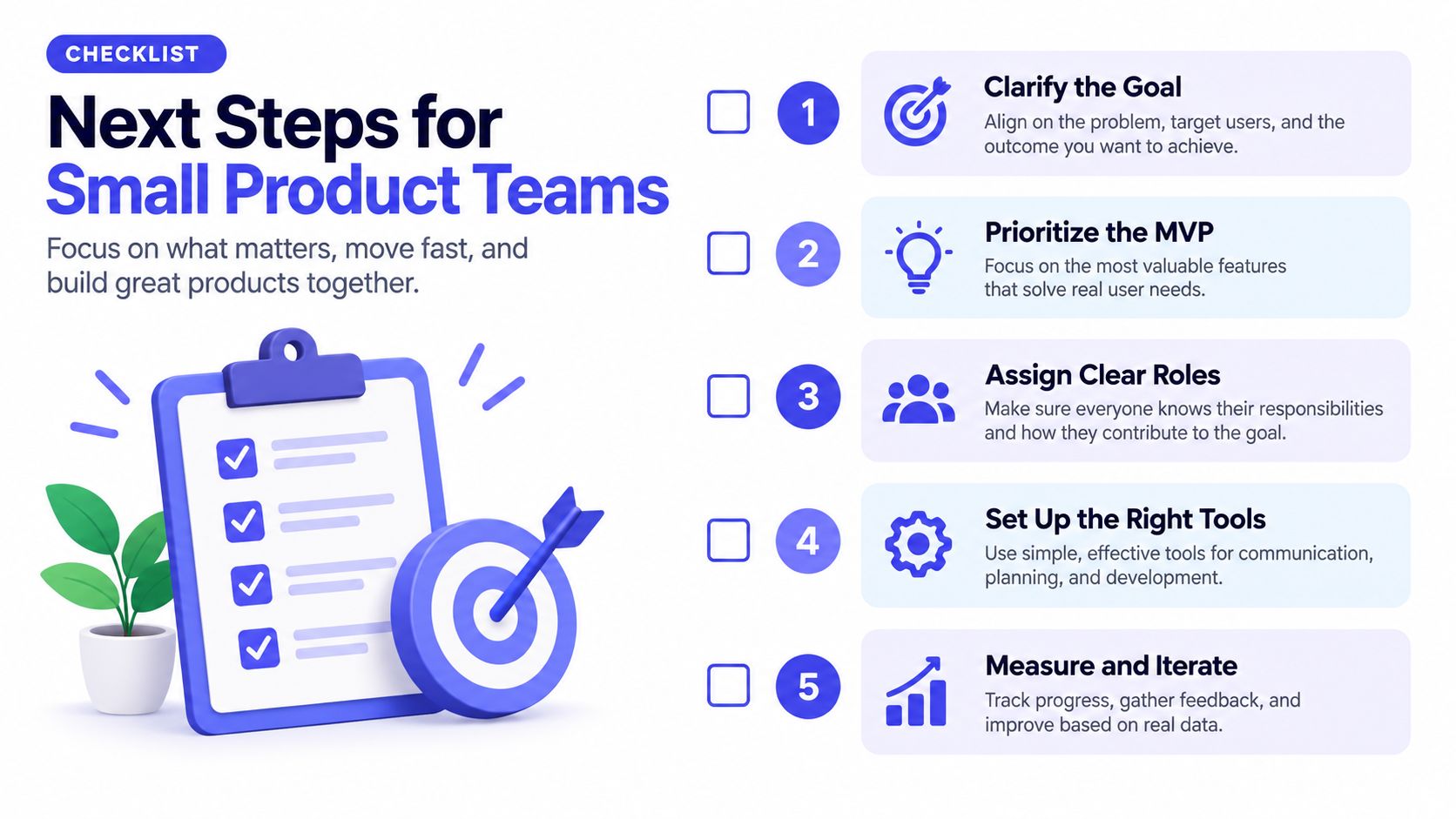
Start with a narrow experiment
Run one AI-assisted planning session, save the transcript as a file, and sync it with the editor the team already uses. Let the agent produce a first implementation pass. Review that output against the written decision, acceptance criteria, and release plan, rather than judging only the shape of the code. Vague output usually points to incomplete context capture or an unresolved product choice.
Give the experiment a clear owner and a defined release path. One person should maintain the decision record, another should review the implementation, and the pipeline should enforce tests and other quality gates. That separation makes failures easier to diagnose.
Keep the experiment cheap and reversible
Use portable artifacts and avoid a heavy rollout or seat-based commitment. A team can test the workflow for a few hours each week, then assess whether it shortens the path from discussion to production. Keep the process easy to stop or change.
SpecStory, Inc. helps product teams connect live conversations, transcripts, decisions, and code artifacts so an AI agent receives implementation context instead of isolated notes.
Newsletter
Get new posts in your inbox
Bring your team together to build better products. Fresh takes on remote collaboration and AI-driven development.