


In a 2024 survey of 5,000 knowledge workers and 100 Fortune 500 executives by Atlassian, 55% of knowledge workers said they found it difficult to track down information even though they knew plenty of people at their company. Small product teams assume size protects them from that problem. Everyone sits in the same Slack workspace, joins the same Monday standup, and ships into the same handful of repositories.
Then a Friday architecture decision evaporates over the weekend. By Monday morning, an engineer is building against the rejected option, a designer is updating the wrong flow, and a product manager is hunting through three threads to reconstruct why the team changed direction. Knowing your teammates doesn't mean you can find what they decided.
Most guides treat team knowledge management as a wiki project: pick a workspace, write longer docs, and hope people search them. That fails on fast-moving product teams because documentation work always loses to shipping work. A system that holds captures decisions at the moment of work through a runnable three-phase loop, and judges itself by reuse inside PRDs, pull requests, and onboarding answers instead of page counts.
Table of Contents
- What Team Knowledge Management Actually Covers
- How to Capture, Curate and Connect Knowledge
- Why It Pays Off for Seed-Stage and Developer-First Teams
- Patterns and Anti-Patterns That Decide Whether It Holds
- Migration and Onboarding Checklists
- KPIs That Prove It Is Working
- Troubleshooting When the Loop Breaks
- Wire It Into Your Tools and Start This Week
What Team Knowledge Management Actually Covers
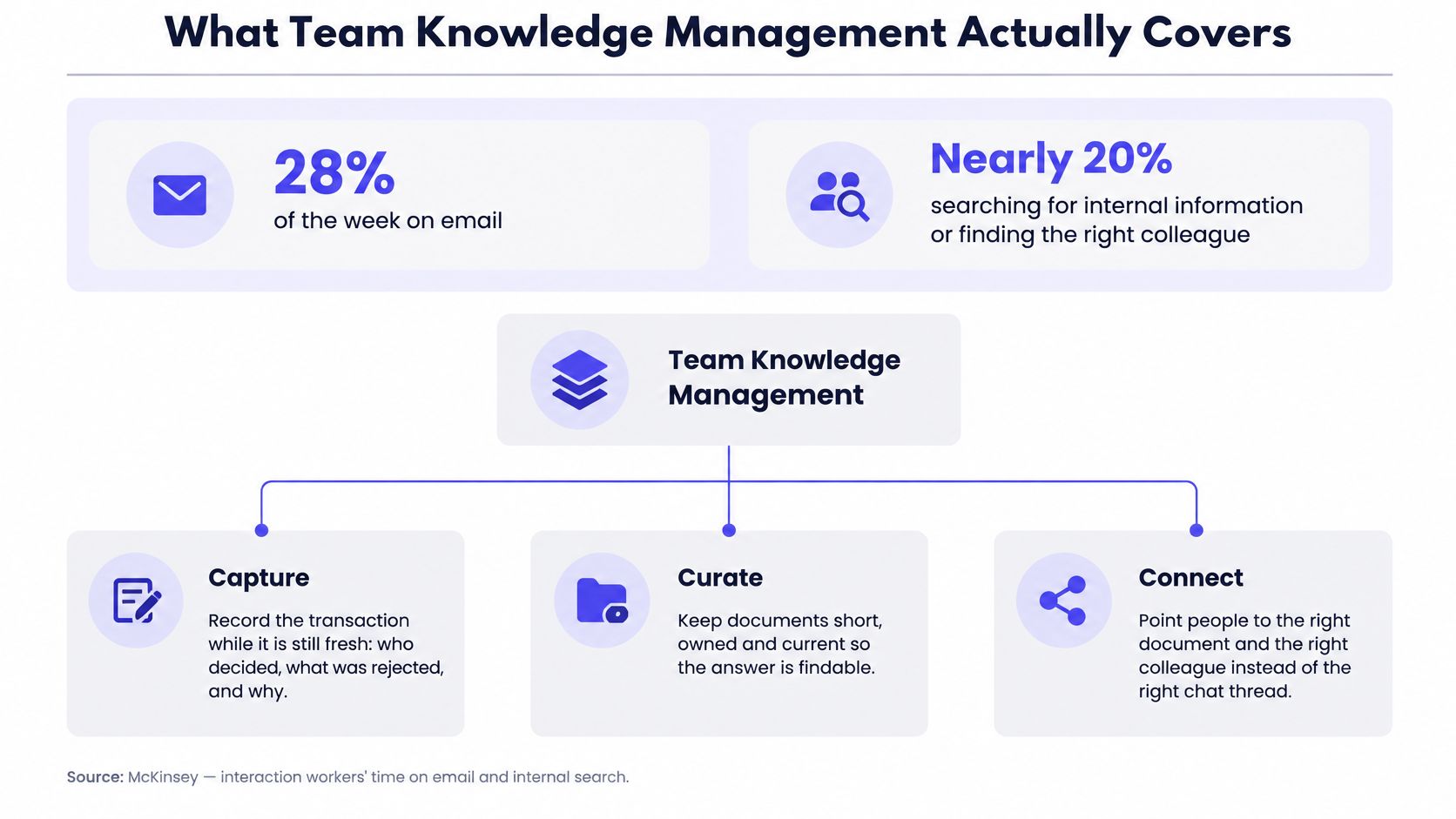
Team knowledge management is the deliberate set of habits and systems that let a team capture what it learns, keep it findable, and reuse it without tracking down the person who was in the room. Think of chat channels and video calls as a team's short-term memory that resets every Monday, while your knowledge system is the long-term memory that survives personnel changes, pivots, and sprint handoffs.
A team's knowledge system only pays off when it connects stored artifacts to real ownership and day-to-day execution. In a field study of 139 ongoing teams comprising 743 employees across two major South Korean firms, published in the ACM Digital Library, IT support strengthened teams' transactive memory systems (TMS), meaning shared awareness of who knows what. Both TMS and IT support improved knowledge sharing and application, and knowledge sharing lifted team performance only indirectly through knowledge application rather than directly. Saving a meeting transcript does nothing by itself; knowing who owns a service and linking their rationale into the next spec or code review is what moves delivery.
The diagram below outlines the core scope of capture, curation, and connection alongside the coordination drag that makes these habits necessary.
The Five Layers of Team Knowledge
Every small product team generates five distinct kinds of knowledge, plus a noisy sixth category that shouldn't be stored at all. Each layer has its own natural owner, home, and shelf life.
| Layer | What belongs here | Typical owner | Where it lives | Decay speed |
|---|---|---|---|---|
| Decisions and rationale | Chosen option, alternatives rejected, trade-offs, dissent, open questions | Tech lead or PM | PRD, decision record or spec linked to the issue | Slow, but must be linked to the artifact it shaped |
| Durable process docs | Onboarding steps, deploy runbook, code review rules, environments | Eng lead | Repo README, runbook folder, onboarding doc | Slow; review quarterly |
| Meeting context | Transcripts, action items, unresolved questions, attendees | Meeting facilitator | Workspace or meeting tool, exported to files | Fast; extract decisions within 24 hours |
| Component and domain expertise | Who knows what, architecture notes, service ownership | Named component owners | Ownership map plus short design notes next to code | Medium; update on ownership change |
| External-facing knowledge | Customer objections, support answers, sales notes | PM or support lead | Shared doc linked from CRM or support tool | Fast; monthly refresh |
| Anti-layer: everything else | Random links, unowned notes, duplicate pages | Nobody | Nowhere; archive or delete | Immediate |
Separating these layers prevents the single most common structural mistake on small teams: treating all five as one flat wiki. When fast-decaying meeting notes sit inside the same sidebar as deploy runbooks and architectural rationale, search results fill with stale scraps and engineers stop trusting the whole workspace.
How to Capture, Curate and Connect Knowledge
Written specifications capture conclusions, but they almost always strip out the reasoning needed when requirements shift six months later. A systematic review of software-engineering knowledge-management research in Information and Software Technology analyzed 29 empirical investigations and 39 lessons-learned reports and found a consistent requirement: effective systems have to capture tacit knowledge, including trade-offs, assumptions, design intuition, and unresolved risks, not just finalized explicit documents.
You can't recover tacit context retroactively during a quarterly cleanup sprint. The workflow below breaks knowledge management into a tight three-phase loop you can run this week, with clear triggers, owners, and time caps.
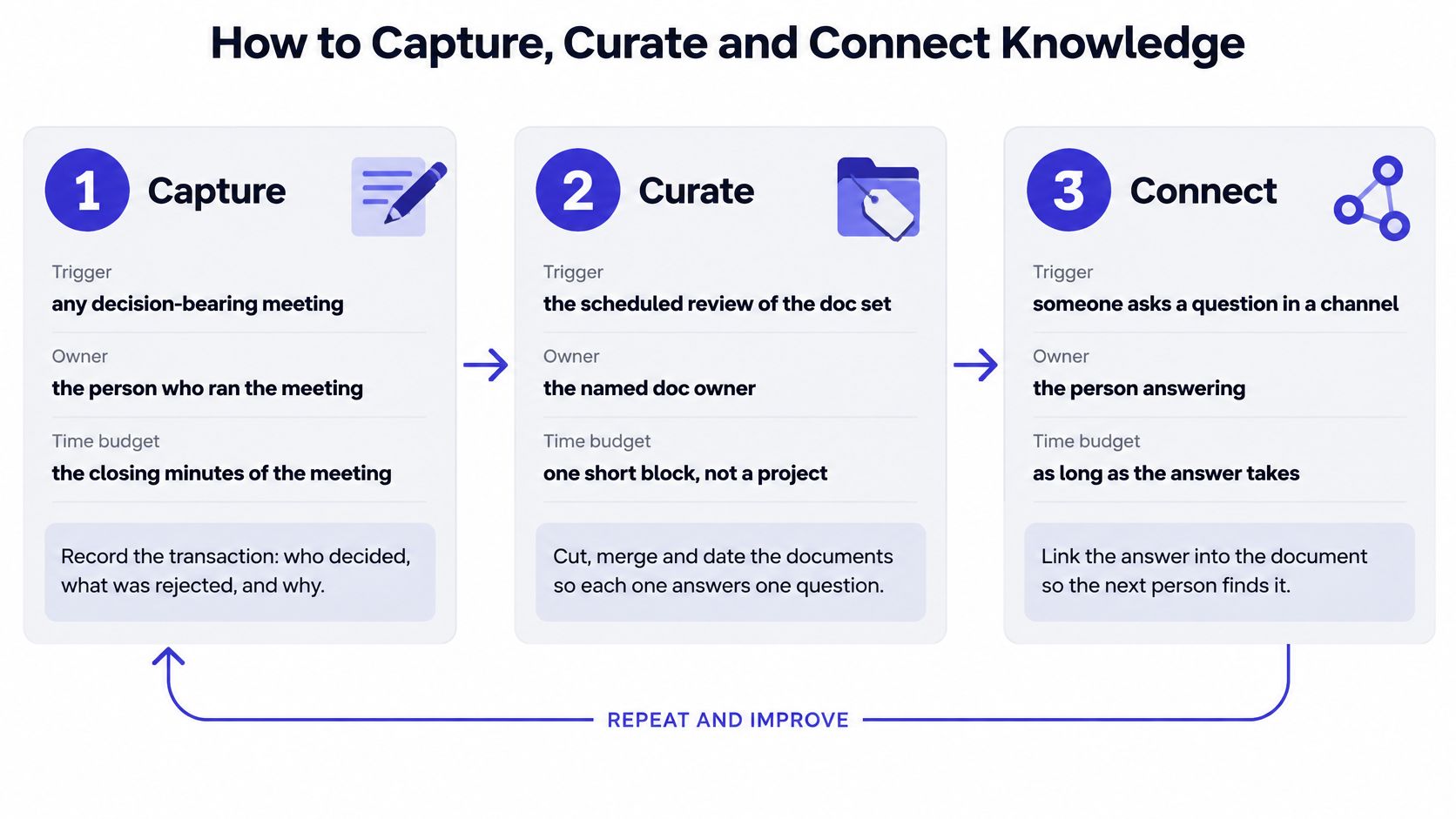
Running the Three-Phase Loop
Treat this loop as part of normal delivery rather than a side chore, and pair it with proven best practices for technical documentation so every record stays brief and scannable.
- Capture during the decision, not after: In any meeting where the team makes a trade-off, the facilitator records the transaction live in the same space the meeting is transcribed: who decided, what options were rejected, and what remains open. Within 24 hours, the note-taker or PM extracts that choice into a short decision record linked directly to the PRD, issue, or design it affects. Before anyone hangs up, every unresolved question gets a named owner and a deadline.
- Curate on a fixed cadence: Assign each layer a concrete review cycle: quarterly for durable process docs, monthly for external and meeting-derived notes, and on-change for component ownership. If a page is older than two quarters and has zero inbound links, archive it instead of polishing it. Every edit ends with a one-minute stamp updating the owner and last-verified date at the top of the file.
- Connect records to working artifacts: A document nobody trips over during real work might as well not exist. Link each durable doc to the exact repository folder, service, or owner it describes, and mirror key decisions into the spec, issue, or first commit message so the context travels alongside the code.
Practical rule: If capturing a decision requires scheduling a second meeting or opening a separate documentation sprint, the loop is too heavy and your team will abandon it by week three.
None of these mechanics survive without two social preconditions: psychological trust and protected time. Teammates won't log rejected options or open risks if dissent looks like insubordination, and engineers won't write crisp summaries if capture competes with sprint commitments instead of occupying the closing five minutes of a call.
The walkthrough video below illustrates how teams turn live discussion and everyday workflows into structured, reusable context without piling on manual write-ups.
Owners and Time Budgets for Every Step
Assign each row below to a real person before your next planning cycle starts. Keeping every step timeboxed turns vague good intentions into a repeatable habit.
| Step | Trigger | Owner | Time budget | Output location |
|---|---|---|---|---|
| Record who decided what, alternatives rejected and open questions | Any meeting where a choice is made | Facilitator or PM | Live, no extra time | Meeting transcript or shared room |
| Extract the decision into a short record linked to PRD, issue or design | Within 24 hours of the meeting | Note-taker or PM | 15 minutes | Decision record linked to the artifact it shaped |
| Log open questions with named owner and deadline | Before the meeting ends | Facilitator | 5 minutes | Open questions list |
| Review durable process docs against cadence | Quarterly | Eng lead | 30 minutes per doc | Repo README or runbook |
| Review external and meeting-derived docs | Monthly | PM or support lead | 20 minutes | Shared doc linked from CRM or support tool |
| Archive docs with no inbound links for two quarters | When a doc has no readers | Knowledge owner | 15 minutes per doc | Archive folder |
| Stamp last-verified date and owner line | On every edit | Editor | 1 minute | Top of the document |
| Link doc to the component, code or owner it describes | On creation and on ownership change | Doc owner | 5 minutes | Cross-link in repo and doc |
| Mirror the decision into spec, issue or commit message | On the first commit after the decision | Implementing engineer | 5 minutes | Issue, spec or commit message |
Why It Pays Off for Seed-Stage and Developer-First Teams
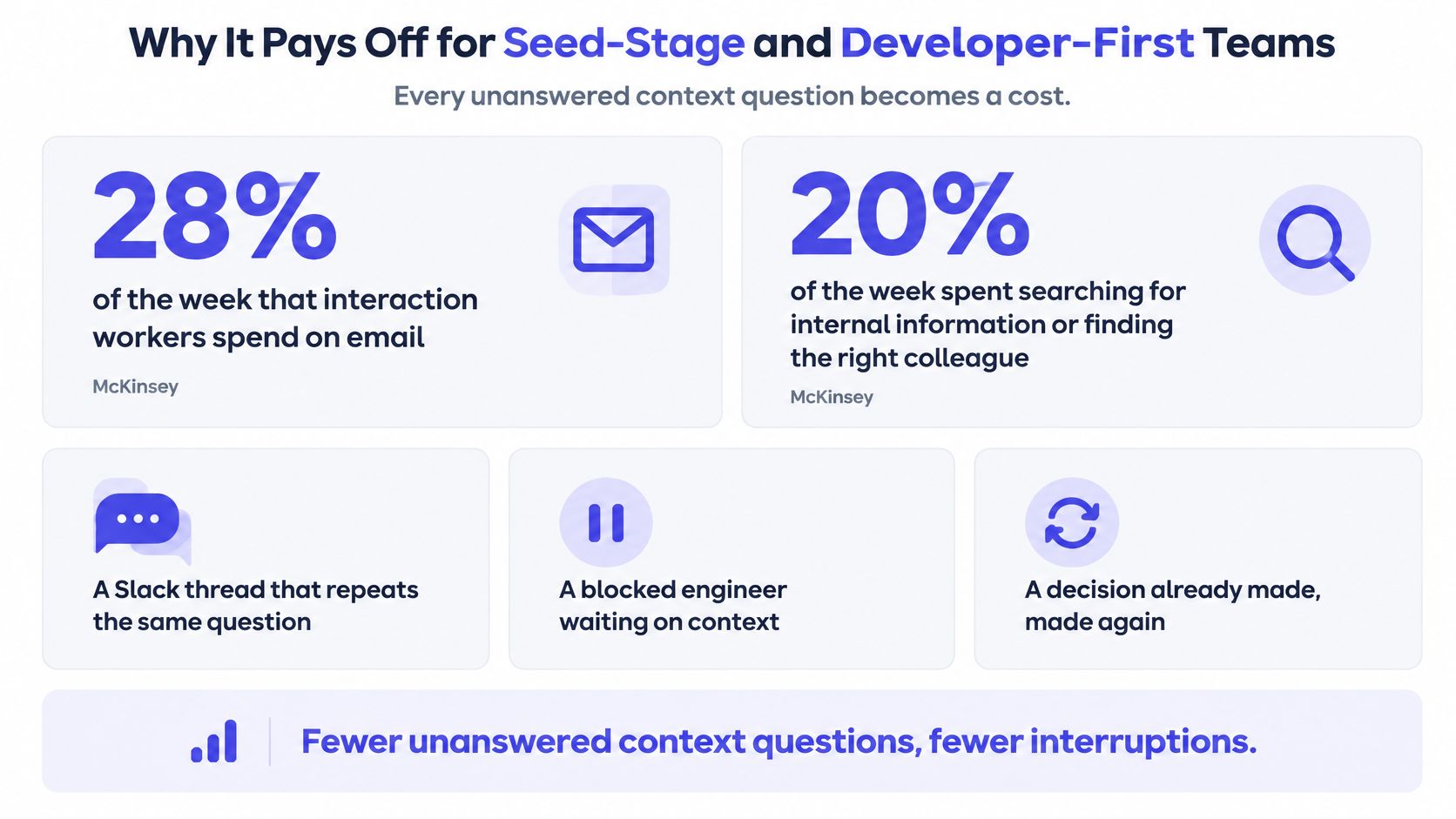
Every missing piece of context shows up on a small team as one of three daily taxes: a Slack thread re-answering an old question, a blocked engineer waiting on a teammate in another time zone, or a team re-debating a call it already settled last quarter.
To see the scale of that drag, look at the McKinsey Global Institute analysis of interaction workers. Although the study dates from 2012, it measured the exact coordination tax distributed product teams still pay: employees spent roughly 28% of the workweek managing email and nearly 20% searching for internal information or locating a colleague who could help. McKinsey estimated that making internal conversations and expertise searchable could cut search time by as much as 35%, with the potential to lift overall knowledge-worker productivity by 20–25% when collaboration tools are rolled out well.
The visual below translates those coordination losses into the concrete interruptions small product teams feel every week.
The Startup Cost Curve and Developer-First Payoff
What makes this urgent for seed-stage companies isn't an enterprise efficiency slide; it's the asymmetry of headcount growth. When a startup has 10 to 30 people, knowledge loss stays mostly invisible because anyone can tap a founder or founding engineer and get an answer in two minutes. As the company grows toward 60 people, that same informal lookup habit mutates into a compounding hiring tax. Senior engineers become human routers, and onboarding slows to a crawl.
Developer-first teams hit this wall in three critical workflows before anyone else notices:
- Code review: Reviewers waste cycles challenging why a service uses an unusual schema or retry boundary because the original trade-off never made it out of a design call.
- Incident response: On-call engineers lose precious minutes hunting for who owns an unfamiliar queue or why a fallback threshold was chosen.
- AI coding agents: Tools like Cursor, Claude Code, and Codex generate far cleaner diffs when constraints, rejected approaches, and architecture decisions live as plain readable files next to the codebase rather than inside private chat threads.
Compare the two sides of the ledger. Capturing a decision transaction takes minutes while the context is still warm in everyone's head; reconstructing that same decision three months later takes hours of archaeology across git blame, stale tickets, and half-remembered calls.
If new hires are still asking the same foundational questions past week four, your team isn't suffering from a talent problem. You've crossed the threshold where capturing context earns back more engineering time than another feature sprint.
Patterns and Anti-Patterns That Decide Whether It Holds
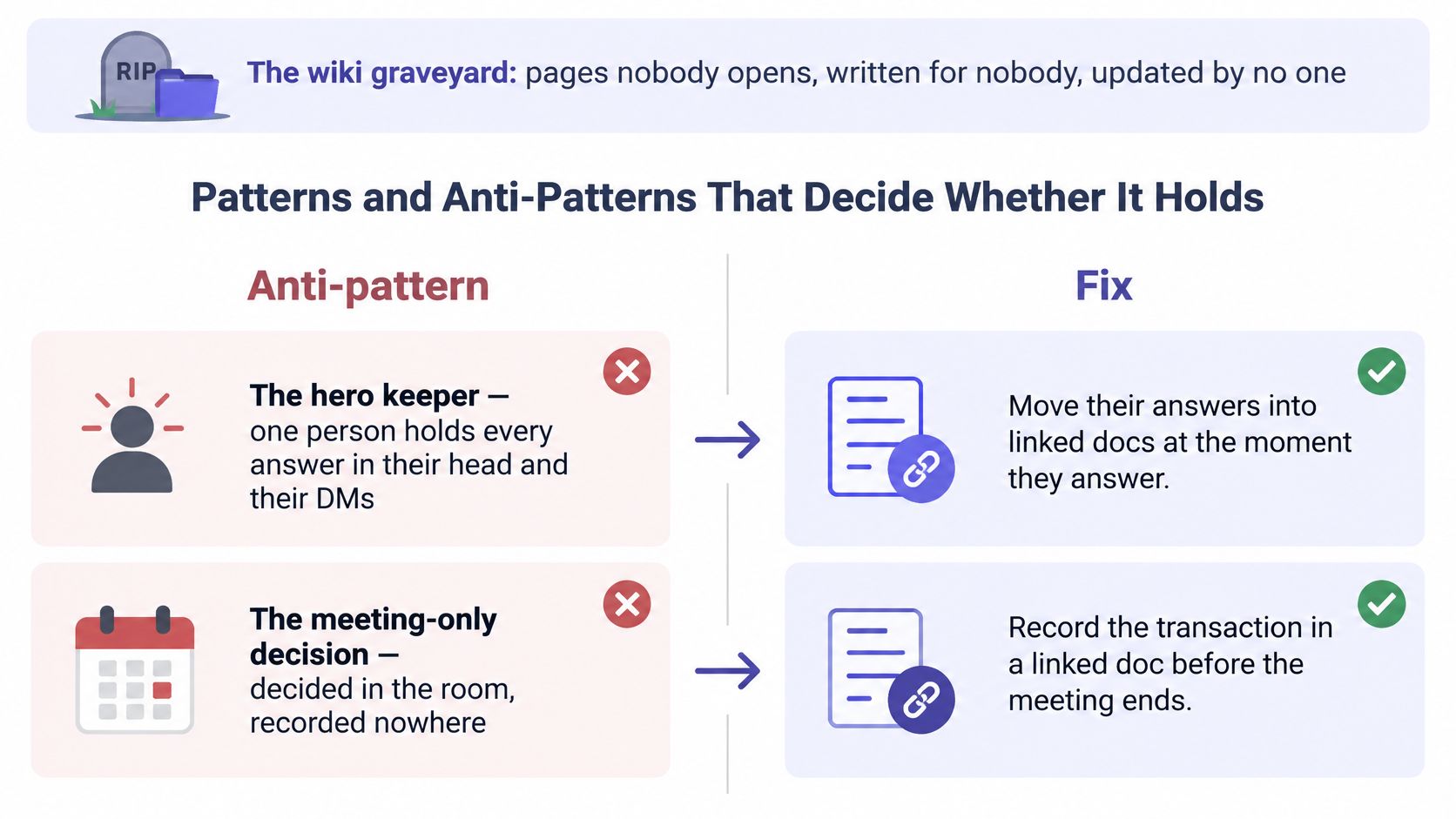
Almost every startup has lived through the wiki graveyard: a tidy tree of pages written during an ambitious Friday afternoon, opened by nobody, and contradicted by production code two sprints later. Teams blame laziness, buy a prettier workspace, and rebuild the exact same graveyard six months later.
The chart below pairs the most common failure patterns with the lightweight operational fixes that stop them from spreading.
Replacing bad habits requires naming them explicitly and changing the default trigger behind each one:
- The hero keeper: One veteran engineer holds the entire billing architecture in their head and answers every DM in seconds. Fix it by moving their answer into a linked doc the moment they give it, then replying in chat with the link instead of a fresh explanation.
- The meeting memo nobody reads: Three pages of chronological prose bury the one thing the team agreed on. Capture only the decision transaction, and use structured meeting layouts that separate inputs from choices. Our Feature Kickoff template, for instance, breaks the session into How to run this meeting, Before the meeting, Meeting Details, Feature Overview, Goals, User Stories, Technical Considerations, Design Constraints, Open Questions, Action Items, and Follow-up so nothing critical hides in freeform notes.
- Duplicate sources of truth: Copy-pasting requirements across Linear, Notion, and Google Docs guarantees drift within a week. Declare the spec or architecture decision record canonical and link outward from every other tool.
- Doc-before-build theatre: Long upfront essays stall shipping and breed resentment. Cap every decision record to four fields (decision, rejected alternatives, owner, open question) and a strict 15-minute write-up ceiling.
Why do tools alone never solve these patterns? In a study of software organizations published in the South African Journal of Information Management, five social and organizational factors drove whether teammates shared what they knew: openness (53%), team structure (52%), trust among team members (43%), team orientation (40%), and available time (29%). The same respondents already split their exchanges across fragmented channels: email (54%), wikis (39%), team networking (30%), organizational structure (21%), and chat rooms (7%). Adding yet another repository without changing social norms just multiplies the places people have to search.
That sprawl now collides head-on with AI search. In APQC's 2026 knowledge management priorities report, organizations report struggling with content scattered across data lakes, project sites, chat, intranets, and specialized repositories, where inconsistent processes and unclear ownership block trusted access. Remote-work findings highlighted alongside those priorities also point to about a 25% decline in cross-group collaboration time after teams shifted out of offices, which means AI tools and humans alike often lack reliable social context behind a document.
One-Page Governance That Keeps Capture Cheap
You don't need a bureaucracy to prevent decay; you need five crisp rules that fit on a single screen:
- Assign clear, lightweight roles: Name one knowledge owner per layer (typically a component owner or PM), make the person who called the meeting the default decision-record author, and rotate a 30-to-60-minute weekly curator who checks new docs, fixes broken links, and archives orphans. Review whether the system still supports the team's workload during a quarterly 60–75 minute Team Health Check.
- Default to open read: Make internal docs readable across the whole company, restricting access only for customer contracts or legal obligations rather than seniority. Keep dissent and rejected options visible so teammates know it's safe to question past assumptions.
- Enforce the supersede and citation rules: When two documents contradict each other, the newer decision wins only if it links directly to the record it replaces. Any AI-generated summary must cite its underlying source decision before anyone acts on it.
- Apply the two-question tool test: Before adopting any new workspace or assistant, ask two questions. First, does it capture decisions as a by-product of work without adding a separate destination? Second, does it tie every answer back to a named owner and source decision?
- Protect the exit ramps: Cap every decision record at 15 minutes, and write no record at all for a meeting that made no decision.
Migration and Onboarding Checklists
Moving from scattered docs and tribal memory to a working loop doesn't require a month-long reorg. It requires a clean cutover and an onboarding process that stress-tests your records immediately.
Training and explicit ownership matter far more in distributed setups than in collocated offices. In a 2022 Knowledge Management Survey reported by KMWorld, 76% of respondents cited a greater need for employee training on knowledge-management systems because workers could no longer walk over to a desk for immediate expertise. When hybrid schedules shrink casual cross-group contact, weak ties between squads stop working by accident and need named owners instead. Treating documentation discoverability as part of how to improve developer experience turns onboarding from an oral tradition into a repeatable system.
Migration Checklist for Two to Three Weeks
Paste these seven steps into your issue tracker and run them sequentially without trying to rewrite old history.
- Inventory every current storage spot across wikis, chat channels, meeting tools, repos, and your CRM, then pick exactly one canonical home for each of the five knowledge layers.
- Freeze new page creation in old workspaces until the canonical homes and templates are live.
- Migrate only documents with an active reader, tagging everything else as archived so dead pages don't pollute search on day one.
- Delete duplicate pages and leave a single redirect link pointing to the canonical record.
- Add an owner and last-verified line to the top of every migrated file before marking it live.
- Run one real decision through the new loop, circulating the feature brief or one-pager at least 48 hours before the meeting and confirming that every open question has an owner and deadline before the kickoff wraps, then review what the capture missed.
- Announce the new convention in one concise message that links to that real decision as the working example.
First-Week Onboarding Checklist
Run these four tasks with every new hire during days one through five. They double as a live audit of your knowledge health.
- Hand them the component ownership map on day one so they know exactly who owns every service and cross-team dependency without guessing.
- Ask them to reconstruct one past technical or product decision from the written record alone. If they can't explain why the team chose that path or who owns it today, the record failed, not the hire.
- Have them write or patch the one doc they wished existed while their fresh-eyes friction is still vivid.
- Assign them ownership of one small layer or runbook so contributing to the system becomes part of the job from week one.
KPIs That Prove It Is Working
Counting total wiki pages or newly created notes measures typing, not impact. A team can publish 200 neatly formatted pages in a quarter and still waste half its week answering repeat questions in Slack.
Real-world adoption numbers confirm that gap between having a tool and getting value from it. According to the 2024 Stack Overflow Developer Survey as reported by Stealth Agents, 68% of developers use an internal wiki or documentation system, yet only 41% rate their organization's internal documentation as adequate. Getting people into a repository proves nothing.
Because knowledge sharing improves team performance only when people apply what was captured, your metrics have to track reuse and retrieval inside specs, code, and onboarding rather than raw storage volume.
Outcome Metrics Over Page Counts
Track these six metrics on a lightweight monthly scorecard. Each one points directly to a broken habit when it slips.
| Metric | Definition | How to measure | Target | If missed |
|---|---|---|---|---|
| Decision-to-artifact traceability | Share of shipped specs and code changes that link to a recorded decision | Sample 20 merged PRs and PRDs monthly for a decision link | 70%+ within one quarter | Capture is not happening at the moment of work |
| Time-to-answer across teams | Hours from a cross-team question to a usable answer | Log five sampled questions per month with timestamps | Under 24 hours | Ownership map or links are missing |
| New-hire time to first independent PR | Days from start date to a merged change without hand-holding | Compare cohorts by start month | Trending down quarter over quarter | Onboarding docs are narrative, not actionable |
| Repeat-question rate | Questions in onboarding channels that a doc already answers | Tag and count weekly in the help channel | Falling month over month | Docs exist but are not findable |
| Stale-doc share | Share of docs past their review cadence | Count against owner and last-verified fields | Under 20% | Review cadence is unowned |
| Search success rate | Share of searches that end in a useful click | Pull from tool analytics | 60%+ | Taxonomy or titles do not match how people ask |
Keep review overhead tiny by running a monthly 15-minute knowledge check-in. Look at one trending metric, archive one unlinked doc that missed its review window, and promote one high-value thread or note into canonical status. Three concrete actions a month keep the system sharp without turning anyone into a full-time librarian.
Troubleshooting When the Loop Breaks
Even well-designed workflows hit friction during the first month of adoption. When momentum slips, diagnose the exact failure mode instead of nagging the team to "document more."
Four Common First-Month Failures
- Nobody records decisions: Calls wrap up, people jump straight into coding, and zero records appear. This almost always means nobody was named facilitator before the conversation started. Fix it by assigning the decision-record author in the first thirty seconds of the call and holding firm to the 15-minute write-up cap.
- Records go stale and contradict each other: Two specs or runbooks give conflicting answers, so engineers stop trusting both and fall back to DMing a veteran teammate. Enforce the supersede rule without exceptions: a newer decision only takes effect when it links directly to the older document it replaces, and the weekly curator checks last-verified stamps on actively referenced pages.
- Cross-team questions stall behind permissions or social distance: An engineer needs context from sales, infrastructure, or another squad, but the answer sits in a private channel or belongs to an informal contact nobody knows. Escalate straight to the named owner for that knowledge layer, open read permissions unless a customer contract forbids it, and log an explicit owner for every cross-team weak tie your roadmap depends on.
- An AI summary is wrong or unauthorized: Someone pastes an AI-generated recap into a ticket, and half the team builds against a hallucinated requirement or an overruled draft. Treat any generated answer without a clickable source-decision link as untrusted, resolve disputes exclusively against the linked decision record, and add citation spot-checks to the weekly curator rotation.
Whenever a repair feels busy yet doesn't speed up delivery, check the application layer. If captured context isn't reaching PRDs, pull requests, or onboarding answers, you're still storing text rather than moving work forward.
Triage order when the loop stalls: Fix the missing owner first, the missing artifact link second, and the missing review cadence third.
Wire It Into Your Tools and Start This Week
You don't need to rip out your current stack to run this loop. Anchor the workflow around four tool-agnostic integration patterns that survive SaaS migrations and team growth.
Four Integration Patterns That Survive Tool Churn
- Keep durable records as plain markdown in the repo: Storing decision records, architecture notes, and runbooks in git means context versions alongside the code, shows up in pull requests, and never gets trapped behind a vendor paywall.
- Capture inside the meeting tool you already open: Friction kills live capture. Record decisions, rejected alternatives, and open questions inside the room where the conversation happens, then export the structured output to its canonical home within 24 hours.
- Sync context directly into editors and AI coding agents: Constraints only prevent rework when they sit in front of the engineer writing the patch. Pipe specs and decision records into local files that VS Code, Cursor, Claude Code, or Codex can read directly. For European teams or organizations with strict data-residency requirements looking to pair governed AI assistance with daily collaboration, an EU-hosted workspace from BromeAI is worth reviewing alongside a repo-first setup.
- Place the ownership map next to the source tree: Maintain a lightweight ownership file alongside
CODEOWNERSinside the repository rather than hiding a stale org chart inside a wiki nobody visits.
Tools such as Stoa offer one option built specifically around this pattern, tracking open questions a team can't settle live during meetings and syncing context to your desktop via the stoa CLI so you can open it in Claude Code, Codex, VS Code, or any other tool with no MCP required; evaluate any meeting-based option against the two-question tool test and make sure your cost estimate counts all meetings across your team, not just the ones you attend.
Your First-Week Plan
Skip the grand migration memo for now and prove the loop on a single thread of real work:
- Pick one decision-heavy meeting on this week's calendar, such as a feature kickoff or architecture review.
- Run the full capture loop on it, recording the chosen option, rejected alternatives, named owner, and timeboxed open questions live, then linking the extracted record into the target spec or issue within 24 hours.
- Measure traceability across your next ten merged PRs to see how many changes point back to a recorded decision and where links broke down.
Make one concrete commitment before the week wraps: by Friday afternoon, choose your single canonical home for each of the five knowledge layers and push one real decision all the way from conversation to code.
If you want meeting decisions, open questions, and specs captured in real time instead of reconstructed from chat threads on Monday morning, SpecStory, Inc. builds Stoa, a multiplayer AI workspace that turns live product conversations into living markdown specs, code in shared sandboxes, and plain local files synced straight to your editor. Explore how Stoa keeps context traceable from meeting room to first commit and try it on your next decision-heavy session.
Newsletter
Get new posts in your inbox
Bring your team together to build better products. Fresh takes on remote collaboration and AI-driven development.