


A mid-sized engineering organization rolls out agile with good intentions. Leadership mandates daily standups, two-week sprints, Jira boards, and retrospectives. Six months later, the calendar is full, the board is carefully maintained, and delivery feels slower. Developers spend more time explaining status than resolving bottlenecks, while stakeholders still can't say which customer outcome the team is accelerating.
That pattern is common because agile isn't a meeting schedule. It's a way to shorten the distance between a decision, a working increment, and useful feedback. Understanding agile methodology means learning how to create that feedback loop, then choosing only the practices that help your team improve it.
Table of Contents
- Why Most Agile Rollouts Stall Before They Start
- The Agile Manifesto in Plain Language
- From Snowbird 2001 to Today
- Scrum, Kanban, XP, and SAFe Compared
- Roles, Ceremonies, and Artifacts in Practice
- Metrics That Actually Predict Delivery
- Adoption Plan, Pitfalls, and What to Try Next
Why Most Agile Rollouts Stall Before They Start
The rollout usually fails before anyone chooses between Scrum and Kanban. A leadership team may define agile as predictability and governance. A product manager may hear “respond to customer needs faster.” A team lead may interpret it as smaller batches and fewer handoffs. Individual contributors may experience it as more meetings, more ticket updates, and less uninterrupted engineering time.
All of those interpretations can coexist in the same organization. They can't guide the same decisions.
The practical failure is adopting ceremonies without naming the delivery gap. If the problem is delayed customer feedback, a review with real users may matter more than a perfectly structured sprint. If the problem is too much incoming support work, fixed sprints may create unnecessary friction, while a visible flow board and explicit work-in-progress limits could help. If the problem is recurring production defects, the answer may sit in engineering discipline rather than backlog refinement.
A team should be able to complete this sentence:
We're adopting agile to improve [specific outcome] by changing [specific constraint].
That constraint might be unclear priorities, long approval queues, unstable requirements, excessive handoffs, or weak product discovery. Without it, teams optimize visible activity. They close tickets, increase velocity, attend standups, and still fail to deliver more value.
Stakeholder alignment matters because product, engineering, and leadership need a shared definition of progress before they redesign the workflow. A useful stakeholder alignment approach makes trade-offs explicit instead of pushing them into sprint planning.
Four lenses for making the choice
Use four questions before selecting a framework:
- Values: What behavior should guide decisions when priorities change?
- Frameworks: What structure fits the team's work, risk, and intake pattern?
- Operating mechanics: Which roles, events, and artifacts will create faster feedback?
- Metrics: How will you know whether delivery is becoming more reliable and valuable?
The rest follows from those questions. Agile works when a team treats its process as a hypothesis, observes the result, and changes the system based on evidence. It stalls when the process becomes the deliverable.
The Agile Manifesto in Plain Language
A useful analogy is a restaurant kitchen running a tasting menu. The chef doesn't prepare every course in isolation, send the entire meal to the table at the end, and discover that the guest dislikes the direction. Each course creates feedback for the next one. The kitchen still plans, but it keeps learning while the meal is being made.
That's the intent behind the Agile Manifesto. The four values aren't instructions to abandon structure. They tell teams which side of a trade-off deserves priority when the two sides conflict.
The four values as operating decisions
Individuals and interactions over processes and tools means a workflow tool can't resolve a misunderstanding between a product owner and an engineer. Use Jira, Linear, or another board to expose work, but talk directly when context is ambiguous. A documented process should support collaboration, not replace it.
Working software over complete documentation means a usable increment provides stronger evidence than a large collection of plans. Documentation still matters for architecture, operations, accessibility, security, and regulated work. The question is whether the document helps someone make or use the product, or merely records activity.
Customer collaboration over contract negotiation means teams should involve the people affected by the product while decisions can still change. A signed scope document may define an obligation, but it won't tell you whether a workflow is confusing or a feature solves the right problem.
Responding to change over following a plan means a plan is a starting model, not a promise to ignore new evidence. Teams need enough stability to finish meaningful work, while product owners need room to reorder priorities when customer, technical, or market information changes.
A practical guide to iterative processes makes the same distinction clear. Iteration isn't random motion. Each cycle should produce something inspectable and use what the team learns to shape the next decision.
Twelve principles reduced to four habits
The manifesto's principles are easier to apply when grouped into working habits:
- Ship small. Deliver valuable software early and often, keep scope understandable, and avoid carrying hidden work across long phases.
- Talk to users. Keep business stakeholders and developers close enough to resolve ambiguity without a chain of translations.
- Own the whole result. Build around motivated, cross-functional people, maintain technical quality, and sustain a pace the team can continue.
- Tune the engine. Inspect the product and the process regularly, then make a concrete adjustment rather than collecting retrospective comments.
These habits also expose common misuse. A team that ships quickly without technical excellence creates rework. A team that welcomes every change without product direction creates churn. A team that holds retrospectives without changing behavior is performing reflection rather than improving.
Agile values are therefore less about being fast than about learning early enough to avoid expensive wrong turns.
From Snowbird 2001 to Today
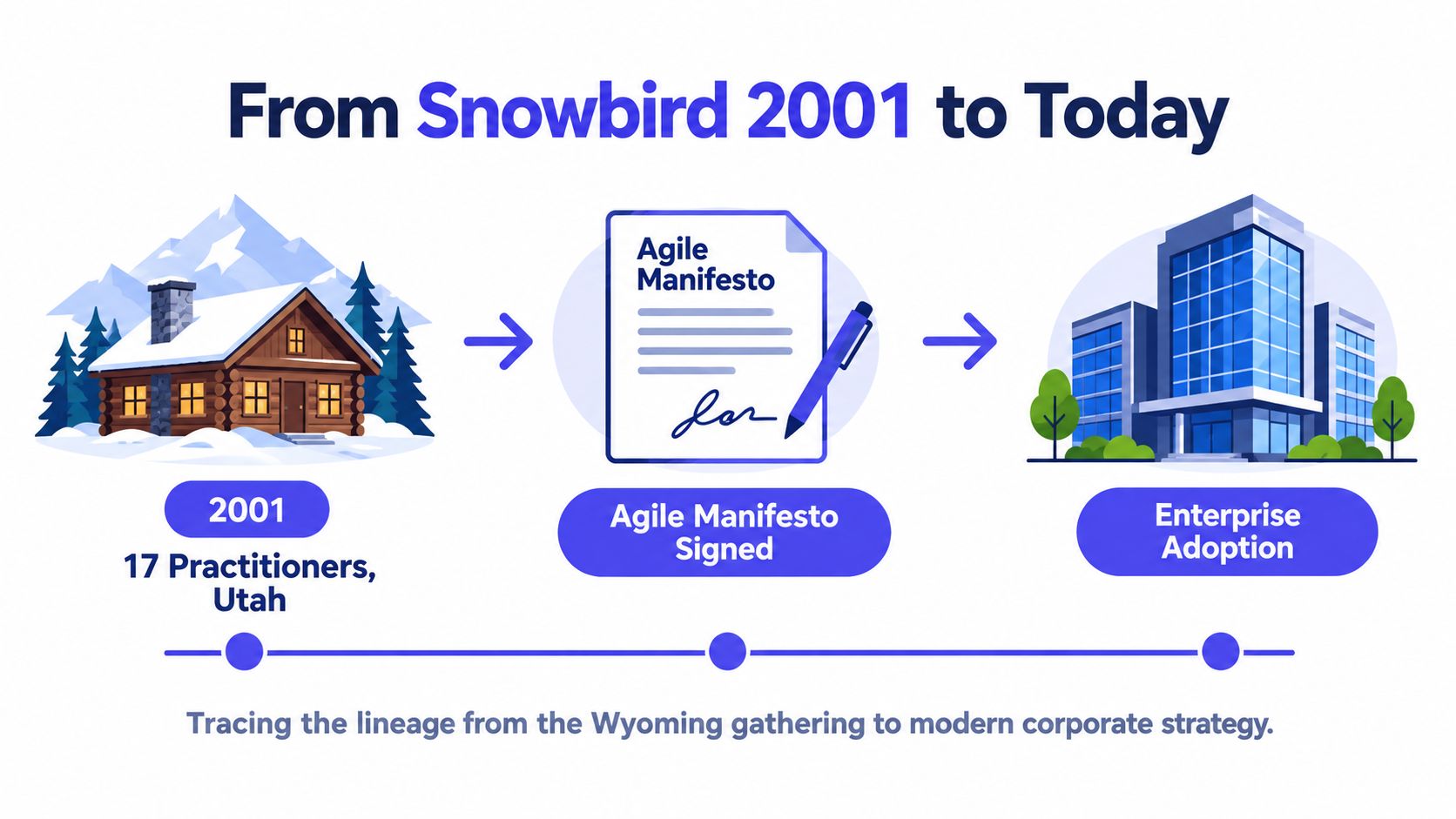
A team can adopt daily stand-ups, sprint planning, and a backlog yet still miss the business outcome. The history of Agile helps explain why. In February 2001, 17 software practitioners met in Snowbird, Utah, and defined the manifesto for agile software development. Their meeting gave a shared name to ideas already taking shape in approaches such as Scrum and Extreme Programming.
The origin matters because common language makes collaboration easier. Agile did not begin as a complete corporate operating system. It responded to delivery methods that struggled with changing requirements, delayed feedback, and large batches of unvalidated work. The practical question remains the same: what is the team trying to ship faster, and what feedback will show whether it is valuable?
The movement spread through team-level techniques. Scrum introduced a repeatable cadence and clear accountabilities. XP pushed engineering teams toward rapid feedback through practices such as automated testing and continuous integration. Kanban exposed queues and work in progress, helping teams examine flow instead of only counting completed tasks.
Adoption became measurable. The State of Agile survey has run annually since 2006, and its 11th annual report in 2016 found that 94% of respondent organizations practiced agile. Scrum and Scrum/XP Hybrid were the most common approaches at 68% of respondents' organizations, while 60% of respondents said fewer than half of their teams used agile practices (State of Agile survey). Agile had broad recognition, but adoption across enterprises remained uneven.
A later global agility survey collected responses representing 76 countries and 17 industry sectors. A subsequent annual survey reported that 95% of respondents practiced agile development methods. At least 75% used Scrum or a Scrum-based hybrid, while the Scaled Agile Framework was reported by 35% of respondents (KPMG Agile project delivery survey.
That history explains the current trade-off. As Agile moved from team practice to enterprise operating model, organizations added governance, portfolio planning, and coordination layers for larger systems. Those layers can clarify dependencies, but they can also lengthen feedback loops. A framework earns its place only when it helps a real team make better decisions about the work it needs to ship.
Scrum, Kanban, XP, and SAFe Compared
Framework choice should follow the work. A team handling unpredictable production incidents needs a different control system from a product group building a coherent feature increment, and both differ from a large organization coordinating multiple delivery trains.
| Framework | Cadence | Planning Horizon | Core Roles | Best-Fit Team Shape |
|---|---|---|---|---|
| Scrum | Fixed sprints, commonly two to four weeks | Sprint goal with a near-term product backlog | Product Owner, Scrum Master, Developers | Cross-functional product team building inspectable increments |
| Kanban | Continuous flow | Replenishment based on available capacity and WIP limits | No required framework-specific roles | Support, operations, maintenance, or teams with unpredictable intake |
| XP | Iterative delivery with continuous engineering feedback | Short technical planning horizons shaped by customer stories | Customer or product representative, programmers, testers, coaches | Teams where code quality, integration, or defect risk constrains delivery |
| SAFe | Program increments and coordinated planning | Portfolio, program, and team horizons | Product and portfolio roles, release coordination, team roles | Multiple teams that genuinely need structured enterprise coordination |
Scrum fits bounded product work
Scrum gives a team a protected sprint goal, a prioritized backlog, and regular inspection points. It works when the team can form a stable product unit and produce a meaningful increment without constant interruption. The trade-off is ceremony and commitment. If urgent work routinely breaks the sprint, the team may be using Scrum to hide a flow problem.
Kanban fits variable demand
Kanban starts with the existing workflow. The team visualizes states, limits work in progress, and manages how items move through the system. It doesn't require a product owner or sprint master, which makes it adaptable for operations and service work. Its weakness is that a board alone doesn't create prioritization. Someone still needs authority to decide what enters the system.
XP fits technical risk
XP adds engineering practices that make fast feedback possible, including pair programming, test-driven development, continuous integration, and simple design. It's a strong choice when defects, fragile architecture, or integration failures are the binding constraint. Teams shouldn't adopt XP practices as rituals detached from a quality problem. They should use them to reduce the cost of changing code.
SAFe fits coordination, not prestige
SAFe can provide program and portfolio structures when many teams share dependencies, funding decisions, and release coordination. It also introduces substantial planning and governance overhead. Scaling before teams have stable backlogs, clear ownership, and reliable delivery creates a larger version of the original confusion.
Choose based on variability, risk, and coordination load, not on what another department calls agile.
Roles, Ceremonies, and Artifacts in Practice
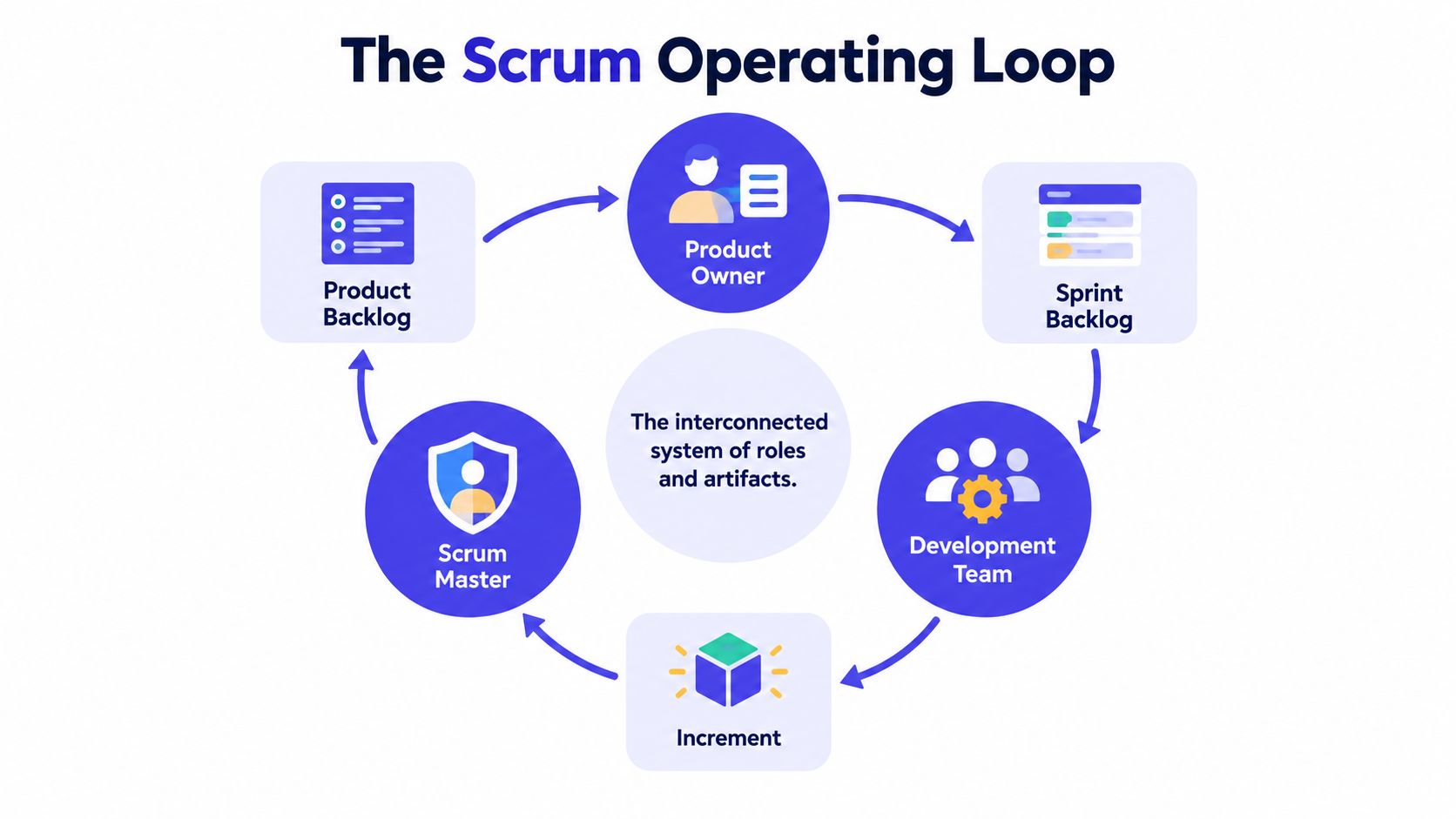
Scrum works as a connected operating loop, not as a collection of meetings. The Product Owner orders the Product Backlog around value, risk, and learning. Developers decide how to turn selected items into a usable increment and own the technical path. The Scrum Master protects the system by removing impediments, facilitating inspection, and helping the team become more self-managing.
The Product Backlog is more than a queue of requests. It should express the next decisions the product team needs to make, with enough context for developers and stakeholders to understand the expected outcome. User stories and acceptance criteria help, but they aren't substitutes for conversation.
The loop in motion
Sprint Planning turns an ordered backlog into a Sprint Goal and a forecast. The team checks capacity, clarifies acceptance criteria, identifies dependencies, and selects work it can finish without weakening the definition of Done.
The Daily Scrum is a short coordination point. Developers inspect progress toward the goal, expose blockers, and adjust their plan. It shouldn't become a manager-facing report where each person recites yesterday and today.
Backlog Refinement keeps upcoming work understandable and small enough to plan. The team discusses risks, splits oversized stories, and surfaces missing decisions before planning. Refinement has no value when it becomes an endless specification meeting.
The Sprint Review puts the increment in front of stakeholders. A slide deck can support the conversation, but the important evidence is working software and the feedback it generates.
The Retrospective examines the team's system. Strong retrospectives end with a small experiment, an owner, and a way to observe whether the change helped. “Communicate better” is not an experiment. “Pair on the next two high-risk stories and review escaped defects at the next retrospective” is testable.
The artifacts complete the circuit:
- Product Backlog: The ordered list of product opportunities, risks, fixes, and technical work.
- Sprint Backlog: The team's current forecast and plan for reaching the Sprint Goal.
- Increment: The integrated, usable output that meets the team's definition of Done.
The next planning session should learn from what the review and retrospective reveal. If every event produces a new document but no changed decision, the loop has become administrative.
Watch the operating loop in action before tailoring it to your own team.
Metrics That Actually Predict Delivery
An agile dashboard should answer separate questions. How much can we forecast? How long does work take? Where is it waiting? How often does quality fail? One metric can't answer all four.
The 2024 review of agile measurement found that story points and burn-down charts are widely used, but teams face persistent problems with transparency, standardization, and accuracy. It recommends combining velocity and custom measures with test coverage and lead time rather than treating a single chart as a complete performance signal (2024 review of agile metrics).
Read each metric with its failure mode
Velocity is the amount of locally estimated work completed in a sprint. It can help one team forecast its own capacity when scope and estimation habits remain reasonably stable. It becomes harmful when leaders compare teams, turn points into targets, or reward inflation.
If your team is still learning story-point estimation, use points to support conversation about uncertainty. Don't present them as hours, productivity units, or a universal benchmark.
Cycle time measures the period from work started to work completed. It reveals delivery flow and is often more useful than velocity for teams managing continuous intake. An average can conceal aging outliers, so inspect the distribution and the items that have remained open longest.
Lead time begins when a request enters the system and ends when the customer receives the result. It reflects both queueing and execution. A rising lead time may indicate too much work entering the backlog, weak prioritization, or a slow delivery path.
Burndown shows remaining work over a sprint. It can expose a stalled sprint early, but it becomes misleading when scope changes, estimates are rewritten, or teams treat the line as a scorecard.
Cumulative Flow Diagrams show how work accumulates across workflow states. A widening band usually deserves investigation because work is entering a stage faster than it leaves. The diagram is valuable before a bottleneck becomes an obvious delivery failure.
A 2026 thesis on cross-team comparison found that cycle time and predictability are the most consistently meaningful indicators of team performance over time, while direct team comparisons are limited by differences in practices, maturity, and context (2026 thesis on cross-team comparison).
A practical starter dashboard
Start with:
- Cycle-time distribution: Show typical work and aging exceptions.
- Weekly throughput: Count completed items without turning the count into a target.
- Work in progress: Make overload visible.
- Escaped defects per sprint: Pair speed signals with product quality.
Use the dashboard in retrospectives, not as a ranking system. The useful question is, “What changed in our system, and what should we test next?”
Adoption Plan, Pitfalls, and What to Try Next
Agile rollouts fail in predictable ways. The visible symptom is usually a missed sprint goal, but the deeper cause often sits in ownership, feedback, or incentives.
Forrester's 2025 survey found that 95% of professionals considered agile critically relevant, while only 33% said faster or greater business value had been realized and 7% reported full proficiency in agile practices (Forrester's 2025 agile survey). Adoption alone isn't evidence of improvement.
| Pitfall | Diagnostic Question | Countermeasure |
|---|---|---|
| Cargo-culted Scrum without Product Owner authority | Who can make the priority decision when stakeholders disagree? | Give one accountable product owner decision rights and direct access to users. |
| Retrospectives with no action | Which experiment from the last retrospective changed team behavior? | Commit to one observable experiment with an owner and review date. |
| Velocity treated as a target | What would happen if the team delivered fewer points but more customer value? | Use velocity only for local forecasting, never as a performance quota. |
| Scaling before teams are stable | Can the team finish work predictably without hiding dependencies? | Stabilize ownership, workflow, and quality practices before adding scaling layers. |
| No working agreement | What should a teammate do when work is blocked or priorities conflict? | Write explicit rules for response time, review, WIP, escalation, and decision-making. |
A small team can test the model without launching a company-wide transformation.
A one-quarter adoption sequence
- Week one: Create a working agreement and a visible board. Define workflow states, blocked-work behavior, review expectations, and what “Done” means.
- Week two: Establish backlog refinement. Bring the product owner and developers together to order work, split large items, and identify unanswered questions.
- Week three: Run the first sprint with an explicit Sprint Goal and definition of Done. Protect the team from unrelated intake.
- Week four: Hold the first retrospective and choose two experiments. Keep them specific enough to observe.
- Weeks five through eight: Baseline cycle time, throughput, WIP, and escaped defects. Add WIP limits where work piles up.
- Weeks nine through twelve: Stabilize the cadence, review whether the framework still fits, and document the practices that are helping.
A working agreement can stay short:
- We prioritize one shared goal at a time.
- We swarm on blocked or aging work before starting more.
- We review code and decisions within an agreed team window.
- We raise uncertainty early, without treating questions as failure.
- We change the process only after observing the current behavior.
Before calling adoption complete, the team should have an ordered backlog, a visible workflow, a definition of Done, a working agreement, a review cadence, retrospective experiments, and a small dashboard. It should also be able to name the business outcome the process is intended to improve.
For teams turning conversations into requirements and implementation context, SpecStory, Inc. offers a workspace that captures decisions, open questions, plans, and AI coding conversations as traceable artifacts. Visit SpecStory to see whether that approach can help your team reduce context loss between stakeholder alignment, backlog decisions, and the first commit.
Newsletter
Get new posts in your inbox
Bring your team together to build better products. Fresh takes on remote collaboration and AI-driven development.