


I just ended a team meeting with that familiar, slightly hollow feeling.
Everyone talked. A lot.
We'd spent over an hour together. Slack will no doubt soon show another dozen follow-ups. Someone must've taken notes, right?
And yet I couldn't answer the one question that mattered:
Did we actually decide anything?
Nobody said it out loud, but you could see it on people's faces as the call ended. The subtle hesitation before leaving the Zoom. The quiet, "okay… talk later."
It's the feeling of motion without progress.
I've seen this pattern enough times to recognize it now. It isn't about personalities, and it isn't even really about meeting facilitation.
It's about something much simpler.
We were mixing two completely different kinds of thinking in the same conversation.
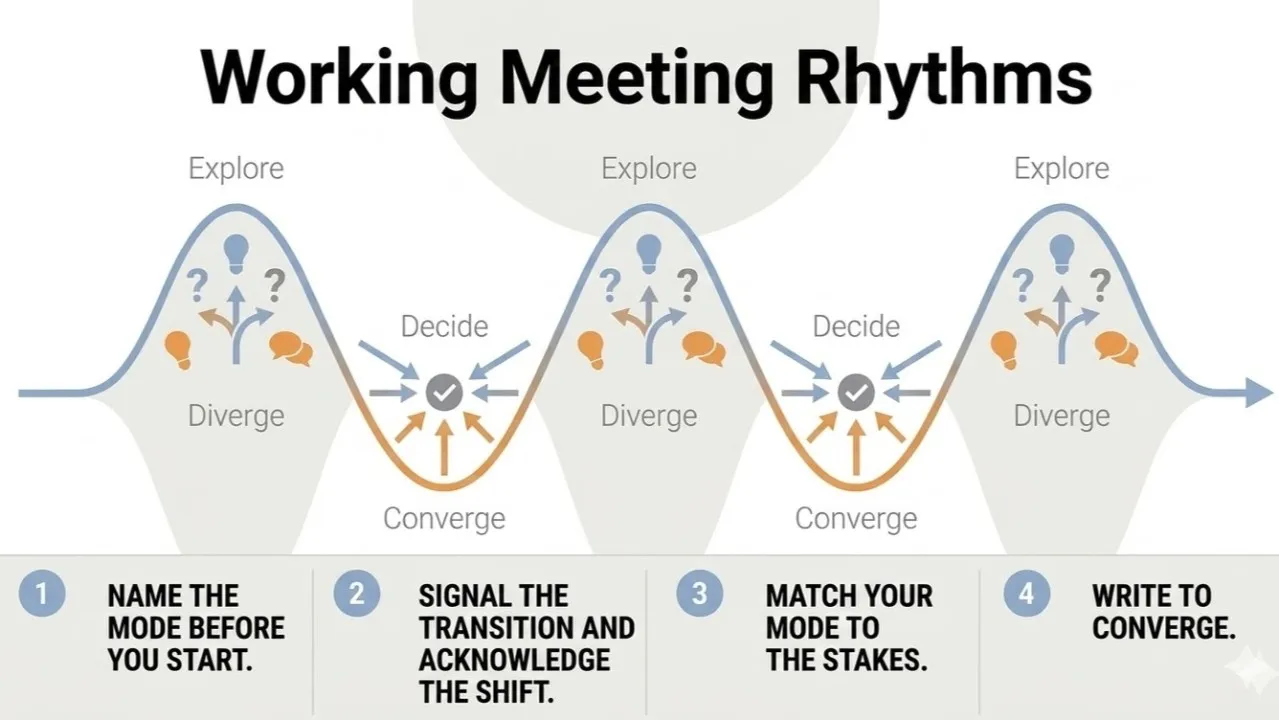
In the language of design thinking, we had a divergence / convergence problem.
Every productive conversation moves through two distinct phases, and they're not compatible with each other.
Divergent thinking opens things up. It asks: what are we missing? What alternatives haven't we considered? What does the person who disagrees with us see that we don't? This mode is generative. It requires psychological safety, patience, and a willingness to sit with ambiguity.
Convergent thinking closes things down. It asks: given what we know, what's the best path forward? It requires criteria, tradeoffs, and the courage to leave good options on the table in service of a decision.
Great teams move between these modes intentionally. Most teams blur them together and wonder why nothing sticks.
The tell is in the friction. When someone pushes back with a new idea during what the leader thought was a decision moment, that's divergent energy colliding with a convergent expectation. When someone asks "so what are we actually deciding?" in the middle of an open brainstorm, that's convergent pressure crashing into a divergent space. Neither person is wrong. They're just in different modes, and nobody said which mode the room was in.
The fix isn't complicated, but it requires intentionality.
Name the mode before you start. Before any agenda item, say out loud which phase you're in. "For the next fifteen minutes, I want us to think expansively. Nothing is decided yet, all options are on the table." Or: "We've done the exploration. Now I want to converge on a recommendation." These aren't magic words, but they orient the room. People stop fighting the current when they know which direction it's flowing.
Signal the transition and acknowledge the shift. Most meetings have a natural inflection point where the conversation wants to move from exploration to decision. Most facilitators miss it and let the meeting drift. The better move is to name it out loud: "I think we have enough on the table. Let's converge." But the transition is also the moment some people feel unheard, so a small acknowledgment goes a long way: "We've heard the concerns. Let's hold those and move toward a recommendation."
Match your mode to the stakes. Not every topic deserves a full divergent phase. Small decisions don't need open-ended exploration — jumping straight to convergence is efficient and appropriate. But big decisions that haven't had a real divergent phase are dangerous. You're choosing between options someone already filtered, without knowing what got left out. The bigger the decision, the more intentional you need to be about earning your convergence.
Write to converge. When you think the room has landed somewhere, don't just say it. Write it. Share your screen or open a shared doc and try to put the convergence into words in real time: what did we decide, and what's the reasoning? This does two things. It exposes gaps immediately, and it creates a record that everyone can push back on before the meeting ends, rather than relitigating it over Slack three days later. The goal isn't a polished document. It's a single sentence or two that the room can read and say "yes, that's what we decided." If you can't write it, you haven't converged yet.
There's a deeper reason this matters.
When a team doesn't distinguish between modes, two bad things happen over time. The people who are naturally divergent start to feel like the deciders run everything. The people who are naturally convergent start to feel like exploration is performative — that the real decision was made before the meeting started. Both perceptions corrode trust. Both are avoidable.
The goal isn't to rush through exploration or drag out decisions. It's to make each phase feel real. When people believe the divergent phase actually influenced the outcome, they commit more fully to the convergent one. When they trust the convergence is real, they explore more freely before it arrives.
That's the rhythm. Open, then close. Expand, then decide. Not once in a meeting — sometimes two or three times, as you work through different agenda items or surface new information that reopens a question.
The best meeting facilitators I've seen don't just manage time. They manage energy. They read the room, feel when it wants to open up and when it wants to close down, and they name it. Not with elaborate ceremony — with a simple sentence.
"Let's explore this for a while."
"Okay. Let's converge."
That's it. That's the whole practice.
Try it in your next meeting. Name the mode. Signal the shift. Watch what happens to the energy in the room.
The conversations won't feel shorter. But they'll feel like they went somewhere.
Older
The Rise of the Producing Manager
Newer
Please Review the Safety Card Before Airdropping Your Prototype
Newsletter
Get new posts in your inbox
Bring your team together to build better products. Fresh takes on remote collaboration and AI-driven development.