


A teammate says, “Add a way to mark a decision unresolved and bring it back at the next planning check.” The request sounds clear in the meeting, but the codebase already has a decision list, a data model, and conventions the sentence doesn't mention. A code-generating tool can produce a compiling patch before anyone notices it added a separate list that doesn't fit the existing workflow.
That's the test of AI text to code: not whether a sentence turns into syntax, but whether the resulting change preserves the intent people agreed on. Treat the sentence as a product decision. The generated diff is unfinished until someone can trace its code back to that intent and run it.
Table of Contents
- Pick a Text to Code Workflow First
- How Words Become a Program
- Tasks Models Handle and Tasks They Miss
- One Feature From Sentence to Diff
- Code That Compiles and Still Is Wrong
- Review Habits That Keep the Diff Honest
- Turn the Conversation Into the First Commit
Pick a Text to Code Workflow First
| Workflow | Best for | What you provide | What you still review |
|---|---|---|---|
| Chat generation | One function, script, or query | A paragraph naming inputs, output, and constraints | It runs and matches the sentence |
| Inline completion | The next block in an open file | A stub or a one-line intent in the editor | The block fits this function and this style |
| Repo agent | A change across several files | A checklist of files, behavior, and tests to run | The full diff plus the test result |
| Spec to pull request | A feature with acceptance criteria | Bullets of done and not-done | Diff, rationale, and anything left open |
| Meeting to prototype | A page or feature described out loud | A live conversation with brand, content, and goal | A runnable draft traced to what was agreed |
Choose by the size of the change. A standalone function belongs in a chat box; a cross-file feature needs an agent that can inspect the repository and run checks. The larger the change, the more explicit the input and the broader the review must be.
Match the workflow to the artifact
Chat generation works well when you can paste the result into a scratch file and run it independently. Name the input shape, expected output, and constraints. “Parse this CSV” leaves too much open; “Parse rows with a header, reject missing email fields, and return valid records plus row-level errors” gives the model something testable.
Inline completion is a narrower bet. The editor supplies the neighboring code and style, so a short stub may be enough. Review the completion where it lands: a block can look polished and still be wrong for the function's responsibilities or duplicate logic that already exists nearby.
For repository-level work, ask for an artifact you can inspect, not a promise. A repo agent should identify the files it changed, show the full diff, and report which test command it ran. Spec-to-pull-request work benefits from acceptance criteria that distinguish what is in scope from what is explicitly not. For a spoken feature idea, a meeting-to-prototype workflow should produce a runnable draft in the session, not just a helper function detached from the page people discussed.
Every workflow has the same minimum bar: run the code, read the diff, and compare the behavior with the original sentence. A green check can't tell you whether the code implemented the decision the team meant to make.
For changes that touch operational procedures, it helps to think about how code fits into the surrounding work, not just the file being edited. Fivenines' guide to practical workflow automation for SRE teams is useful context for teams connecting software changes with repeatable operational workflows. If you're choosing between coding-agent approaches, this AI coding agent comparison can help frame the trade-offs. The useful next question isn't which tool has the longest feature list. It's what mechanism will keep the generated change attached to the decision that caused it.
How Words Become a Program
Think of a request as a kitchen order. The sentence is the order, the model is the cook who has seen many tickets, and the repository is the pantry that decides what can be plated. A cook may know a familiar recipe, but the pantry tells them which ingredients are on hand. A model may produce familiar code, but the files and constraints you provide determine whether that code fits this project.
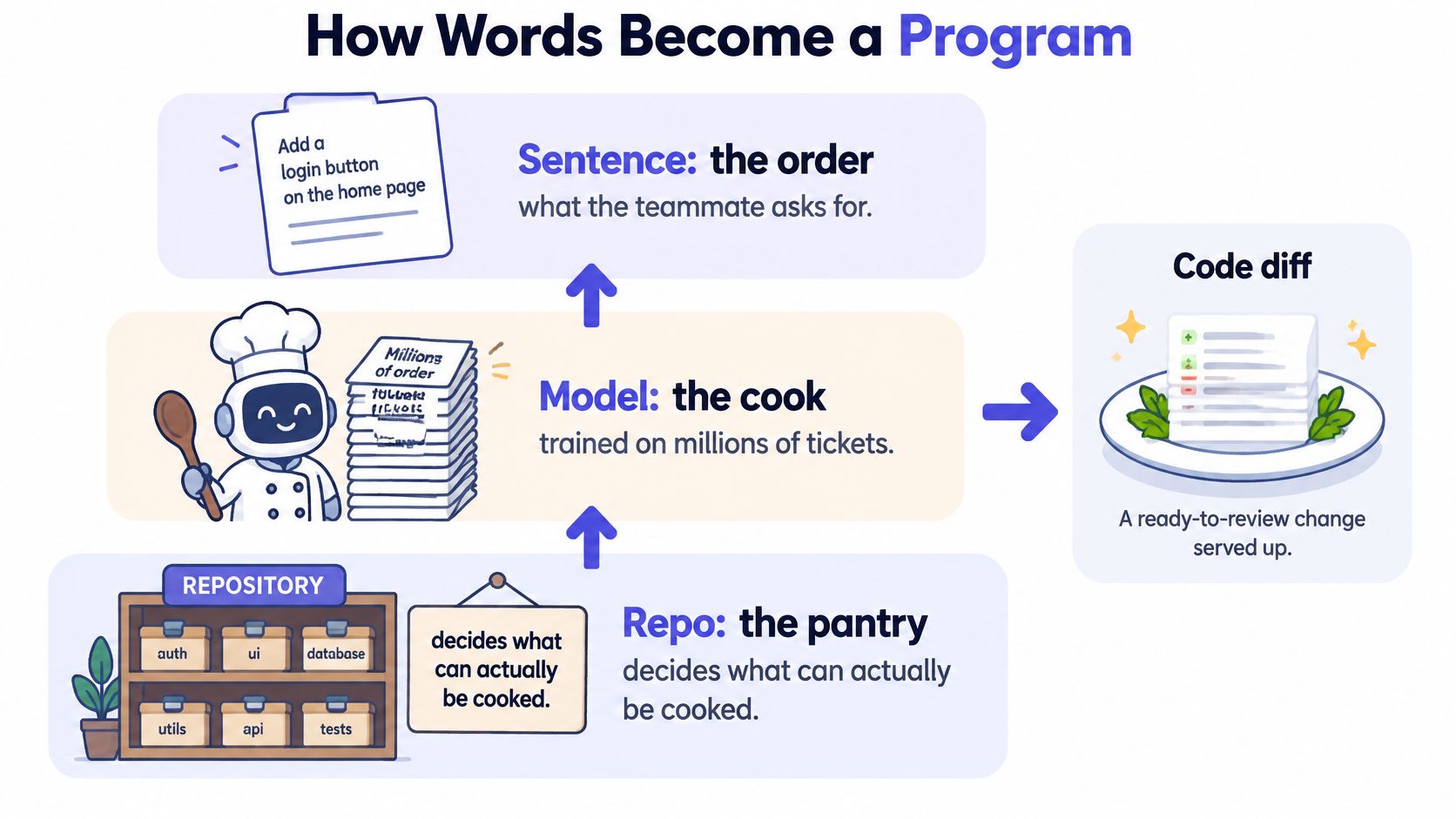
The model doesn't read a request as a human reader does. It breaks text into tokens, which may be whole words, parts of words, punctuation, or other pieces. Then it predicts the next token based on patterns learned from training code and the context supplied for this task. Names, punctuation, and indentation all help shape what comes next.
That prediction process explains why “handle errors” can yield a convincing function that handles the wrong errors. The instruction doesn't identify which errors matter, how the application represents them, or what the caller should do. A short specification plus relevant files usually gives the model better grounding than a long essay that never shows the code it needs to change. Context-engineering techniques, such as those in this guide to context engineering for AI agents, can help you decide what information to expose.
The model doesn't execute the program while it writes. A function can look right and still call a nonexistent helper, mishandle an edge case, or fail to compile. A compiler, runtime, or test has to exercise the draft before anyone can say what it does in practice.
The agent adds a feedback loop
A chat response ends when the model sends the answer. An agent can work against the repository in a loop: read files, propose an edit, run a command, and try again. That makes an agent more useful for work that needs repository context and a test run, but the loop doesn't make its choices automatically correct.
The loop should stay small and traceable:
- Ground the instruction in the files.
- Draft the smallest edit that meets it.
- Run one relevant check.
- Stop when the check passes or the instruction proves ambiguous.
The check tells you whether a particular test passed, not whether the team agreed with the behavior. Keep that distinction clear as the loop runs.
The sentence is the spec. The tokens are a draft of that spec.
Better context beats a longer prompt. It gives the model something concrete to match rather than more ways to guess.
Tasks Models Handle and Tasks They Miss
| Task | Typical result | Stop when |
|---|---|---|
| Boilerplate and glue | A runnable function in the local style | It adds a dependency you didn't name |
| Port a small function | A close translation you can diff | Types or errors were guessed, not mapped |
| Tests from an example | Cases that mirror existing tests | Assertions only restate the implementation |
| Local refactor | Call sites updated inside visible files | The pattern changes in files the model didn't open |
| UI from a description | A first screen, not a finished layout | Empty, error, and keyboard states are missing |
| Debug from a trace | The obvious null or off-by-one | The same test fails after two edits |
| Cross-service change | A plausible but invented integration | An endpoint, flag, or rule isn't in the repo |
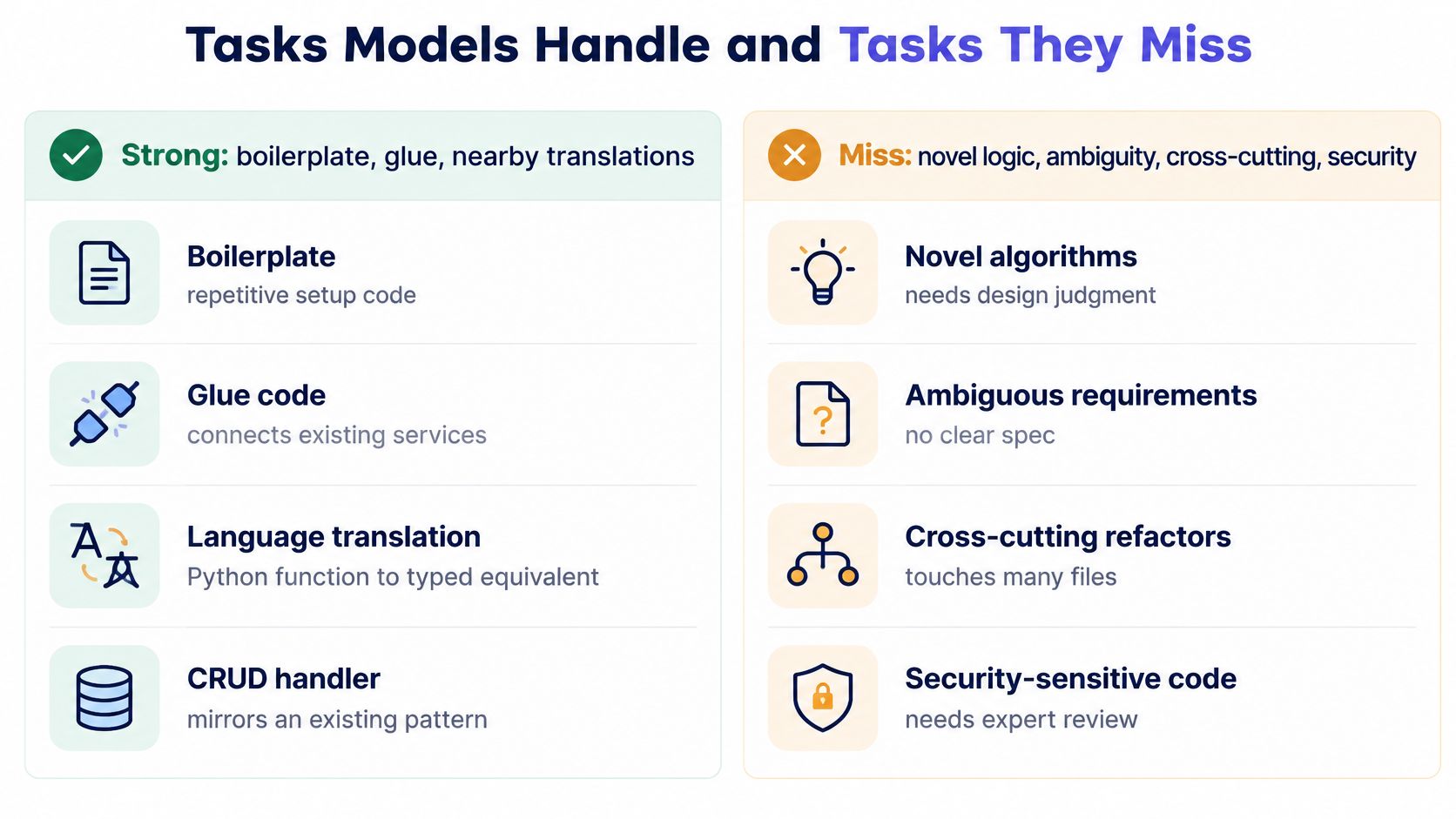
The strongest results come from work that resembles code the model can already inspect. A CRUD handler that mirrors a neighboring handler, a test that follows an existing test, or a small translation between familiar languages gives the model patterns to copy and a diff a person can judge. A refactor can work when the relevant call sites are visible and the repository follows a consistent convention.
UI drafts are often useful as a starting point, not a finished interface. A description may convey the main screen while omitting loading behavior, empty results, keyboard access, and error recovery. Those omissions aren't decorative: they change how a person can use the feature. Review the states, not just the screenshot-worthy happy path.
Debugging from a pasted stack trace is similarly easy to overrate. A trace can point toward a null value or an obvious boundary mistake, but it doesn't necessarily contain the data history, runtime configuration, or concurrency conditions that caused the failure. If the same test keeps failing after another edit, stop generating and inspect the actual inputs and execution path. More attempts won't supply evidence that the prompt lacks.
Cross-service work is riskier because a model can fill gaps with plausible inventions. If the endpoint, feature flag, or business rule isn't in the repository context, the result may be coherent code for a system that doesn't exist. Repeated test failures, unrequested dependencies, and comments that merely paraphrase the request are all signs to take over by hand.
If a feature depends on API behavior or product rules that live outside the code, a teammate with the right domain context has to supply them. For teams considering how to add engineering capacity, hiring developers from Mexico is one option to evaluate alongside the expertise and review ownership the work requires.
Reliability tracks how much of the answer is already in the files you showed the model. When the repo contains a clear pattern, the model can extend it. When a requirement is missing, the model can only guess.
One Feature From Sentence to Diff
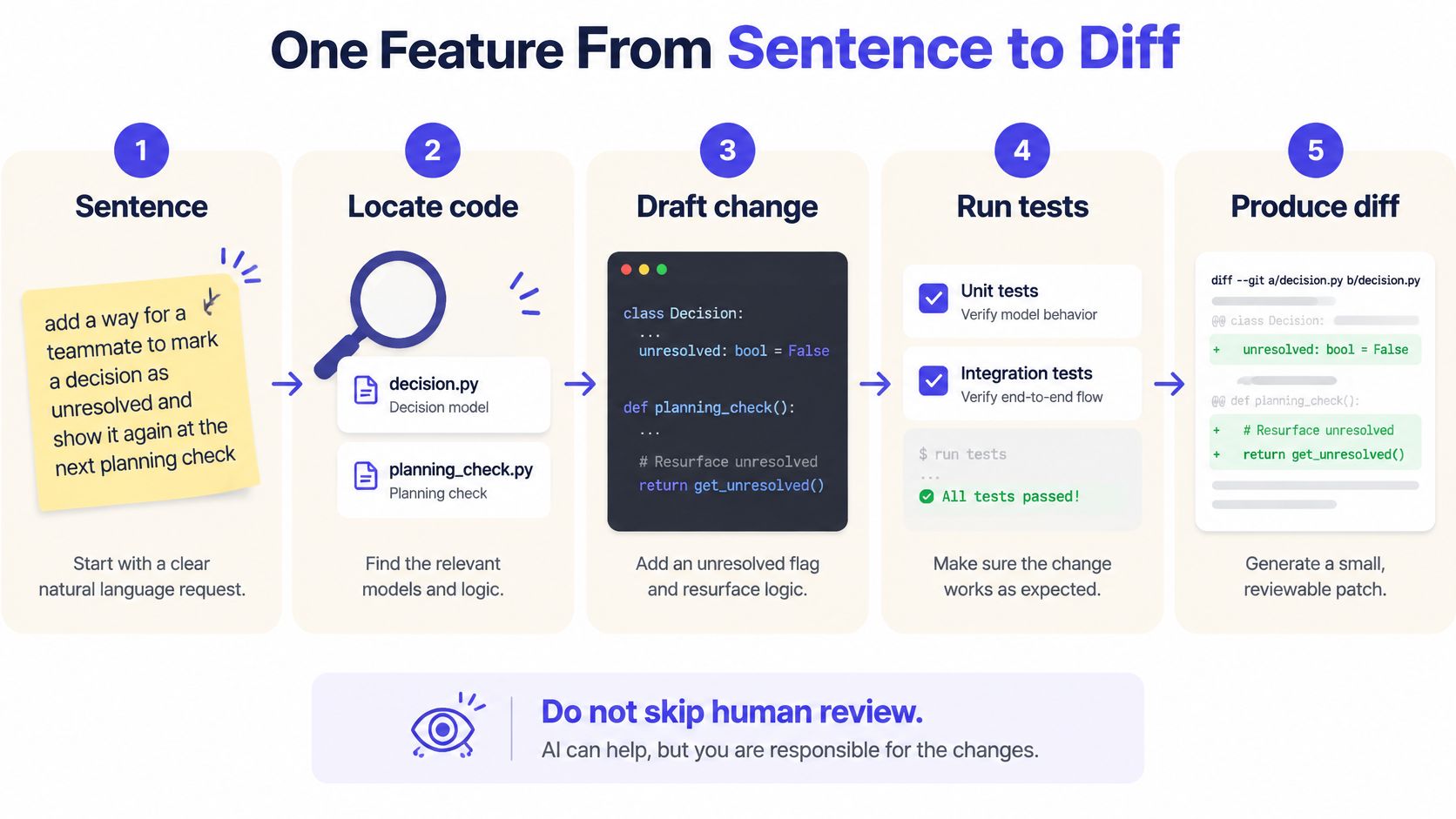
Start with a decision the team has made: “Add a way for a teammate to mark a decision as unresolved and show it again at the next planning check.” That sentence names an action and a return point, but it still needs the existing product context to become a good change.
A weak prompt would be “add unresolved questions.” The model could respond with a new table, a generic component, and no connection to the screen that already lists decisions. The output might compile. It would still miss the product decision.
A careful prompt adds the missing context: “In the existing decision list, let a teammate mark a decision as unresolved. Store that state using the existing decision model, show unresolved decisions at the next planning check, and leave the current resolved-decision behavior unchanged. Use the existing UI patterns. Add a test proving that a resolved item doesn't appear in the open list.”
Then guide the change through a focused review:
- Locate the existing code. Point the agent to the decision list and the file that stores the decision. Ask it to identify the relevant files before editing. That makes it easier to catch an edit that starts from the wrong part of the product.
- Limit the implementation. Ask for the smallest change: a status field, a control beside the existing row, and a filter for the next planning check. State that no new framework is needed. A narrow request keeps the diff aligned with the feature.
- Make the test express the behavior. Require a test that fails if a resolved item still appears in the open list. The test should describe the rule, not just repeat the implementation's internal method names.
- Read the diff against the decision. Look for renamed fields and copy the team hasn't approved. Check that the new control sits with the existing decision rather than creating a disconnected path.
- Run the test and inspect what it proves. Reject a green result if the test never sets the decision to unresolved. A test that doesn't exercise the requested behavior can pass without verifying the feature.
A healthy result is small enough to explain: a few lines in the existing model, a control beside the existing row, and a test name that repeats the original instruction. If the agent introduces a second data structure or touches unrelated screens, the diff needs a reason grounded in the request.
A meeting can supply the sentence when the team agrees on the filter out loud and the agent drafts from the transcript. What matters is that the resulting patch remains connected to the words people approved, rather than to an interpretation written down later. Demand a diff whose test name is the instruction.
Code That Compiles and Still Is Wrong
The file runs. The happy-path test is green. The behavior still doesn't match what anyone decided. That's not a contradiction: a compiler checks whether code can be translated, and a test checks the cases someone wrote. Neither one independently verifies the product intent.
Four ways a plausible diff can miss
Invented APIs. The diff imports a helper or calls an endpoint that would make sense in another project but doesn't exist here. Ask: which file defines this function or route? If there's no answer in the repository, the code's apparent familiarity is no evidence that the integration is real.
Silent scope creep. A one-field change reformats a whole file, bumps a dependency, or rewrites an unrelated function. The symptom is a diff with behavior the instruction never requested. Ask: which part of the sentence required this hunk? If you can't trace it to the request, the patch has expanded beyond its brief.
Tests that lock in the bug. A test copies the implementation's assumption, including a wrong boundary, and then passes because both share the same mistake. Ask: which input would distinguish the intended behavior from this implementation? A green result only means the code agrees with the assertion.
Hidden assumptions. Time zones, permissions, empty lists, and concurrent edits weren't mentioned, so the model picks an interpretation. The diff may contain a default or a branch that makes that choice look settled. Ask: which relevant input is absent from the test, and who decided how it should behave?
A passing check proves only the check you wrote.
That's why reviewing how to test AI-generated code means looking beyond whether a test command exits successfully. You need to know whether the test represents the decision and exercises the behavior the team intends.
These misses are why a trace from sentence to lines matters more than changing a temperature setting or asking the model to regenerate. A second draft can produce different guesses. It can't resolve an unstated product rule.
Review Habits That Keep the Diff Honest
A good review begins with the request, not with the implementation. Use these habits on the next generated change, whether it came from inline completion, a chat box, or an agent.
- Read the instruction and test name together. Check that the test expresses the requested behavior. Reject it if the same test could pass for a different feature.
- Ask for the context list. Know which files the model could inspect. A clever change in a module it never opened still needs a reason to be in scope.
- Keep the diff on-task. Formatting-only hunks and unrelated refactors make it harder to tell whether the requested behavior changed. Send them back or split them out.
- Run the check yourself and try an unmentioned input. If the prompt says nothing about an empty list or missing permission, test that case before treating the happy path as sufficient.
- Save the prompt beside the change. Keep the original sentence where the next person can see why the branch exists. This is the habit teams skip when they treat chat as disposable. Without the prompt, a later edit tends to optimize the code rather than preserve the decision, and review time drifts toward style arguments.
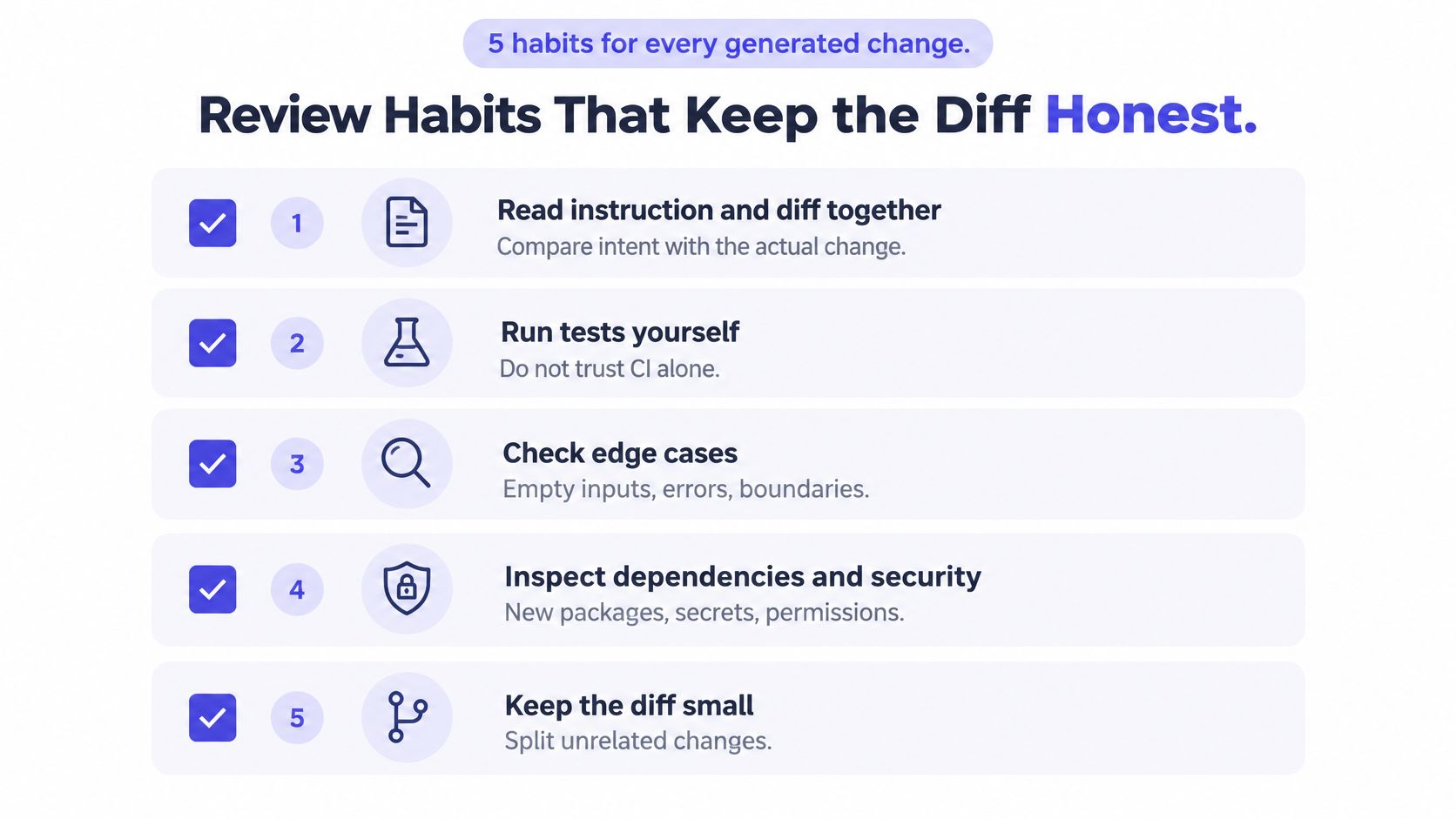
The merge bar is simple: a person who wasn't in the generation step can point from the test to the original instruction without asking the author what they meant.
Turn the Conversation Into the First Commit
In your next working session, take a change the team is already discussing and leave with a runnable draft, not just meeting notes. Write the instruction as the test you want: who does what, on which existing screen or file, and what must not change. Choose a repo agent for a change across files or a meeting-to-prototype path for a feature the team is describing together, then ask for the smallest diff that can verify the decision.
Don't celebrate a green check until someone has saved the prompt beside the code. The decision and the lines that implement it should remain part of the same reviewable artifact.
When the instruction takes shape in a live conversation, Stoa connects meetings, transcription, collaborative editing on local project context, and shared sandboxed agents in one build surface. A team can agree on what should happen, draft from that context, and run code in a shared sandbox. Context can also move to a desktop with the stoa CLI and open in Claude Code, Codex, VS Code, or another tool, with no MCP required. SpecStory links code directly to the prompts used to write it, making the decision easier to trace during review.
End the session only when the draft runs and the prompt is saved. The meeting timer isn't the deliverable.
SpecStory, Inc. builds tools that connect product conversations to executable context and code, including Stoa for collaborative work from live discussions and SpecStory for linking code to the prompts that produced it. If your team wants the decision and the diff to stay connected, visit SpecStory, Inc. and see how it fits your workflow.
Newsletter
Get new posts in your inbox
Bring your team together to build better products. Fresh takes on remote collaboration and AI-driven development.