


Most founders hear “validate before you build” and respond with the same ritual: interview a few people, publish a landing page, collect encouraging replies, then start coding. That process feels disciplined, but it often validates only that people understand your pitch and enjoy discussing an interesting possibility. It doesn't prove they'll change a workflow, tolerate implementation friction, or allocate a budget.
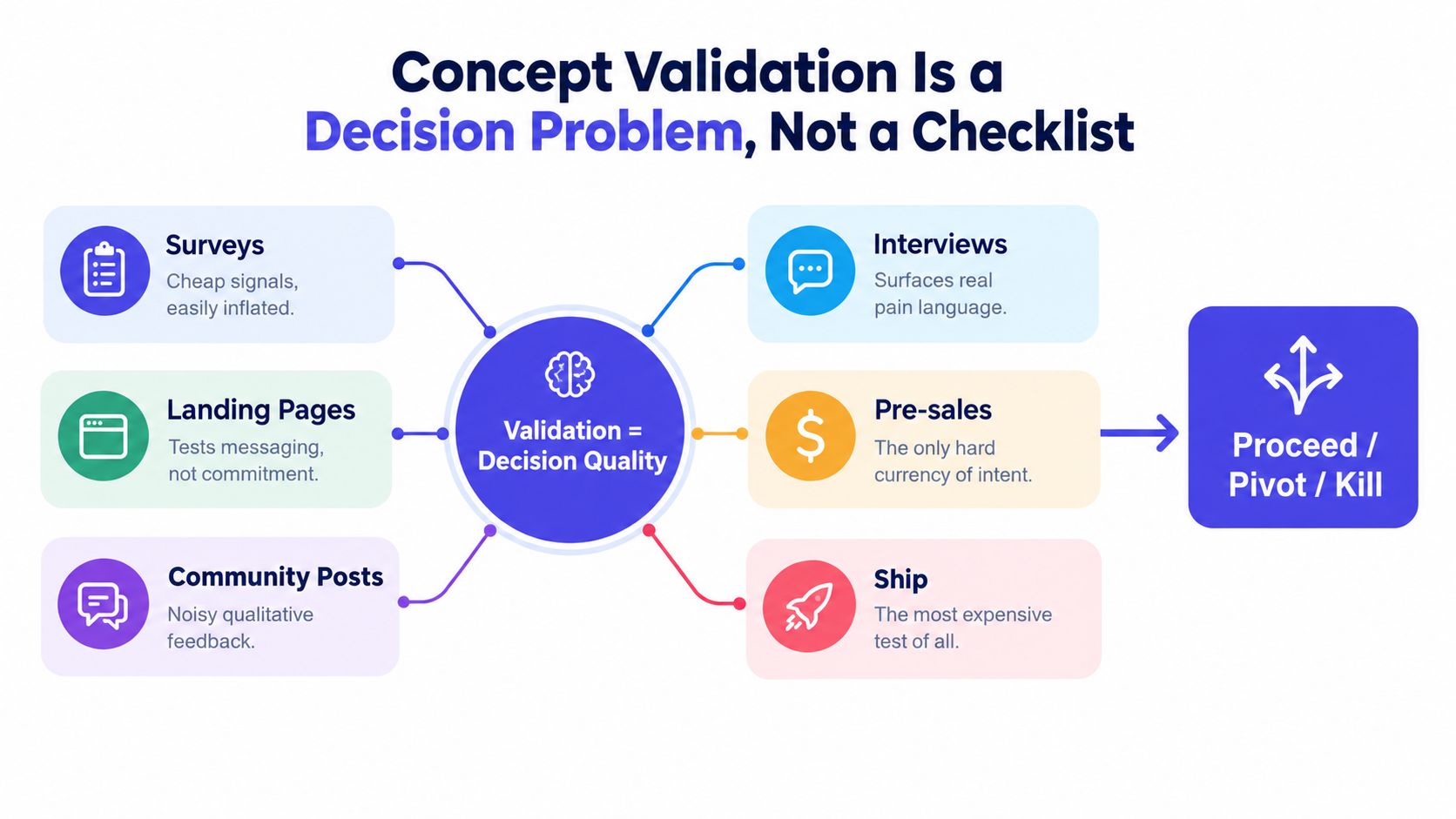
Concept validation is a decision problem, not a checklist of fashionable tactics. The question isn't whether your idea gets positive feedback. It's whether the evidence is strong enough to proceed, pivot, or stop. That requires separating three risks: desirability, whether the target user wants the outcome; feasibility, whether your team can deliver it at the required quality and speed; and viability, whether pricing, delivery costs, compliance, and acquisition can support a real business.
Replace activity with evidence
A survey can help you measure a message. An interview can reveal how prospects describe a problem. A prototype can expose workflow friction. None of those methods automatically answers the same question, and none should be treated as universal proof.
Practical rule: Before choosing a method, write the decision it must support and the evidence that would change your mind.
For example, “procurement teams want faster supplier reviews” is too broad to test. A useful hypothesis might be that procurement managers will request a demonstration after seeing a short explanation of an AI-assisted workflow. That hypothesis has a target group, an observable action, and a clear point at which you'll reconsider the idea.
Founders also need to distinguish genuine concern from general readiness. A useful companion is this guide to not ready for crowdfunding signs, because public fundraising can amplify a weak concept before the underlying demand is clear. The same warning applies to an AI demo that attracts attention but leaves users with no reason to adopt it.
Table of Contents
- Replace activity with evidence
- The Cost of Getting It Wrong Before and After Validation
- The Seven Validation Methods Founders Actually Use
- Choosing the Right Method for Your Risk
- Setting Success Thresholds Before You Run the Test
- When Stated Intent Lies and Behavior Tells the Truth
- A Reusable Experiment Template You Can Run This Week
- Common Pitfalls and Your Next Validation Step
The Cost of Getting It Wrong Before and After Validation
Concept validation became important for a practical reason. New products have historically failed often enough that testing demand before launch became a core product-strategy discipline. A 2001 MIT course document records new consumer packaged goods failure rates rising from 45.6% in 1961 to 80.0% in 1991, a historical arc that helps explain why teams began testing concepts before committing to full development. The same document lists a concept test at about $20,000, with a cost ratio of 1:2, compared with $320,000 later in the process. The MIT document makes the economic logic visible: early evidence can be far cheaper than correcting a failed launch after resources have accumulated around it.
The exact figures belong to that historical context, not to every startup today. The principle still holds. A landing page, interview series, prototype, or manual pilot can challenge an assumption before engineering, design, support, and sales teams build their plans around it.
Speed makes the trap easier to enter
AI-native products create a new version of the old problem. A founder can produce a convincing demo quickly, connect an API, and show a workflow that looks complete enough to attract praise. That apparent speed encourages teams to treat the demo as validation, even though the difficult questions may begin only after a user must provide data, change habits, involve colleagues, or approve payment.
A fast build doesn't remove uncertainty. It can hide uncertainty behind polished output.
The concept development and validation guidance from Umbrex recommends setting explicit thresholds before testing, including examples such as a landing-page click-through rate of at least 30%, gross margin of at least 40% at pilot volumes, or regulatory approval within four weeks. Those are examples of decision gates, not universal benchmarks. Their value comes from writing down what success means before results arrive.
Seed-stage teams face the sharpest downside because a single wrong investment can consume the time needed to discover the next opportunity. The expensive mistake isn't learning that an idea is weak. It's learning that fact after a long build, when sunk costs and internal expectations make stopping emotionally difficult.
The Seven Validation Methods Founders Actually Use
Founders rarely need every method. They need the lightest experiment capable of producing credible evidence for the risk they care about. Research guidance from Quantilope's concept-testing guide supports combining interviews, surveys, prototypes, and landing-page tests to examine appeal, uniqueness, purchase intent, and willingness to pay before major investment.
Start with the lightest useful test
-
Customer interviews. Use them to discover pain language, current workarounds, urgency, and buying context. They primarily test desirability and problem severity. Interviews are inexpensive compared with development, but leading questions and friendly participants can make them feel more conclusive than they are.
-
Fake-door or landing-page test. Present one clear promise and measure whether the intended audience takes a meaningful next step. This tests message-market fit and early desirability, not product delivery. A page can demonstrate that a promise attracts clicks while saying little about retention or implementation friction.
-
Concierge MVP. Deliver the outcome manually for a small group of customers. Use it when you need to learn whether the job matters enough for someone to tolerate a human-powered service. It produces better behavioral evidence than a survey, though manual delivery can conceal automation costs.
-
Wizard of Oz prototype. Give users a real interface while a person performs the hidden work. This approach tests the front-end workflow and user expectations before you build the backend. It's useful when the user experience is uncertain but the underlying operation can be performed manually.
-
Pilot with design partners. Recruit a small number of target organizations and define a real workflow, owner, data requirement, and review point. A pilot tests adoption, feasibility, and time-to-value. It also exposes coordination costs that individual interviews won't reveal.
-
Paid acquisition test. Put a modest budget behind a specific audience and message. This tests whether demand survives the distance between your personal network and a colder market. Clicks alone are weak evidence unless they lead to a relevant action.
-
Pre-sale or letter of intent. Ask for money or a signed commitment at the proposed commercial terms. This is the strongest early signal for viability, but it carries delivery obligations and can create pressure to promise more than the team can support.
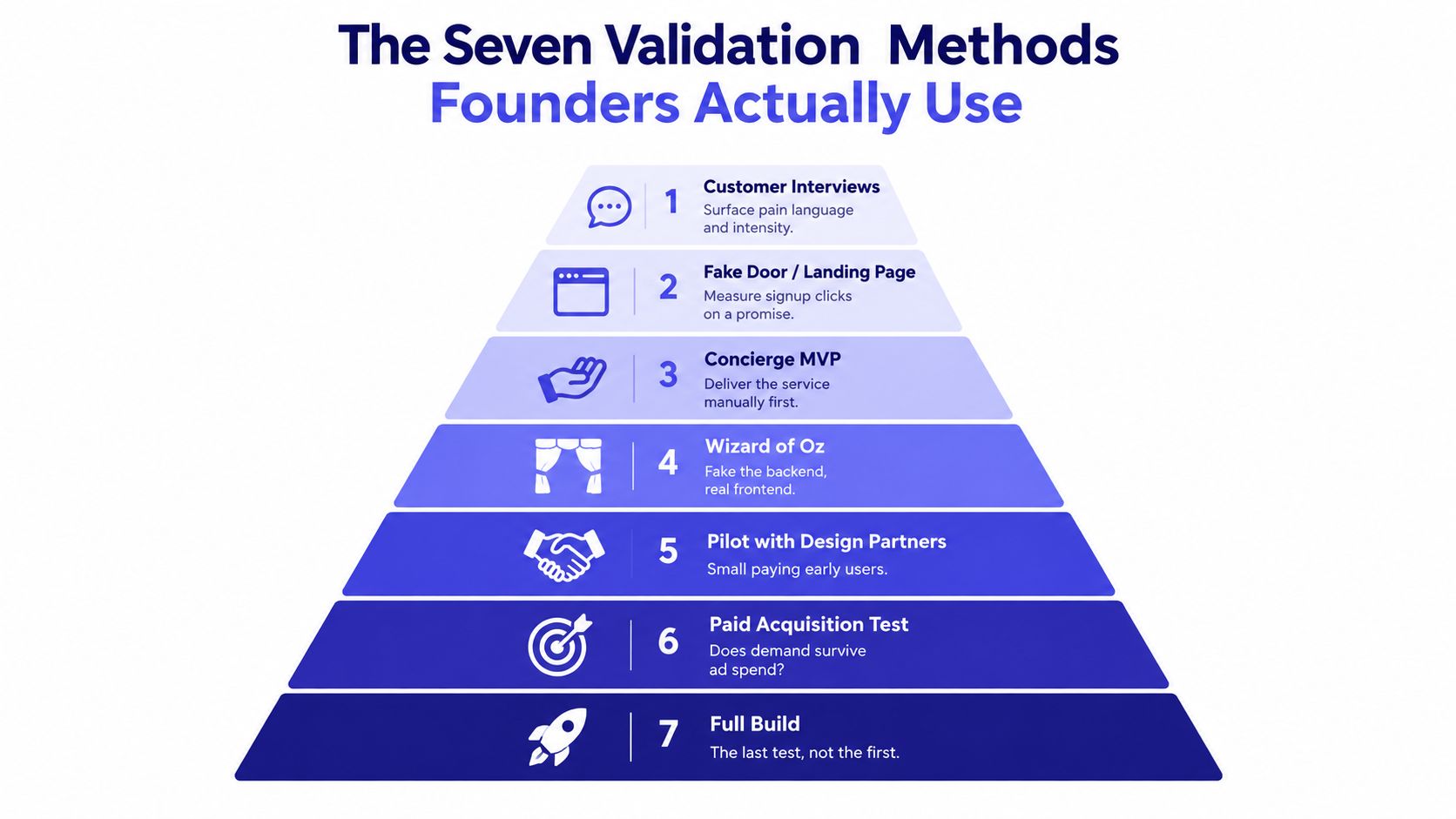
A useful product-discovery workflow begins with a clear customer needs assessment, then escalates only when the earlier evidence supports continuing. Founders who want broader context on achieving product-market fit should still treat market fit as an outcome of repeated behavioral learning, not as a label earned from a successful survey.
Choosing the Right Method for Your Risk
A method is only as useful as the hypothesis it can falsify. Interviews are well suited to discovering whether a problem exists and how people currently cope. Pre-sales are better suited to testing whether a defined offer deserves a budget. A prototype can reveal that a valuable outcome is buried inside an unusable workflow.
| Method | Cost | Time to Signal | Signal Quality | Best-Fit Hypothesis |
|---|---|---|---|---|
| Customer interviews | Low relative to building | Fast | Medium | The problem is real, urgent, and described consistently |
| Fake door or landing page | Low to moderate | Fast | Low to medium | The message attracts the intended audience |
| Concierge MVP | Moderate | Moderate | High for the job | Users will accept the outcome when delivery is manual |
| Wizard of Oz | Moderate | Moderate | Medium to high | The proposed interaction fits the workflow |
| Pilot with design partners | Moderate to high | Longer | High | Teams will adopt the workflow under real constraints |
| Paid acquisition test | Moderate | Fast to moderate | Medium | Demand survives beyond personal networks |
| Pre-sale or LOI | Moderate | Moderate | High for commercial intent | Buyers will commit at the proposed terms |
The table should guide sequencing, not encourage parallel experimentation. Run a cheap screening method first, then move to behavior. For a B2B workflow tool, a survey can identify the segment and language, while a concierge pilot tests whether employees will incorporate the solution into their work. For a consumer product where price sensitivity is the primary uncertainty, a landing page can test the promise, followed by a pre-sale at the intended price.
Escalation is the point
The most efficient chain is usually screen, observe, transact. Each stage should answer a narrower question than the one before it. If the screening result is weak, don't build a more expensive test to rescue the idea. If the screening result is strong, don't mistake it for permission to skip the behavioral step.
Conjointly's product concept testing guidance is particularly relevant when pricing, packaging, and perceived value are uncertain. A concept can generate authentic interest while still failing to support a workable commercial model.
Setting Success Thresholds Before You Run the Test
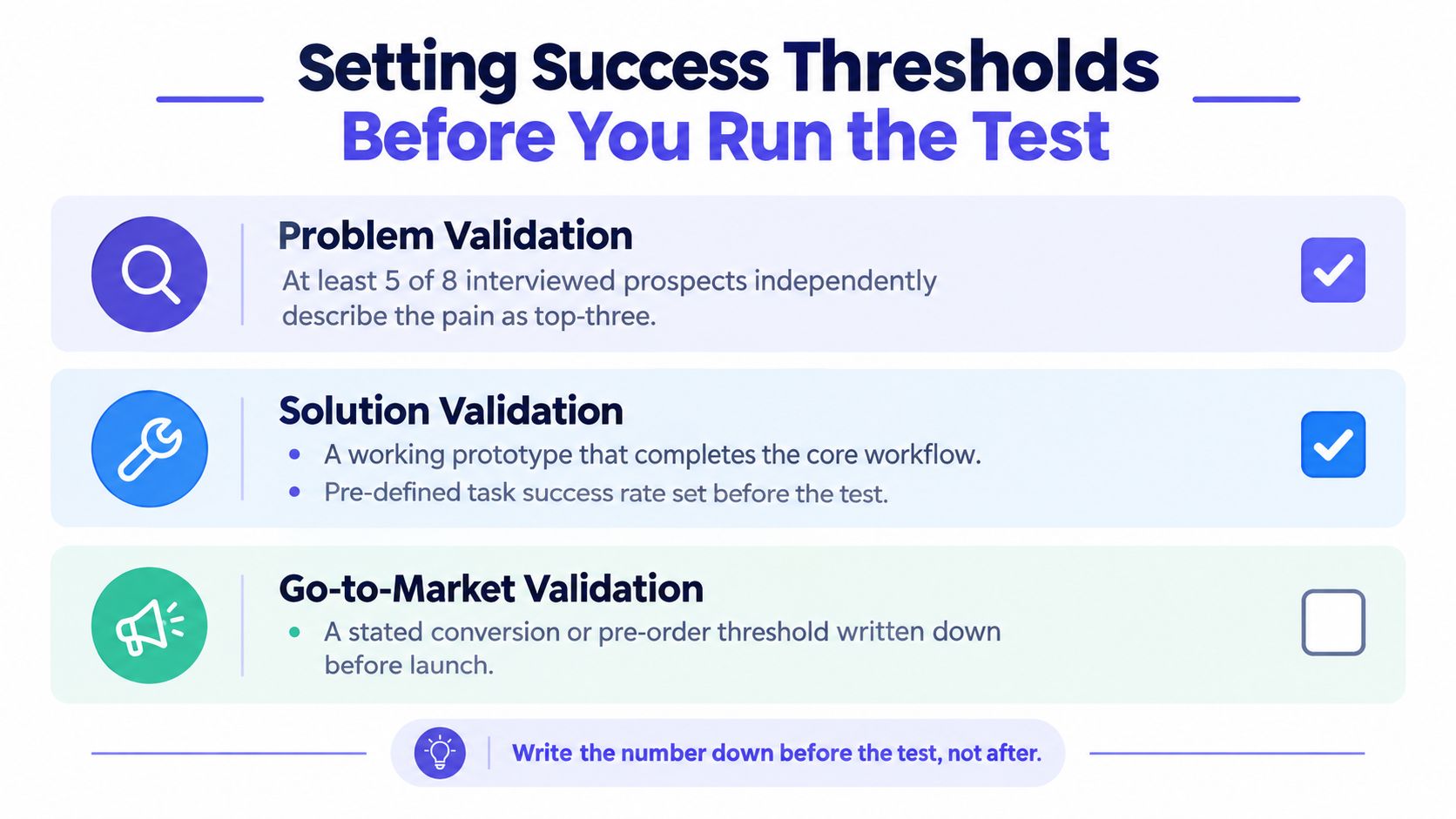
A threshold turns feedback into a decision. Without one, founders tend to reinterpret ambiguous results as encouragement, especially when they're attached to the idea. Set separate gates for problem validation, solution validation, and pricing and economics validation.
Problem validation
The first test should establish whether the problem deserves attention. One practical qualitative gate is that at least 5 of 8 interviewed prospects independently describe the pain as a top-three issue in their workflow. For a quantitative screen, you might require 40% or more of a relevant survey segment to rate the problem as urgent. These examples are useful because they force specificity, but the right threshold depends on the market, sample quality, and decision cost.
Avoid asking only whether respondents like your proposed solution. Ask what they do today, what they have already tried, and what happens if they leave the problem unresolved. Unprompted descriptions and existing workarounds carry more weight than compliments about your concept.
Solution validation
Solution evidence should involve a task. A prototype or smoke test might require a click-through rate of at least 30% to a defined next action, an example threshold documented in Umbrex's validation playbook. A concierge pilot might require 60% or more weekly active usage across two weeks, if repeated use is central to the product's value.
Economics and feasibility
Pricing should be tested before the build becomes expensive. One possible gate is that stated price tolerance from at least 30 surveyed buyers clears the gross margin you require after delivery costs. Another is 10 or more pre-sale or LOI commitments at the target price. The numbers aren't universal forecasts. They're pre-commitments that stop you from moving the goalposts.
Regulatory risk is different. If compliance controls whether you can launch, the threshold may be qualitative confirmation from a qualified advisor, rather than a conversion percentage. A strong demand signal can't compensate for an approval you can't obtain.
When Stated Intent Lies and Behavior Tells the Truth
People answer hypothetical questions from a position of curiosity. They don't feel the cost of migrating data, training colleagues, changing a routine, or defending a new line item in a budget. That gap is why concept scores and stated purchase intent should be treated as directional evidence, not as a forecast.
The underserved question in most validation content is whether the concept predicts behavior under real constraints. Startups.com's overview of the idea-validation process reflects the common emphasis on interviews, surveys, and landing pages, while newer validation approaches increasingly emphasize pilots, pre-sales, and evidence over opinions. The practical difference is significant. A person can sincerely like an AI assistant and still refuse to connect the systems, review its output, or ask a manager to approve it.
The strongest test isn't “Would you use this?” It's “What would you change this week to use it?”
Add a behavior layer
Pair every stated-intent method with an action that introduces friction:
- Interviews plus task trials: Ask prospects to complete the current workflow, then attempt the proposed one.
- Surveys plus price selection: Show a concrete package and ask respondents to choose among realistic options, rather than inviting an abstract willingness-to-pay answer.
- Landing pages plus scheduling: Measure whether visitors book a conversation or provide information needed for a real next step.
- Concept scores plus pilots: Observe repeated use, setup effort, collaboration, and time-to-first-value.
A short pilot is especially revealing for collaborative products. The user must spend calendar time, involve another person, and expose the concept to the messy conditions that a polished survey never reproduces. Teams can use a focused quick feedback form after the task, but the form should supplement observed behavior, not replace it.
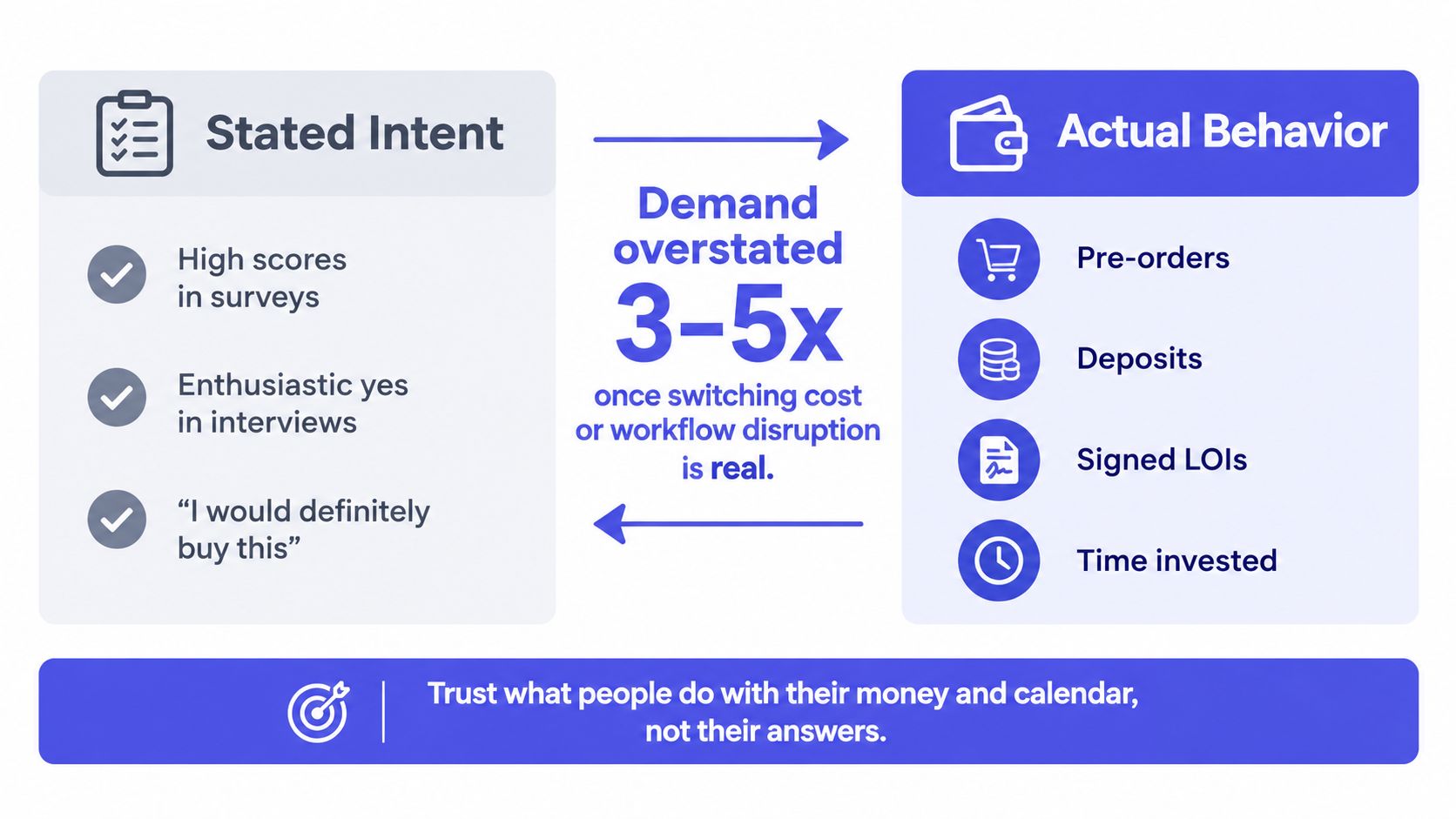
The lesson is uncomfortable but useful. High enthusiasm can coexist with weak adoption when switching costs and workflow disruption are high. Don't ask users to imagine commitment when you can design a small commitment and watch what they do.
A Reusable Experiment Template You Can Run This Week
A useful experiment fits on one page. Write five blocks before you contact anyone:
-
Hypothesis: State who will take what action, under which condition. “Procurement managers will request a demo after watching a 90-second explanation of an AI-assisted review workflow” is testable. “People will love our product” isn't.
-
Method: Choose the cheapest method that could prove the hypothesis wrong. If the question is message clarity, use a landing page. If the question is workflow adoption, use a concierge or pilot test.
-
Audience: Recruit from one defined segment and one channel. A mixed audience produces mixed answers that are difficult to interpret.
-
Threshold: Decide the minimum result that earns the next investment. Put the threshold in writing before launch.
-
Decision rule: Pre-commit to kill, pivot, or continue. A result below the threshold isn't a personal verdict. It tells you which assumption failed.
A fourteen-day operating plan
- Day 1: Write the hypothesis, risk class, threshold, and decision rule.
- Day 2: Draft the landing page and the prospect screener.
- Day 3: Publish the page with one promise and one meaningful action.
- Day 4: Recruit prospects from the chosen channel.
- Day 5: Start the outreach or paid test.
- Days 6 to 9: Run conversations, observe tasks, and record objections.
- Days 10 to 11: Offer the pilot, pre-sale, or scheduled next step.
- Day 12: Score each response against the prewritten criteria.
- Day 13: Review evidence by risk class, not by anecdote.
- Day 14: Make the decision and document what you learned.
Copy can stay simple:
Landing-page headline: “Review supplier decisions faster without adding another manual handoff.”
Ad copy: “Your procurement review is already documented across email, spreadsheets, and shared folders. See a focused workflow for turning that material into a reviewable decision.”
Follow-up email: “Thanks for taking a look. We're testing whether this workflow fits your current review process. Would you be willing to complete one real example with us and tell us where it breaks?”
Use a product discovery template to capture the hypothesis, evidence, owners, and unresolved questions in one place. The artifact matters because teams often remember the positive comments and forget the conditions attached to them.
Common Pitfalls and Your Next Validation Step
Most failed experiments don't fail because the founder chose the wrong tool. They fail because the team covertly changes what counts as evidence.
- Shifting goalposts: You planned to continue only after a defined action, then counted impressions or polite replies when the action didn't happen. Guardrail: record the threshold and decision rule before launch.
- Confirmation bias: You describe the solution in a way that makes agreement easy. Guardrail: begin with the prospect's current workflow and ask open questions before showing your concept.
- Friend-lies: Friends, investors, and loyal users may protect the relationship by being encouraging. Guardrail: recruit people who experience the problem but have no social reason to support you.
- Vanity metrics: Signups, comments, and time on page can indicate curiosity without proving willingness to pay. Guardrail: connect every metric to the next costly or meaningful action.
- Validating the wrong risk: You spend time measuring desirability while price, compliance, delivery cost, or workflow adoption remains unknown. Guardrail: name the dominant risk before choosing the method.
The practical sequence is short:
- Pick the dominant risk. Decide whether the biggest uncertainty concerns the problem, the workflow, delivery, or economics.
- Choose the cheapest method that can refute it. Don't use a full build to answer a question an interview or manual pilot can settle.
- Lock the threshold before launch. Decide what result earns another experiment and what result ends the current path.
Concept validation isn't a milestone you complete once. It's a habit of making smaller bets, watching real behavior, and refusing to let enthusiasm substitute for evidence. For teams that need to preserve decisions, hypotheses, and implementation context while they test, SpecStory, Inc. offers Stoa, a collaborative AI workspace that captures live product conversations, decisions, open questions, and working artifacts so validation evidence can stay connected to the work it changes. Start your next experiment with one written hypothesis, one threshold, and one decision date, then use Stoa to keep the resulting context available to everyone who turns that decision into product work.
Newsletter
Get new posts in your inbox
Bring your team together to build better products. Fresh takes on remote collaboration and AI-driven development.