


The designer drops a Figma link into Slack on Monday morning. Engineering opens it and finds a polished screen, three missing states, an interaction that conflicts with the existing component library, and no answer to what should happen when the API is slow. The designer thought the handoff had started. The developer knows the work is only beginning.
That moment isn't mainly a documentation failure. It's the visible symptom of decisions that were made earlier, without the people who would need to implement, test, support, and maintain them. At small startups, developer designer collaboration works when both disciplines shape the problem before the pixels harden, then leave behind enough context for implementation to move without guesswork.
Table of Contents
- The Bottleneck Is Upstream
- Where Developers Should Actually Be in the Room
- Meeting Rhythms That Earn Their Seats
- Artifacts That Survive the Handoff
- Async Workflows That Actually Scale
- Metrics That Prove It Is Working
- A 30-Day Rollout for a Small Product Team
The Bottleneck Is Upstream
Teams usually notice collaboration problems at the handoff because that is where hidden decisions become visible. A Figma file arrives, questions collect in comments, and the designer learns that a simple interaction needs new data, a responsive approach, or an accessibility decision nobody made. The usual response is more annotations, fuller specifications, or another handoff meeting.
Those changes may reduce confusion, but they address the final stage. The costly mistake occurred earlier, when the team framed the problem without engineering input and treated product intent as background context instead of a decision that needed to become executable.
A 2023 survey of 200 front-end developers found that 92% wanted designers to understand more about the development process, 80% believed their businesses would benefit from closer collaboration, and 55% wanted to be involved earlier in design work. The same source reports that 55% believed a better developer designer relationship could accelerate time to market. The findings identify a timing problem alongside any tooling problem. Developers need influence while the team can still change direction without reworking settled decisions. (Figma's developer designer collaboration survey)
The perception gap hides the cost
Leadership hears “the handoff was unclear” and reaches for a template. Designers may believe they supplied enough detail, while developers receive unresolved product decisions disguised as implementation tasks.
Collaboration works as an operating capability when both disciplines share the user problem, constraints, alternatives, and acceptance conditions before committing to a direction. Attendance at the same meeting matters less than reaching that shared understanding.
Map where decisions become expensive to change. Product intent loses flexibility as it moves from conversation to design, design to code, and code to release. Early technical and interaction questions preserve more options. Teams can apply this bottleneck identification framework to locate constraints, then use the same method to examine product decisions.
Practical rule: A handoff should transfer an agreed decision, not ask engineering to discover what the decision was.
Healthy collaboration has a different shape from sequential specialization. The designer owns interaction quality, hierarchy, content behavior, and visual coherence. The developer owns feasibility, maintainability, performance risks, accessibility implementation, and technical trade-offs. Both own the connection between the user problem and the behavior that ships.
Where Developers Should Actually Be in the Room
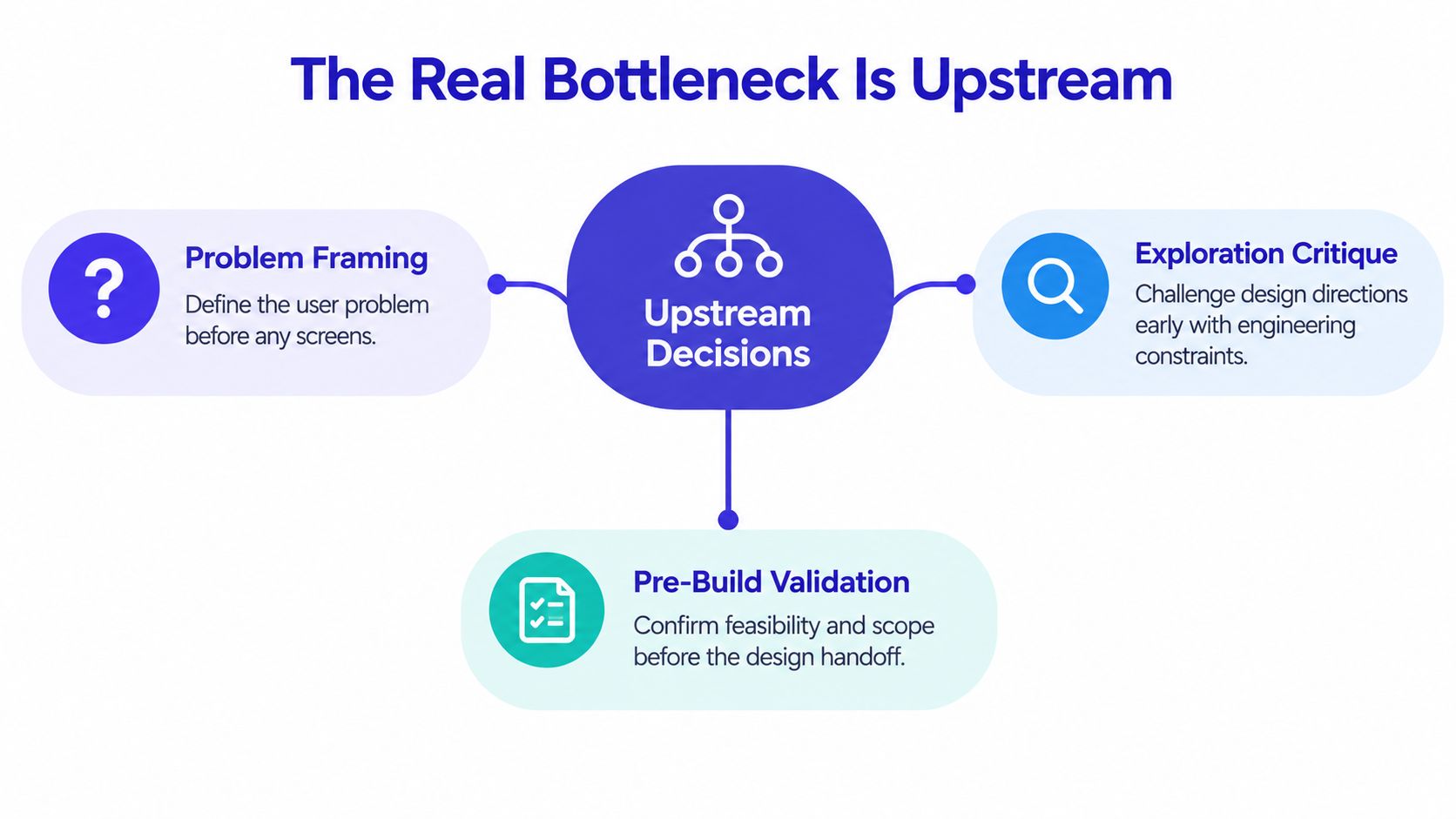
Developers don't need to attend every design activity. They do need to join the moments when the team can still change the problem, the direction, or the scope. On a small product team, I use three decision points: problem framing, exploration critique, and pre-build validation.

Start with the problem, not the screen
At problem framing, the product manager or designer brings the user evidence, desired outcome, known constraints, and non-goals. The developer contributes system realities that may change the shape of the opportunity: available data, existing APIs, browser limitations, security implications, and likely operational cost.
The team should leave with a short problem statement and a list of unresolved questions. Don't ask engineering to approve a finished solution. Ask whether the proposed problem is observable, whether the product can respond to it, and what technical facts could invalidate the direction.
Critique alternatives while they are still cheap
During exploration, the designer should show more than one plausible direction when the choice has meaningful product or technical consequences. The developer should challenge assumptions without turning every critique into an implementation veto.
Discuss:
- Interaction behavior: What happens on loading, empty, error, permission, and partial-data states?
- Technical boundaries: Which behavior fits existing components and services, and which creates a new dependency?
- Accessibility floor: Can keyboard, screen-reader, focus, contrast, and motion requirements shape the interaction before visual polish?
- Performance risk: What does the experience require before it becomes useful, and what can load progressively?
- Content variability: Does the design survive short labels, long names, localization, and unexpected user-generated content?
A controlled study of distributed and co-located software-design teams recorded 140, 179, and 122 design-thinking interactions for three distributed teams, compared with 303, 203, and 323 for their corresponding co-located teams. The distributed teams also emphasized solution-space exploration more than problem-space exploration, which suggests a practical remote-work failure mode: teams can jump into screens and architecture before agreeing on the user problem. (The controlled study of distributed software-design teams)
Validate before visual completion
Pre-build validation is not a ceremonial approval. It's a short review of the selected direction, its states, constraints, testable behavior, and implementation sequence. The designer explains intended behavior and edge cases. The developer identifies feasibility, accessibility, security, and maintenance risks. Product confirms scope and success conditions.
For features involving sensitive inputs, permissions, or account behavior, bring security into this review rather than treating it as a late gate. A practical resource on how to review security during development can help teams expose risks while interaction decisions are still adjustable.
Keep the protocol lightweight. A five-person team doesn't need a steering committee. It needs a decision owner, a designer, a developer, and a written record containing the decision, alternatives considered, open questions, and acceptance criteria. A reusable product design review template can provide the structure, but the team should adapt it to the feature rather than fill it out mechanically.
Meeting Rhythms That Earn Their Seats
A meeting earns its place by producing something the team will use. If participants leave with only a shared feeling that progress happened, the meeting is probably compensating for missing artifacts.
The four rhythms below work because each has a different job. They shouldn't collapse into one recurring “design and engineering sync” where status, critique, planning, and retro feedback compete for the same minutes.
| Rhythm | Cadence | Core attendees | What it produces |
|---|---|---|---|
| Kickoff | Once per feature or meaningful slice | Product, designer, developer, relevant technical owner | Problem statement, scope, constraints, decision owner |
| Mid-build critique | At a meaningful interaction milestone | Designer, developer, product, targeted reviewers | Reviewed behavior, trade-offs, unresolved questions |
| Async standup | Ongoing, written | Everyone contributing to the feature | Current state, blockers, decisions needed, next action |
| Sprint retro | At the end of a delivery cycle | The working team | One or two process changes with owners |
Keep kickoff narrow
Kickoff should establish the problem and boundaries, not become a tour of every screen. The designer brings the user journey and open interaction questions. The developer brings technical constraints and dependencies. Product decides what the team will not solve in this slice.
The output should fit on one page. If the meeting produces a long transcript but no clear owner or acceptance conditions, it has postponed the ambiguity rather than removed it.
Use critique for decisions, not status
A mid-build critique is most useful when something real exists to react to, such as a clickable flow, a working component, or a staging implementation. It shouldn't become a second kickoff. The designer and developer should bring specific questions, such as whether a loading transition communicates progress or whether a component can support the required content states.
Async standup is where many teams over-meet. A written update should state what changed, what is blocked, which decision is needed, and where the relevant artifact lives. If nobody needs discussion, don't schedule discussion.
For teams comparing project or agency tools, a structured browse of agency software comparisons can help separate workflow needs from tool-brand preferences. The important choice is not the platform with the most features. It's the place where decisions remain searchable and attached to the work.
Retrospectives should alter the system
A retro is valuable when the team changes a behavior. “Communicate better” isn't an action. “Every feature with a new interaction gets a developer critique before visual polish” is an action with an owner and a test.
When calendars fill up, cut status meetings first. Keep the pre-build decision review and the mid-build critique, then move routine updates into a shared record. These are the sessions most likely to prevent rework rather than merely report it. Teams can use this meeting best-practices guide to tighten agendas, attendance, and outputs.
Artifacts That Survive the Handoff
A feature can have a beautiful Figma file and still be impossible to build confidently. The problem is that many artifacts describe screens while leaving decisions implicit. A durable handoff describes the user intent, behavior, boundaries, and evidence that will tell the team whether the implementation is correct.
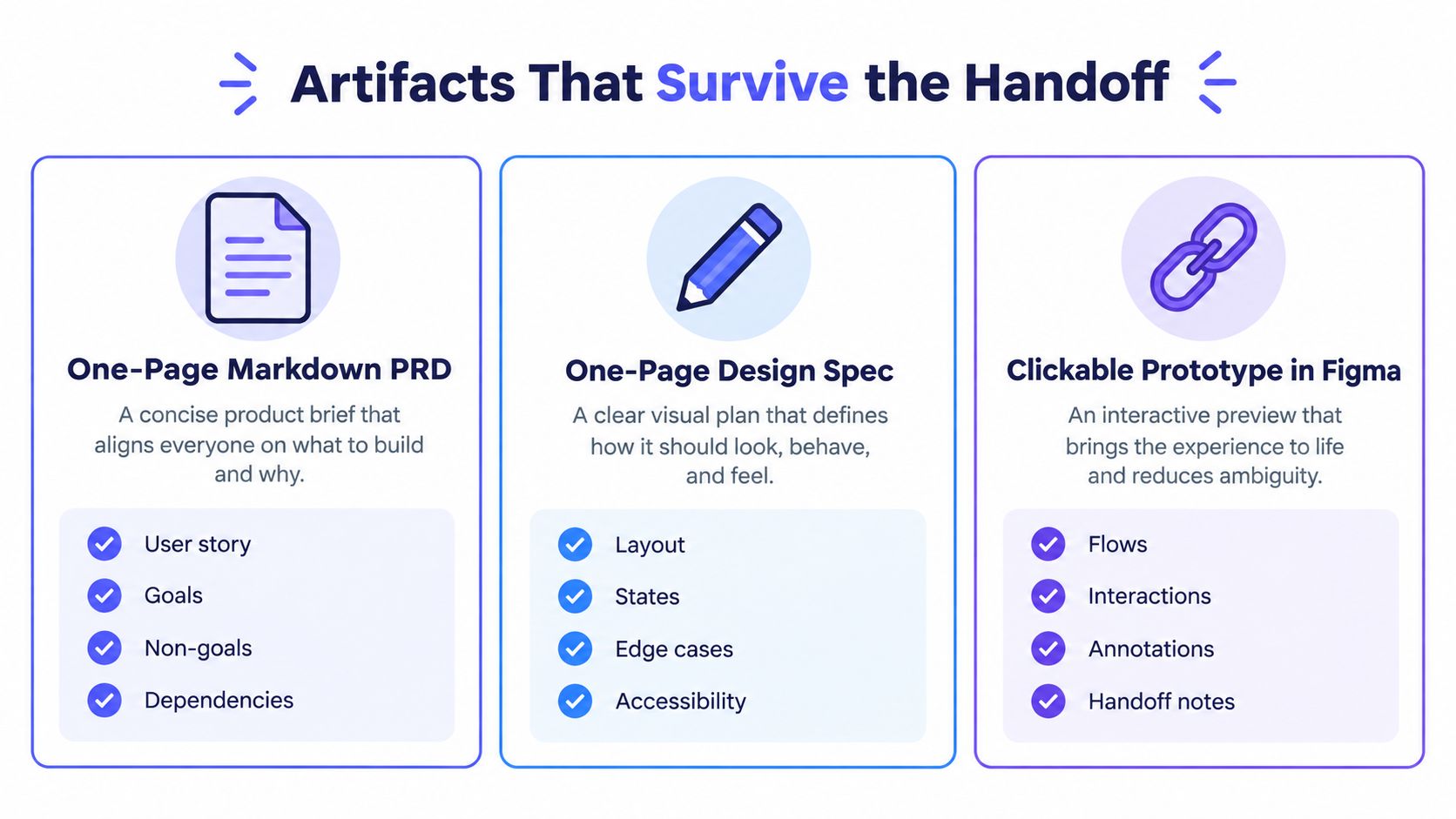
Use three small artifacts for one feature: a one-page Markdown PRD, a one-page design spec, and a clickable prototype in Figma.
The one-page Markdown PRD
The PRD should answer why the feature exists before it describes what the interface looks like. Include:
- User story: Who needs what, and in which situation?
- Goal: What user or product behavior should change?
- Non-goals: Which adjacent problems are deliberately excluded?
- Success metric: What observable result will validate the feature?
- Dependencies: Which services, content, permissions, or decisions must be available?
- Open questions: What remains unknown, and who will resolve it?
A weak PRD says, “Build a dashboard for account activity.” A useful one says what users are trying to understand, what evidence they need, and what the first release won't cover. That distinction gives designers a meaningful target and gives developers a boundary for implementation.
The one-page design spec
The design spec converts intent into behavior. Record layout rules, interaction states, responsive behavior, accessibility notes, edge-case content, and any performance budget that affects the experience.
The designer owns the interaction model, hierarchy, visual language, and content behavior. The developer checks whether the model fits the platform and identifies where a design assumption could create disproportionate complexity. Both should annotate states that don't appear in the primary flow.
The prototype then demonstrates the path through the experience. It shouldn't pretend to specify every implementation detail. It should make key transitions, conditional states, and unresolved questions visible enough for the team to challenge them.
A useful handoff says, “When the activity request is pending, show the last known state, expose progress, and allow retry. The first release excludes historical export.” A blocking handoff says, “Build this screen,” and leaves the developer to infer what happens outside the screenshot.
Pre-build validation checklist
Before coding starts, confirm:
- User intent: The problem statement and target behavior are written.
- Scope: Goals, non-goals, dependencies, and decision ownership are explicit.
- States: Loading, empty, error, permission, success, and long-content states are covered where relevant.
- Accessibility: Keyboard behavior, focus order, semantics, contrast, and motion expectations are identified.
- Technical fit: The developer has reviewed feasibility, performance, security, and maintainability risks.
- Acceptance: The team can test the intended behavior without relying on visual interpretation alone.
- Traceability: The prototype, design spec, PRD, code change, and validation result link to one another.
The handoff becomes a checkpoint in a chain of evidence. It no longer asks engineering to translate a picture into a product decision.
Async Workflows That Actually Scale
Async collaboration fails when teams confuse silence with clarity. A designer in one time zone may leave a Figma comment before ending the day, while the developer wakes up and makes a reasonable interpretation that nobody reviews until the next overlap. The issue isn't distance alone. The issue is that the decision has no durable home.
An observational IBM study found that developers spent 45% of their time collaborating, while 31.9% was spent seeking information and 9.35% using software-process tools. Within communication effort, about 15% was spent looking for information needed to understand colleagues' work, share knowledge, and manage dependencies. (IBM's observational study of developer collaboration and information seeking)
That finding changes the design of an async workflow. The goal isn't to eliminate interaction. It's to lower the cost of retrieving the context behind a decision.
Four primitives make async dependable
A shared decision room gives the feature one obvious location for the current problem, links, open questions, and participants. Slack can point to it, but it shouldn't be the only place the decision exists.
A versioned decision record captures context, alternatives, chosen direction, constraints, owner, and validation. When the direction changes, update the record and preserve the reason. This prevents an old Figma comment from becoming the source of truth.
Structured design threads keep questions attached to the relevant frame or flow. Close each thread with a short summary that states the decision and links to the record. Unresolved comments should have an owner, not merely a color-coded status.
Specific voice notes can explain timing, feel, or interaction quality faster than a long written description. Attach them to a page or frame, then summarize the actionable decision in text so the context remains searchable.
Use live calls for ambiguity that written exchange cannot resolve efficiently, especially when several alternatives need rapid comparison. After the call, record the decision. A conversation that exists only in memory is not an async workflow.
For small teams, plain Markdown files, linked Figma frames, issue trackers, and pull requests are often enough. The tooling matters less than the connection between intent and implementation. SpecStory, Inc. offers a multiplayer workspace where teams capture conversations, decisions, designs, and open questions, then connect that context to shared specifications and code work. It is one possible approach when a team wants live collaboration and traceable artifacts in the same workflow.
Metrics That Prove It Is Working
Collaboration metrics should expose friction, not rank individuals. Track whether people can find decisions, answer questions, and validate behavior without repeated reconstruction.
Start with two or three measures. More instrumentation won't rescue a process the team doesn't use.
Five useful signals
Median time to answer a cross-functional question shows how quickly a designer or developer can get unstuck. Record when the question is posted and when a usable answer appears. A falling median suggests that ownership and context are becoming clearer.
Percentage of design decisions with searchable rationale measures whether the team can explain why a direction exists. Sample material decisions and check for the problem, alternatives, chosen path, and owner. Don't count a link to a Figma file as rationale.
Rework caused by missing context captures implementation changes triggered by absent states, unclear intent, or undisclosed constraints. Label the cause in the issue or pull request. This keeps the metric focused on information failure rather than normal iteration.
Elapsed time from design approval to validated UI connects collaboration to delivery without treating coding speed as the only outcome. Start the clock at the agreed design decision and stop it when the behavior passes the acceptance checks in a working environment.
A monthly pulse from both disciplines asks designers and developers whether they had the context, access, and opportunity to influence decisions they were responsible for. Keep the questions identical across roles so leadership can see perception differences rather than averaging them away.
When measuring feature outcomes alongside workflow quality, a practical feature adoption metrics guide can help distinguish “the feature shipped” from “users adopted the intended behavior.”
Measure retrieval cost, not meeting volume
Meeting count is a poor proxy for collaboration. A team can spend more time together and still lose decisions in chat threads. Conversely, a small team may communicate less synchronously while preserving excellent records and resolving questions quickly.
Review the metrics monthly with both roles. Look for patterns, not targets detached from context. If question response improves but rework remains high, the team may be answering questions after design decisions have already hardened. If rationale coverage improves but validation time grows, the protocol may need fewer fields or clearer ownership.
A 30-Day Rollout for a Small Product Team
Don't redesign the entire operating model at once. Install one repeatable loop on the next meaningful feature, observe where it strains, and adjust the smallest necessary part.
Week one maps the current friction
Collect recent examples of late technical constraints, unanswered design comments, repeated questions, and rework caused by missing context. Don't turn this into a blame exercise. Trace each example to the decision that should have happened earlier.
Choose two measures for the first month: median time to answer cross-functional questions and rework caused by missing context are a practical pair. One measures retrieval, the other measures the cost of failed retrieval. Agree on where the records will live before introducing new templates.
Week two installs the pre-commit protocol
Apply the three decision points to the next feature. At problem framing, write the user problem, evidence, constraints, and non-goals. During exploration, review alternatives with a developer. Before build, record states, accessibility expectations, dependencies, and acceptance criteria.
Expect resistance to completeness. The designer may feel asked to specify details too early. The developer may worry that critique is becoming approval bureaucracy. Keep the record short and use unresolved questions instead of forcing false certainty.
Week three retires one meeting
Choose a recurring status meeting that mainly repeats information available elsewhere. Replace it with an async update containing current state, blockers, decisions needed, and next action. Preserve a live critique for ambiguous work rather than moving all collaboration into text.
The team learns here whether its artifacts are real. If people still ask "where did that decision go?", the answer should be a link, not a new meeting.
Week four runs the retro and checks the signals
Review the two measures with the designer, developer, and product owner. Identify which fields were useful, which were ignored, and which questions arrived too late. Update the template and make one process change for the next feature.
The new rhythm is sticking when both sides report fewer moments of searching for lost decisions and rework caused by late technical constraints trends downward. It won't remove disagreement. It should make disagreement earlier, more visible, and cheaper to resolve.
SpecStory, Inc. offers a shared workspace where product conversations become traceable decisions, Markdown specifications, design context, and code-ready work, helping developer designer collaboration survive beyond the meeting or Figma comment. If your team is losing time to missing context, visit SpecStory, Inc. and evaluate whether a connected decision record can shorten the path from agreement to validated implementation.
Newsletter
Get new posts in your inbox
Bring your team together to build better products. Fresh takes on remote collaboration and AI-driven development.