


A release is slipping. Slack looks busy, Jira looks full, Figma has comments everywhere, and GitHub shows plenty of activity. Still, nothing important gets shipped.
Teams in that situation pick the wrong suspect. They blame QA because cards pile up there. They blame engineering because story points spill. They blame design because approvals take too long. Sometimes they're right. Often they're just staring at the place where delay becomes visible, not the place where throughput is constrained.
For remote product teams, that mistake gets worse because the queue often sits between conversation and commit. A decision gets made in a call. Someone leaves with a half-formed action item. A designer updates a file. An engineer waits for a clarifying comment. A PM assumes the trade-off was understood. The work isn't blocked by effort. It's blocked by missing traceability.
Table of Contents
- Why Bottlenecks Hide in Plain Sight
- Mapping the Actual Workflow Before You Measure
- Metrics That Reveal the True Constraint
- Diagnostic Experiments That Validate Your Findings
- Remediation Patterns That Actually Restore Throughput
- Keeping Flow Healthy After the Fix
Why Bottlenecks Hide in Plain Sight
The hardest part of bottleneck identification is that the true constraint rarely looks dramatic. It usually looks normal. A review step seems a little slow. A handoff feels slightly fuzzy. A planning decision stays unresolved for a day too long. Each delay appears small on its own, but the system starts taking its pace from that point.
The slowest-looking step often isn't the bottleneck
Manufacturing research got this point right long before software teams started borrowing the language. A widely used operational definition treats the bottleneck as the station with the largest active-period percentage, and more rigorous approaches compare average active periods with 95% confidence intervals so teams can distinguish a likely bottleneck from other machines whose intervals overlap with the leader's (Chalmers research on active-period bottleneck detection).
That matters outside factories too. The step that looks overloaded may just be absorbing variation created upstream. In product delivery, code review can look like the problem when the actual issue is unstable scope entering development. QA can look slow when acceptance criteria arrive incomplete. Design can look constrained when decisions are still being negotiated after the kickoff call ends.
Practical rule: Treat visible pileups as clues, not verdicts.
I use Intent Lead Time as a working lens for this. It's the time between a team agreeing on what should happen and the first durable execution artifact showing that intent clearly moved forward. That artifact could be a commit, a spec update, a test plan, a design revision, or a linked implementation task. If that gap keeps stretching, your bottleneck may be a decision system problem, not a production problem.
Remote teams create invisible queues
In office settings, some of this friction is audible. You hear the unresolved question. You notice who is waiting. In remote teams, delay hides in tabs and threads.
Common examples:
- Meeting drift: A decision gets discussed but not captured in a reusable form.
- Approval ambiguity: Two people think the other one owns the next step.
- Tool fragmentation: The rationale sits in Zoom, the task sits in Linear, and implementation starts in Cursor with partial context.
- Handoff decay: Each transfer strips away assumptions that were obvious in the live conversation.
When resources are tight, these hidden queues get sharper. A useful framing for leaders dealing with capacity pressure is this leader's guide to scarce resources, because it pushes the conversation away from generic busyness and toward explicit trade-offs about where constrained attention should go.
Throughput matters more than local busyness
The Theory of Constraints changed operations by arguing that system throughput is governed by the constraint, not the average capacity of all resources. Later research made that measurable by defining a machine as the bottleneck when total system throughput is most sensitive to that machine's isolated throughput, and by the 2020s the field had matured into a distinct research area with methods spanning queue analysis, blockage, starvation, and active-state percentages (historical and methodological review in manufacturing bottleneck research).
Product teams need the same discipline. Don't ask who seems busiest. Ask which constraint currently sets the pace of delivery, and whether the evidence from discussion, handoff, and execution all points to the same place.
Mapping the Actual Workflow Before You Measure
A remote product team can look organized on the board and still lose days between a decision in a meeting and the first clean implementation commit. The gap usually is not one stage. It is the chain of small waits, missing context, quiet reversals, and unrecorded approvals that sit between conversation, design, code, and release.
If the map is too tidy, it will point you to the wrong constraint.
Reconstruct the path from evidence, not memory
A useful manufacturing approach starts with event logs and order data, mines the observed process, and then tests where throughput is constrained. It also warns that poor data preparation breaks the analysis, which is why cleaning, filtering, event-log generation, conformance checks, and validation come before any conclusion (process mining and factory-physics pipeline for bottleneck analysis).
For a product team, the raw material is different but the discipline is the same. Start with timestamped records that can survive scrutiny:
- Ticket history from Jira, Linear, or GitHub Issues.
- Commit and PR timestamps from GitHub or GitLab.
- Design activity from Figma comments, status changes, or review requests.
- Conversation records from meeting transcripts, Slack threads, and decision docs.
- Operational requests such as support escalations, customer bugs, or sales-driven asks.
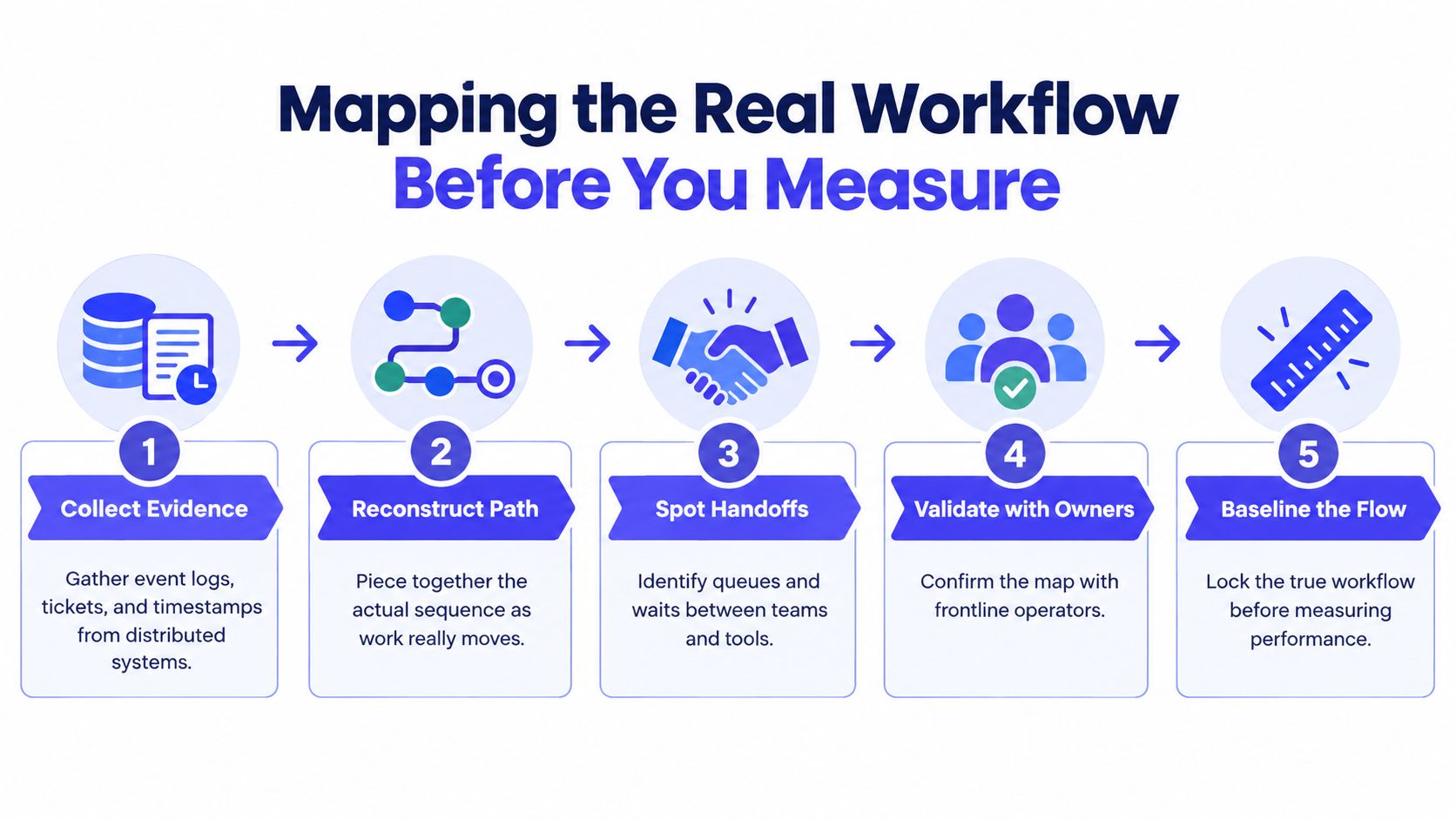
Then build a trace from decision to commit. I usually line up the first problem signal, the moment a team chose a direction, the design approval, the first implementation artifact, and the release confirmation. That sequence shows whether work flowed in one pass or stalled in the spaces between tools and functions.
Compare that observed path with the official workflow. If they differ, measure the observed path. Teams optimize the process they can document, not the one in the handbook.
If you need a practical reference for reconstructing observed paths from operational records, this guide to process mining for workflow analysis is useful because it focuses on how work moved through the system.
Include the artifacts between teams
Status changes alone are too thin for bottleneck work. A card moving from "In Progress" to "Review" does not tell you whether the work was ready, whether the decision was stable, or whether the engineer had to guess.
Map the artifacts that carry intent across functions:
| Workflow moment | Traceable artifact |
|---|---|
| Problem framed | Call note, incident summary, or PRD draft |
| Decision made | Captured decision with owner and unresolved questions |
| Design accepted | Linked file version or approval comment |
| Build started | Branch, PR, or implementation task |
| Delivery verified | Test evidence, release note, or shipped state |
This artifact trail matters more in remote teams because the handoff is often asynchronous. If the decision is buried in a transcript, design approval sits in a comment thread, and implementation starts from a loosely named ticket, delay will show up later as rework, review churn, or idle waiting that no status report explains.
Optimize the workflow your records can defend.
Validate with the people doing the work
Logs give sequence. People explain why the sequence bent.
A ticket timestamp will not tell you that nobody left a meeting with decision rights. A merged PR will not show that the engineer rebuilt the feature after a late design change. I have seen teams call engineering the bottleneck when the slower point was an unresolved product choice that kept resurfacing in Slack and PR review.
Run short validation sessions with the people closest to the work:
- Ask for exceptions: Where does work bypass the stated flow?
- Probe rework loops: Which step sends work backward most often?
- Check hidden approvals: Who can delay progress without appearing on the board?
- Mark unresolved decisions: Which open questions survive meetings and reappear during build or review?
Research on bottleneck detection from unstructured process data and process documents is a useful reminder that clean event logs are unusual in day-to-day operations, especially in knowledge work where decisions are scattered across documents and conversations (research on bottlenecks in messy and unstructured process data).
A good workflow map does not need to look polished. It needs enough evidence that another person can trace the same path and reach the same conclusion.
Metrics That Reveal the True Constraint
A remote team can look busy all week and still ship at the pace of one unresolved decision. That is why bottleneck identification breaks down when teams rely on whichever metric is easiest to screenshot from Jira or GitHub.
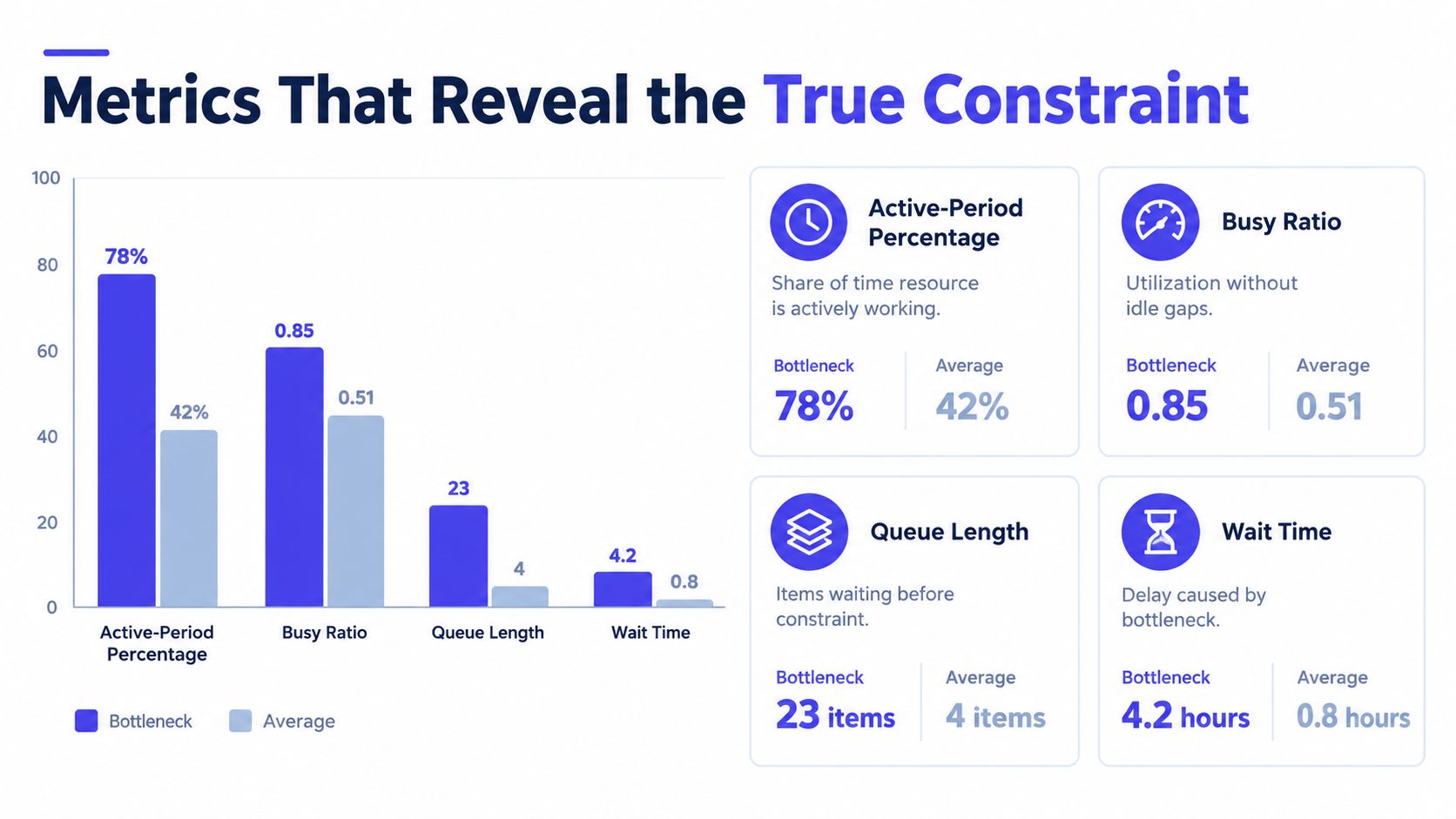
The job here is to find the step that governs system output often enough that changing it would change delivery rate. In product work, that step is not always a person or a column. It can be a review queue, a decision handoff, or the gap between agreement in Slack and a commit that reflects that agreement.
What to measure first
Start with metrics that can survive a traceability check. If a metric points to a constraint, you should be able to follow that signal through ticket history, review activity, and the conversations that changed the work.
I use five measures first:
- Active-period percentage: How much of the observed window a stage is processing work.
- Busy ratio: How often a stage is occupied versus idle. Useful for comparing candidates that all feel overloaded.
- Queue length: How much work waits before a stage. Useful only when paired with arrival rate and completion rate.
- Blockage and starvation patterns: Whether a stage is waiting on input, or waiting because it cannot push completed work forward.
- Inter-departure times: How regularly finished work leaves the system. Irregular exits often expose a hidden gating step.
Used together, these separate local busyness from system constraint. A designer can be fully booked and still not be the bottleneck if engineering keeps shipping steadily. A review stage with uneven departures and recurring wait states is a stronger candidate, especially when the underlying reason traces back to missing decisions or repeated clarification loops.
What misleads teams
Queue size gets too much attention because it is visible. In knowledge work, the longest column often forms after the constraint.
Research on statistical bottleneck detection shows why queue-based methods can mislead when observation windows are short or buffers are constrained, and why throughput sensitivity is a better test than queue size alone (benchmark and pitfalls in statistical bottleneck detection).
The same mistake shows up in product delivery:
| Misleading signal | Why it fails |
|---|---|
| Biggest backlog column | Often reflects ambiguity introduced earlier, not the point governing output |
| Highest utilization person | Often marks the person absorbing poor inputs, interrupts, or exception work |
| Longest stage duration | Often includes waiting created by another team or an unresolved decision |
| Most escalations | Often tracks customer visibility, not actual system constraint |
If your goal is shorter elapsed delivery time, this guide on cycle time reduction in product workflows is useful because it separates active work from waiting, handoff delay, and rework.
Measure decision latency, not just work-item latency
Remote teams add one more failure mode. The constraint often sits between conversation and execution.
A ticket can move into "in progress" while the underlying work is blocked by a missing product call, a design clarification buried in Figma comments, or a review thread that settled nothing. Standard flow metrics flatten those delays into one stage duration. That hides the difference between execution delay and decision delay.
Track decision-to-commit signals alongside stage metrics:
- time from open question to named decision
- time from decision to first code change
- count of reopened decisions per item
- share of PR comments that introduce new scope rather than review the stated scope
- number of handoffs between the last requirement change and merge
These are not factory metrics in the strict sense. They make factory-physics measures usable in remote product work because they show whether the governing constraint is capacity, variability, or missing decision rights.
Segment the constraint by workflow type
A single workflow average blurs the result. The bottleneck for roadmap work is often different from the bottleneck for urgent customer issues.
In practice, segment by:
- incoming channel
- work type
- priority class
- team boundary crossed
- synchronous versus asynchronous decision path
That cut usually changes the diagnosis. Design is rarely "slow" across all work. One path may depend on same-day clarification from a PM in another time zone. Engineering is rarely "overloaded" in the abstract. One class of changes may depend on a single reviewer, a brittle service owner, or repeated scope decisions after development starts.
A useful metric section should let another operator retrace the conclusion: this queue grew, this stage stayed busy, departures stayed irregular, and these decisions kept reopening before code could move. That is a bottleneck diagnosis a remote team can defend.
Diagnostic Experiments That Validate Your Findings
A remote team can agree on the wrong bottleneck for a month because the pain shows up in one place and the governing constraint sits somewhere else. A PR queue grows, so engineering gets blamed. Then a two-day audit shows the delay started earlier: open questions sat in Slack, no one recorded the decision, and code could not start with confidence.
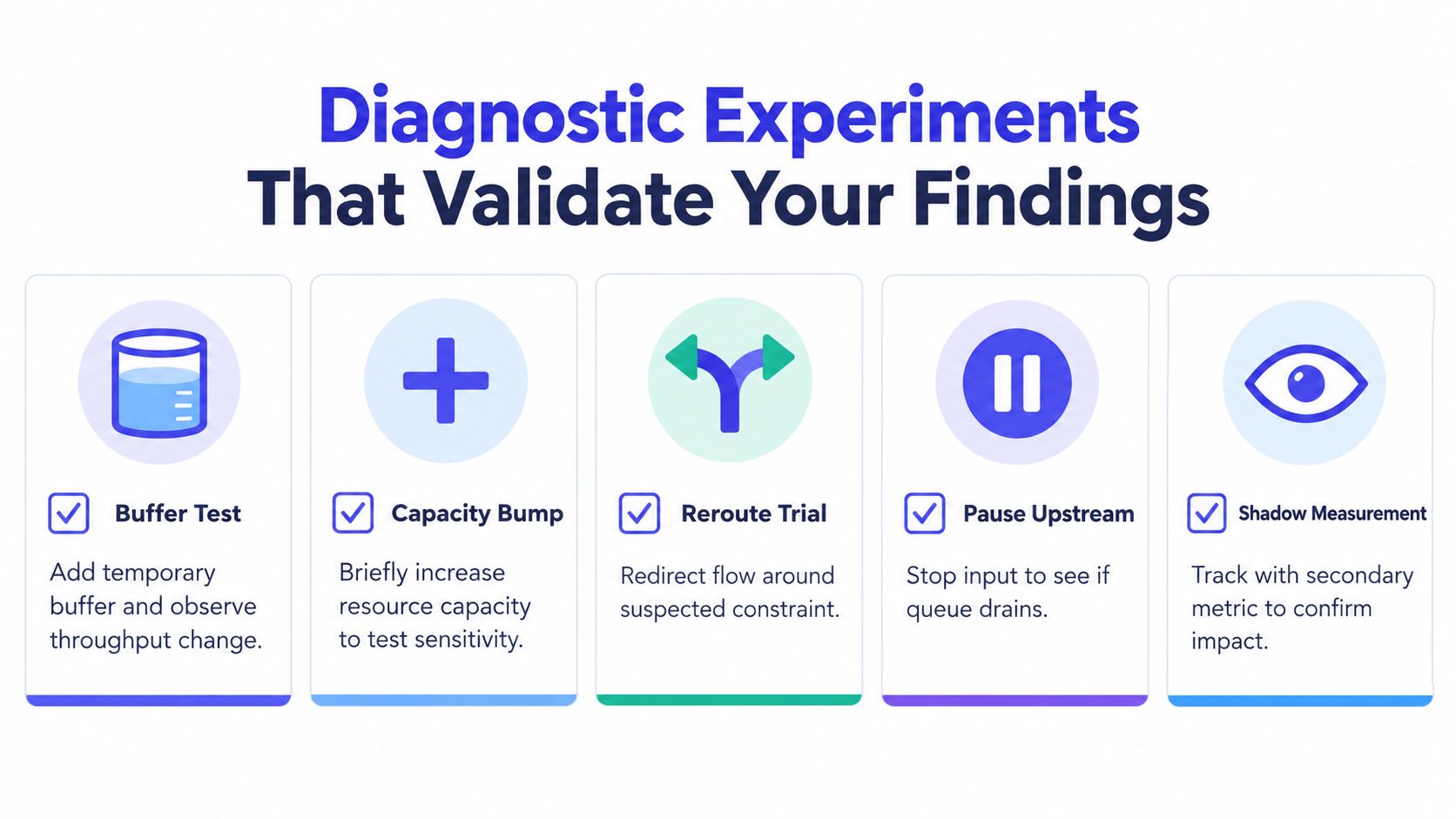
A metric gives you a candidate. Validation comes from a controlled change in the workflow and a visible effect on system output.
Turn the diagnosis into a test
Treat each bottleneck claim as an operational hypothesis tied to a specific decision-to-commit path. If design review is the constraint, a temporary increase in review capacity should change departure rate or queue age for that class of work. If the constraint is unresolved scope, extra reviewers will stay busy while throughput barely moves.
The check is simple:
| Suspected constraint | Validation signal |
|---|---|
| A stage is always busy | Add temporary capacity for a narrow work type and measure whether completed items increase |
| A queue keeps growing before one handoff | Pause or throttle intake briefly and see whether the queue drains in a stable pattern |
| Reviews feel slow | Reroute one class of changes to a different reviewer path and compare cycle time to merge |
| Delivery starts late after approval | Require a written decision record, then check whether time from decision to first commit drops |
| Work keeps bouncing back | Freeze scope after a named checkpoint and measure reopen rate and merge delay |
These tests work because they force a traceable cause-and-effect record. The team can point to one intervention, one date range, one work type, and one outcome.
Run experiments that are small, reversible, and easy to audit
Use changes you can unwind in a week.
- Capacity bump: Add one backup reviewer, one temporary triage owner, or one extra approver for a specific queue.
- WIP tightening: Reduce work released to the step before the suspected constraint and watch whether waiting time falls or downstream work starves.
- Reroute trial: Send a narrow category of tickets, defects, or PRs through an alternate path with different decision rights.
- Upstream pause: Stop feeding new items into the suspected constraint long enough to observe whether the backlog clears predictably.
- Decision trace trial: Require each item to include the latest decision, owner, timestamp, and source thread, then compare start latency and reopen rates.
- Shadow measurement: Track one secondary indicator next to the main one, such as decision age, reviewer load, or time from clarification to first code change.
I prefer tests that isolate one variable, even if they look almost too small to matter. Small tests create cleaner reads. Large fixes mix policy, staffing, and tooling changes, which makes the result hard to attribute.
Match the test to the type of constraint
Capacity experiments are useful for capacity problems. They are much less useful for variability and decision-rights problems.
That trade-off matters in remote product teams. If a team works across time zones, the visible queue in Jira may be a symptom of batched clarification. If a staff engineer approves every risky change, the issue may look like code review load when the actual constraint is a policy about who can make the call. If design files, tickets, and PRs disagree on scope, the system is paying for traceability failure, not lack of hands.
A good experiment respects that difference. It asks, "What would change if this were the constraint?" Then it tests only that.
Use statistical discipline when the sample is good enough
Some teams have enough repeated work to compare paths with more than visual inspection. In that case, use repeated observations, compare candidate constraints directly, and check whether the intervention changed throughput, queue age, or time to commit by more than ordinary variation.
Do not force lightweight product work into a heavy model when the sample is thin or the work mix keeps changing. For many teams, ten clean observations on the same work type are more useful than a quarter of blended averages across bugs, roadmap items, and urgent customer requests.
The standard is not academic purity. The standard is whether another operator could review your experiment log and reach the same conclusion.
Watch for false negatives in messy systems
Validation fails when the observation window is too short, when queues are hidden in side channels, or when teams actively work around the suspected constraint. A modest queue does not prove a stage is healthy. It may mean people are rationing intake, splitting work into smaller tickets to bypass review, or resolving key questions in meetings that never make it back into the artifact trail.
That is why I check the conversation-to-code chain during the test window. Which decision changed the work. Where was it recorded. How long until someone committed code against that decision. How many times did the item reopen after development started.
If the experiment changes local activity but not system output, reject the diagnosis and move on. Traceable decisions make that call easier.
Remediation Patterns That Actually Restore Throughput
After you confirm the constraint, the next mistake is treating every fix as a capacity problem. In remote product teams, the binding constraint is often a broken chain between a decision, the artifact that records it, and the commit that acts on it. Adding people to a stage with unclear intent usually creates more waiting, more review churn, and more reopen loops.

Match the remedy to the constraint type
The useful question is simple: which constraint, if relaxed first, will change shipped output rather than local activity? That framing matters because product work mixes factory-physics effects such as queueing and batch size with softer failure modes such as missing decisions, unclear ownership, and side-channel approvals.
Different constraints need different remedies:
- Decision constraint: Cut approval layers, define delegation, and require unresolved questions to stay attached to the work item until resolved.
- Skill constraint: Cross-train reviewers, separate standard cases from exceptions, and use templates where judgment is repetitive rather than novel.
- Policy constraint: Change batch size, intake rules, release gates, or priority rules that keep expediting work at the expense of planned delivery.
- Tool constraint: Remove manual copying, sync artifacts, and reduce the number of places where people have to reconstruct context.
- Coordination constraint: Tie rationale directly to the ticket, spec, branch, and pull request so handoffs do not depend on memory.
I have seen teams spend a quarter improving sprint hygiene when the delay sat in product and design decisions that never made it into the artifact trail. The board looked organized. Engineers still waited for meaning.
Choose fixes that change system output
A good remediation plan survives contact with measurement. It should improve throughput, queue age, or time from decision to first commit. If it only makes one group feel busier or more comfortable, it is probably cosmetic.
Use a screen like this:
| Candidate fix | Good reason to do it | Weak reason to do it |
|---|---|---|
| Add reviewer capacity | Review limits end-to-end output | Reviewers are the loudest stakeholders |
| Automate status and handoff updates | Missing context delays starts or causes rework | Automation sounds efficient |
| Split work into smaller batches | Large items age in queue or bounce in review | Smaller tickets look cleaner |
| Change priority policy | Expedite work keeps preempting committed work | Leadership wants a new rule |
| Tighten decision records | Teams lose time reconstructing what was agreed | Meeting notes exist somewhere |
If you want a complementary operations view, Doczen enterprise workflow optimization is useful because it focuses on workflow design and throughput improvement at the system level.
Repair the decision-to-commit chain
Remote teams rarely fail because the Kanban column names are wrong. They fail because intent degrades between the call, the doc, the ticket, and the code. That is why the most durable fixes make the decision-to-commit path inspectable.
In practice, that means a few things:
- decisions live in a durable artifact, not only in a meeting
- open questions stay visible until someone closes them
- design rationale follows the engineer into implementation
- implementation feedback returns to the original decision record
- reviewers can see what changed and why without hunting across tools
This is also where trade-offs get real. More traceability adds overhead. Too little traceability creates rework, approval ambiguity, and long review cycles because each person has to rebuild context alone. The target is not perfect documentation. The target is enough evidence that another operator can trace a shipped change back to the decision that authorized it.
SpecStory, Inc. builds tooling that captures live conversations, decisions, and artifacts as plain files tied to execution. That matters when the bottleneck sits between agreement and code rather than inside a single delivery tool.
For broader operating changes after the immediate fix, this guide to team productivity improvement in product orgs is a useful companion because it treats throughput as a system property, not a heroics problem.
Fixes last when the next person can see why a choice was made and how it turned into code.
Expect the constraint to move
A successful fix changes the shape of the system. Once decision lag drops, review often becomes the next limiter. Once review speeds up, release coordination or test environment access may take over.
That shift is normal. Trace the workflow again, starting from a recent shipped item and working backward through decision, design, implementation, and release. The goal is not one permanent cure. The goal is a repeatable way to choose the next intervention with evidence.
Keeping Flow Healthy After the Fix
The teams that stay fast don't treat bottleneck identification as a rescue exercise. They treat it as maintenance.
Once a fix lands, watch whether the workflow still preserves intent from conversation to execution. That's especially important in remote and hybrid teams, where regression usually starts with context drift long before the board shows a backlog problem.
A lightweight operating rhythm
You don't need a big operations function to keep flow healthy. You need a steady review loop.
A simple monthly check works well:
- Audit one real delivery path: Start from a shipped item and trace backward through decision, design, implementation, and release artifacts.
- Review one queue: Pick the stage with the most waiting and ask whether it's the cause or the symptom.
- Reopen unresolved questions: Find decisions that were "good enough for now" and see whether they later created rework.
- Check segment drift: Compare planned work, urgent work, and customer-reported work separately.
What to keep visible all the time
A healthy system makes a few things easy to inspect:
| Keep visible | Why it matters |
|---|---|
| Decision owner | Prevents approval ambiguity |
| Open questions | Stops hidden blockers from aging silently |
| First execution artifact | Shows whether intent actually translated into action |
| Rework loop | Reveals where context is failing |
| Throughput by work segment | Surfaces shifting constraints |
Healthy flow isn't the absence of delay. It's the presence of fast, traceable diagnosis when delay appears.
The discipline that prevents regression
Most regressions come from one of three habits. Teams start work before decisions are stable. They separate rationale from execution. Or they optimize a local pain point without checking system throughput.
Keep the standard high:
- measure the workflow, not the ideal one
- validate the suspected constraint before funding the fix
- relax the constraint that changes output, not the one that draws the most complaints
- preserve context so remote teammates can act without reconstruction work
That operating rhythm is what turns bottleneck identification from a one-off workshop into a practical delivery advantage.
SpecStory, Inc. offers a multiplayer AI workspace for product teams that turns conversations into traceable execution context and code, which is especially useful when your bottleneck sits between a meeting decision and the first commit. If your team is trying to reduce Slack archaeology, keep unresolved questions attached to the work, and make decision-to-commit flow visible, visit SpecStory, Inc..
Newsletter
Get new posts in your inbox
Bring your team together to build better products. Fresh takes on remote collaboration and AI-driven development.