


A customer asks for better reporting in a support ticket. Sales repeats the request after a renewal call, and an engineer discusses an export button in Slack. By planning day, you've got scattered notes, competing interpretations, and nobody responsible for finding out what the customer needs.
Feature request management should turn that mess into a decision you can explain and an outcome you can check. For a small team, that means keeping the original evidence, naming an owner, and testing whether the eventual change solves the problem. You don't need another documentation layer. You need a dependable path through the tools you already use.
Table of Contents
- The Feature Request Workflow Stage by Stage
- How to Set Up Intake and Triage Rules
- Choosing RICE, ICE or Kano for Your Backlog
- Tracing Each Request from Problem to Outcome
- Tools, Automation and the Kickoff Handoff
- KPIs for Request Health and Delivery
- Confirm Your Triage Rules Before the Next Planning Cycle
The Feature Request Workflow Stage by Stage
Treat every incoming feature request as an unproven problem, not a commitment to build. The customer's suggested solution belongs in the record, but it shouldn't determine the implementation before product and engineering understand the need.
A 2025 systematic review of feature-request analysis examined 140 primary studies and reports an earlier finding that approximately 23.3% of mobile-app reviews are feature requests. That finding concerns mobile-app reviews, not every feedback channel, but it illustrates why collecting requests can't remain an occasional cleanup task.
Give every transition an owner
Use the following as recommended operating targets, not industry benchmarks. A person can own several stages on a small team, but each transition still needs an explicit handoff.
Feature request workflow stages, owners and time limits
| Stage | Owner | Target time | Output |
|---|---|---|---|
| Capture | Support or community lead | Within 1 business day | Request record with source and customer quote |
| Triage | Product manager | Within 2 business days | Bucket: bug, need or idea, and duplicate link |
| Evaluate | Product manager with engineering lead | Within one sprint | Score and effort estimate |
| Decide | Product lead | Monthly review | Accept, defer or decline with a written reason |
| Close the loop | Named request owner | At release | Requester notified and outcome recorded |
Accept doesn't mean promise a delivery date. It means the problem merits investment within an explicit scope. Engineering still needs to resolve dependencies, technical uncertainty, and release risk.
A deferred request needs a revisit condition, such as evidence from another customer segment or completion of a prerequisite. Without that condition, defer becomes a polite label for forgotten.
Separate decisions from delivery
The product lead owns the choice to invest. The engineering lead owns the feasibility assessment, and the request owner keeps the customer informed. Don't make support infer a roadmap commitment from an engineering ticket moving into progress.
For declined requests, record the actual reason: the problem falls outside the product's purpose, an existing capability addresses it, or the expected benefit doesn't justify the work. A short, candid explanation is more useful than an indefinite backlog status.
Operating rule: A request isn't finished from the customer's perspective until someone tells them what happened.
Delivery is another checkpoint, not proof that the original problem has disappeared.
How to Set Up Intake and Triage Rules
Start where customers already talk to you. Moving every conversation into a new portal might simplify your board while making it harder for customers to explain their problem. Keep the familiar entry points and consolidate the records behind them.
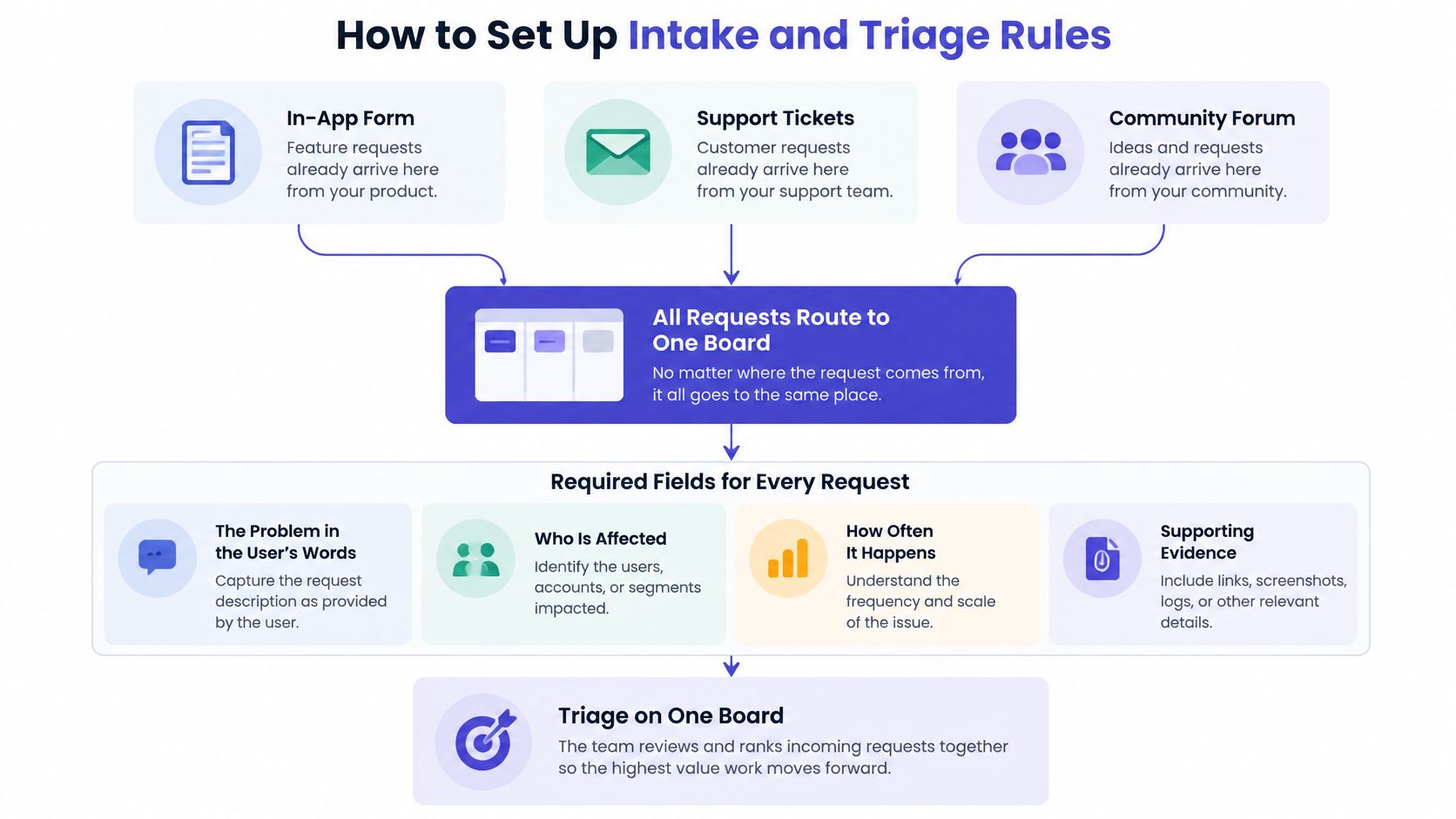
The intake flow should make missing evidence visible before anyone starts ranking ideas.
Make the minimum record useful
-
Route existing channels to a shared board. Start with the in-app form, support tickets, and community forum if that's where your requests arrive. Preserve a link to the source conversation so the product manager can inspect the context rather than ask support to rewrite it.
-
Require problem evidence. Capture the problem in the customer's words, who's affected, how often it happens, and the current workaround. The workaround is especially revealing because it shows what the customer already does to make progress, but no workaround can also mean they're completely blocked.
-
Search before creating. Look for an existing record with the same underlying problem, not merely the same feature name. Attach the new conversation to that record while retaining the customer's distinct circumstances; requests for an export button and scheduled reports might share a need without sharing a solution.
-
Classify before prioritizing. Tag the record as a bug, need, or idea, and route confirmed bugs to the defect queue immediately rather than making them compete with enhancements. Use consistent issue management practices for reproduction details, severity, and escalation.
-
Assign a named owner. Put a person's name on the record, not Product or Engineering. That person must either move it forward or identify exactly what evidence is missing and who will obtain it.
-
Acknowledge receipt automatically. Send the requester the record link and explain the next step without promising implementation. Keep sensitive customer details private, even if a public board displays a sanitized summary.
Keep intake separate from specification
A useful request record isn't a miniature product requirements document. Intake establishes the problem; evaluation determines whether it deserves deeper discovery. Don't ask customers to supply acceptance criteria, technical designs, or your internal business case.
Once a request advances, use Uxia's acceptance criteria and story examples to translate the validated need into testable behavior. Keep that delivery detail attached to the request rather than copying the customer's evidence into another document.
The common slip is a free-text form that accepts a feature name and nothing else. Make the evidence fields required, but allow an explicit unknown with a follow-up owner instead of encouraging invented answers. A teammate should be able to understand the problem, affected users, and next action without reconstructing the conversation.
Choosing RICE, ICE or Kano for Your Backlog
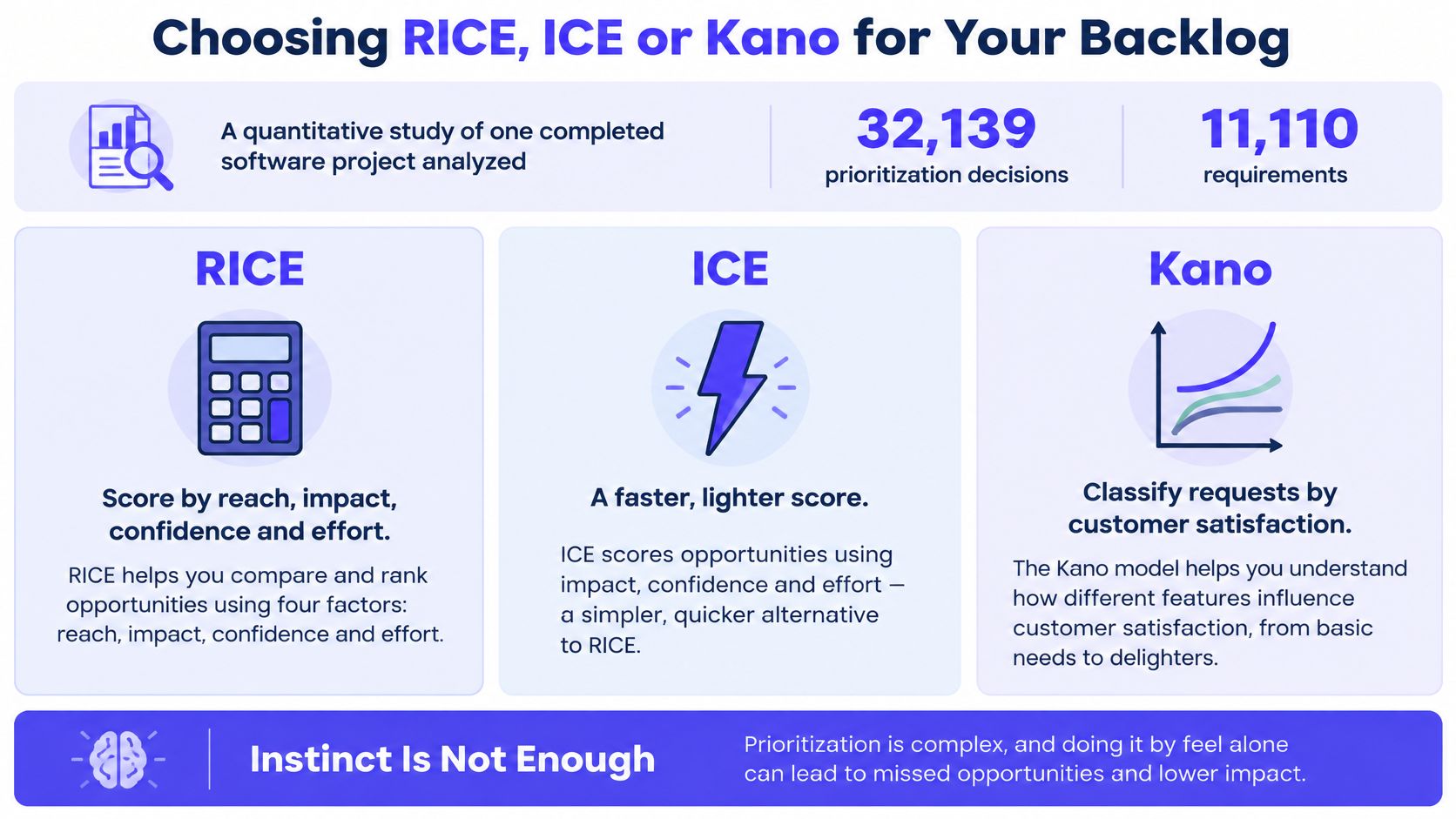
Instinct alone doesn't make competing priorities visible. A quantitative software-requirements study analyzed 32,139 prioritization decisions involving 11,110 requirements in a completed software project and found that internal value, particularly business and stakeholder considerations, had more influence than customer value in early selection. It's evidence from a single project, not a universal verdict, but it exposes a practical risk: customer demand can disappear inside an apparently reasonable planning process.
A scoring framework helps only when people can inspect the assumptions behind it. A precise-looking score built from guesses is still a guess.
Use this comparison to choose the level of decision support your backlog needs.
Match the framework to the decision
RICE, ICE and Kano compared for feature request ranking
| Framework | How it scores | Best when | Main risk |
|---|---|---|---|
| RICE | Reach × impact × confidence ÷ effort | Usage data and engineering estimates exist | Reach numbers become guesses unless tied to account counts |
| ICE | Impact × confidence × ease | A small team needs a fast weekly ranking | Scores drift unless calibrated against past decisions |
| Kano | Customer survey answers sort features into basic, performance and delighter categories | Deciding which gaps to close for retention | Needs regular surveys and is slow for routine triage |
RICE works well when you can identify the affected population and estimate the work consistently. Define whether reach means accounts or users, choose a common planning window, and use the same effort unit throughout. Don't compare requests measured in customer accounts against requests measured in individual sessions.
Confidence should reflect the evidence supporting the expected impact, not how strongly the requester argues. A recurring workflow failure supported by conversations and usage records deserves different treatment from an enthusiastic suggestion with no observed behavior.
ICE removes the reach calculation and substitutes ease for effort. That makes it useful for quick comparisons, but also easier to manipulate unintentionally: someone who understands a familiar implementation may rate it much easier than an unfamiliar but equally small change. Have product and engineering explain the assumptions together.
Kano asks a different question: how does a capability relate to customer satisfaction? It can help distinguish an expected basic capability from a potential delighter. It doesn't tell engineering what to build next without additional consideration of feasibility, dependencies, and strategic fit.
Keep the score open to challenge
Say an integration request has enthusiastic support from a prospective customer, while existing customers struggle with permissions. The integration might look attractive on business value; permissions might matter more to successful daily use. A structured customer needs assessment helps establish whose problem you're comparing before you score either request.
A score should make a disagreement inspectable, not make it disappear.
I would use RICE for planning when reliable usage evidence exists, ICE for lightweight weekly ranking, and Kano for a focused satisfaction question. Keep the chosen scoring rubric stable across planning cycles, and document any override with its reason. Mandatory security work and contractual obligations should be identified explicitly rather than forced through a model designed for discretionary features.
Tracing Each Request from Problem to Outcome
The loudest request isn't necessarily the most important problem. Product Led Alliance's product-management statistics report that 34% of teams regularly collect insights and use them to guide prioritization, while 19.3% rely mostly on ad-hoc requests or escalations.
Keep the evidence visible when the team discusses possible solutions.

Maintain separate fields for the problem, proposed feature, exact customer words, counterevidence, confidence, open questions with owners, outcome target, and post-launch check date. Link directly to conversations, designs, and implementation work rather than writing parallel summaries. That's the practical value of traceability: teammates can inspect why a decision was made.
For example, suppose you ship an export button and check it after a month. Export usage looks healthy, but customers still spend the same amount of time preparing reports; reopen the problem instead of declaring success. Sift AI's guide to closing feedback loops with Sift AI offers context for connecting customer input with follow-through.
Use the same problem-to-outcome questions when reviewing the team's discussion.
As a recommended policy, check outcomes at 30 and 90 days after launch. Record whether the evidence supports success, further discovery, or stopping investment.
Tools, Automation and the Kickoff Handoff
Aim for partial automation before attempting automated product judgment. Unwrap and Gatepoint Research reported in 2025 that only 2% of surveyed senior product leaders had fully automated customer-feedback analysis. Start with repetitive routing and reminders, where mistakes are visible and reversible.
A support tool, a request board, and a chat digest are enough to begin. If Intercom already holds the customer conversation, preserve that thread and connect it to Linear or Jira instead of asking everyone to maintain matching narratives.
Automate movement, not decisions
-
Flag likely duplicates nightly. Match keywords and problem tags, then send candidates to the triage owner. Don't merge automatically, because similar wording can conceal different needs or permission constraints.
-
Route bug-tagged records into the defect queue. Include the source conversation and reproduction evidence. Keep a backlink so support can see progress without chasing engineering.
-
Send a weekly digest grouped by tag. Show new records, missing evidence, and required decisions rather than dumping every comment into Slack. Link each item to the canonical record.
-
Remind the intake lead about unowned records. A suggested trigger is after two business days without an owner. Escalate to a person who can assign responsibility, not a channel everyone assumes someone else watches.
Hand off a decision-ready brief
The build handoff should give designers and engineers enough context to challenge the proposed approach. Include the problem, evidence, desired outcome, non-goals, constraints, and unresolved questions.
Use the kickoff to resolve uncertainty, not read the brief aloud.

Our kickoff guidance recommends:
- Send the brief ahead. Circulate the feature brief or one-pager at least 48 hours before the meeting so participants can review it.
- Assign unresolved work. Give every open question an owner and a deadline before the meeting ends.
- Limit the meeting. Timebox it to 60 to 90 minutes, and schedule a follow-up when major questions remain unresolved.
Have integrations write delivery status back to the request record, including blocked and cancelled states. Check that customer-visible updates are appropriate before sending them; internal implementation notes can contain sensitive details or tentative dates.
Choose the tool that makes the evidence easiest to retrieve. Adding another destination is justified only if it removes more maintenance than it creates.
KPIs for Request Health and Delivery
Votes measure expressed interest, not solved problems. A popular request can be poorly understood, expensive to maintain, or irrelevant to the customers your product serves. Track whether your team responds, makes decisions, and connects delivery to a testable outcome.
Use the targets below as proposed starting thresholds, not published benchmarks. Adjust them after a quarter of observing your workload and capacity.
Feature request KPIs with starting targets and review cadence
| KPI | Definition | Starting target | Review |
|---|---|---|---|
| Time to first response | Hours from capture to acknowledgement | Under 1 business day | Weekly |
| Triage backlog age | Days records sit untriaged | Under 5 days for 90% of records | Weekly |
| Decision rate | Share of scored records with accept, defer or decline in the last quarter | 100% | Monthly |
| Request-to-outcome rate | Share of shipped features linked to a target metric | Above 70% | Quarterly |
| Requester close-out rate | Share of requesters told the outcome | Above 90% | Quarterly |
Define what each measure can prove
An acknowledgement shows receipt, not a substantive response. If your automated receipt performs well while customers still chase updates, inspect the next human action instead of congratulating the team on responsiveness.
The decision rate also needs scrutiny. A defer decision should include a reason and revisit condition; otherwise, a team can clear its decision queue without confronting any trade-offs. Review actual records alongside the percentage.
Likewise, request-to-outcome rate measures instrumentation discipline, not customer success. Linking a shipped feature to a target metric means you can evaluate it. It doesn't mean the metric improved, and the review should distinguish successful, unsuccessful, and inconclusive results.
Measurement guardrail: Don't reward a clean dashboard if the underlying records still leave customers and engineers guessing.
Choose two KPIs to start. I would pair triage backlog age with request-to-outcome rate: the former exposes stalled intake, while the latter reveals whether delivery has a measurable purpose.
Give the reviewer access to the underlying records, not just a chart. When a measure misses its target, assign a specific corrective action, such as simplifying required fields or scheduling an overdue outcome check. Don't respond by adding another dashboard.
Confirm Your Triage Rules Before the Next Planning Cycle
You can establish the operating habit in a working week without migrating your entire history. Apply the workflow to active requests first, then archive obsolete records with a reason.
- Day 1: Publish the stage-and-owner table in a shared document. Replace role names with actual people and confirm who covers absences.
- Day 2: Score the active backlog with your chosen framework. Mark missing evidence explicitly instead of filling gaps with confident estimates.
- Day 3: Compare the ranking with sales and support priorities. Turn each meaningful disagreement into an open question with an owner.
- Day 4: Enable your selected KPIs and schedule the first review for 30 days later, as a starting operating cadence.
- Day 5: Acknowledge every open requester. Explain the current state and next step without implying that intake guarantees delivery.
Capture planning disagreements while people can still clarify them. Our Stoa workspace listens for decisions, open questions, ideas, and owners while people are still in the room.
Name the product lead as owner of the first process review, with the engineering lead and support owner contributing unresolved cases. Put that responsibility on the calendar before planning ends.
A request is only finished when the requester hears the outcome.
SpecStory, Inc. offers Stoa, a shared AI workspace that captures product conversations and turns them into traceable plans and implementation context. Visit SpecStory, Inc. to bring your next feature discussion into a shared room and keep its decisions, evidence, and unresolved questions attached to the work.
Newsletter
Get new posts in your inbox
Bring your team together to build better products. Fresh takes on remote collaboration and AI-driven development.