


Google Cloud's 2024 DORA report reported an estimated 1.5% decrease in delivery throughput and a 7.2% decrease in delivery stability as AI adoption increased. That's the uncomfortable version of the familiar story told internally. More code generated, more drafts, more pull requests, and on average the pipeline doesn't get healthier.
Most seed-stage teams already have the two documents they think they need. There's a deck that says where you're going, and there's a backlog with 140 items in it and no particular order. What's missing is the middle layer: the path that says which bet comes first, who owns it, what evidence would prove it worked, and what happens when the evidence says it didn't.
That middle layer is where strategy and roadmap stop being a slide and a chart and become an operating mechanism for six to fifteen people who can't afford to build the wrong thing twice. It's also where AI stops being free acceleration and starts being a line item for review.
Table of Contents
- Strategy Sets Direction and the Roadmap Shows the Path
- Link Every Bet to an Outcome You Can Miss
- Choose a Scoring Method That Matches Your Evidence
- Pick a Roadmap Shape and a Review Rhythm
- Budget for AI Review Instead of Promised Speed
- Write One Living Roadmap Item This Week
Strategy Sets Direction and the Roadmap Shows the Path
McKinsey surveyed nearly 800 executives about strategic planning and produced a result that should unsettle anyone holding a polished deck: just 45% were satisfied with their company's strategic-planning process, and only 23% said major strategic decisions were made inside that process. More than a quarter reported their companies had plans with no execution path, and 45% said planning failed to track execution of strategic initiatives (McKinsey).
The same research found the split between the satisfied and the frustrated. 79% of managers were satisfied where formal planning played a significant role in strategy development, against 21% where it didn't. Planning isn't the problem. Planning that never touches a decision is.
So separate the two artifacts. Strategy is the choice of customer, the problem you solve for them, and the two or three bets that could change the business in 12 to 18 months. It's a commitment to a direction and, by implication, a list of things you're declining. The roadmap is the sequence that makes those bets reviewable: which initiative comes first, who owns it, what milestone marks progress, and when you'll check.
Think of driving. Strategy is the destination and the rules of the road. The roadmap is the route, and routes get rerouted when there's traffic.
The test I use: if a document doesn't tell you what you're saying no to this quarter, it isn't strategy. It's a description of the market.
Where a vision deck, a backlog, and a Gantt chart each fail
You already own three documents that look like the missing layer. Each fails at least one row below.
| Question | Product strategy | Product roadmap |
|---|---|---|
| Purpose | Choose where to win and why | Sequence the work that proves that choice |
| Time horizon | 12 to 18 months, revisited quarterly | Now, next, and later, with one quarter of committed work |
| Changes when | The customer, market, or thesis shifts | Evidence, capacity, or a dependency shifts |
| Owner | Founder or product lead | The executing team, with one owner per item |
| Done looks like | A measurable outcome, not a feature list | Milestones and progress against that outcome |
| It is not | A backlog or a release Gantt | A date promise to every stakeholder |
A vision deck clears the Purpose row and fails Time horizon, Owner, and Done. A feature backlog has owners and items but no outcome, so it fails Purpose and Done, and it drifts whenever the loudest request arrives. A Gantt chart passes the sequencing test and fails nearly everything else, because it commits dates before you've earned the right to.
If your product and engineering leads relitigate the same three items every week, the problem is usually the shared format rather than the tooling. This guide to aligning product and engineering teams covers the mechanics of building one roadmap that two functions can both read.
Before you open the backlog again, write one sentence naming the objective for the next two quarters, then the first three initiatives that would prove it. Three, not thirteen. If you can't name three, you don't have a strategy yet. You have a set of requests with dates attached.
Link Every Bet to an Outcome You Can Miss
Poor execution has a measurable cost. PMI's 2018 Pulse of the Profession research found organizations wasted an average of 9.9% of every dollar invested because of poor project performance, with 31% of projects failing to meet their goals, 43% not completed within budget, and 48% not completed on time (PMI). 35% of organizations said they lacked strong alignment between initiatives and strategy.
That last number should matter to a small team. Hiring more people rarely fixes weak alignment, because each new hire needs a clear line from customer problem to product bet to shipped work. Broader PMI research also found that aligning project-management offices with strategy improved project completion and reduced scope creep.
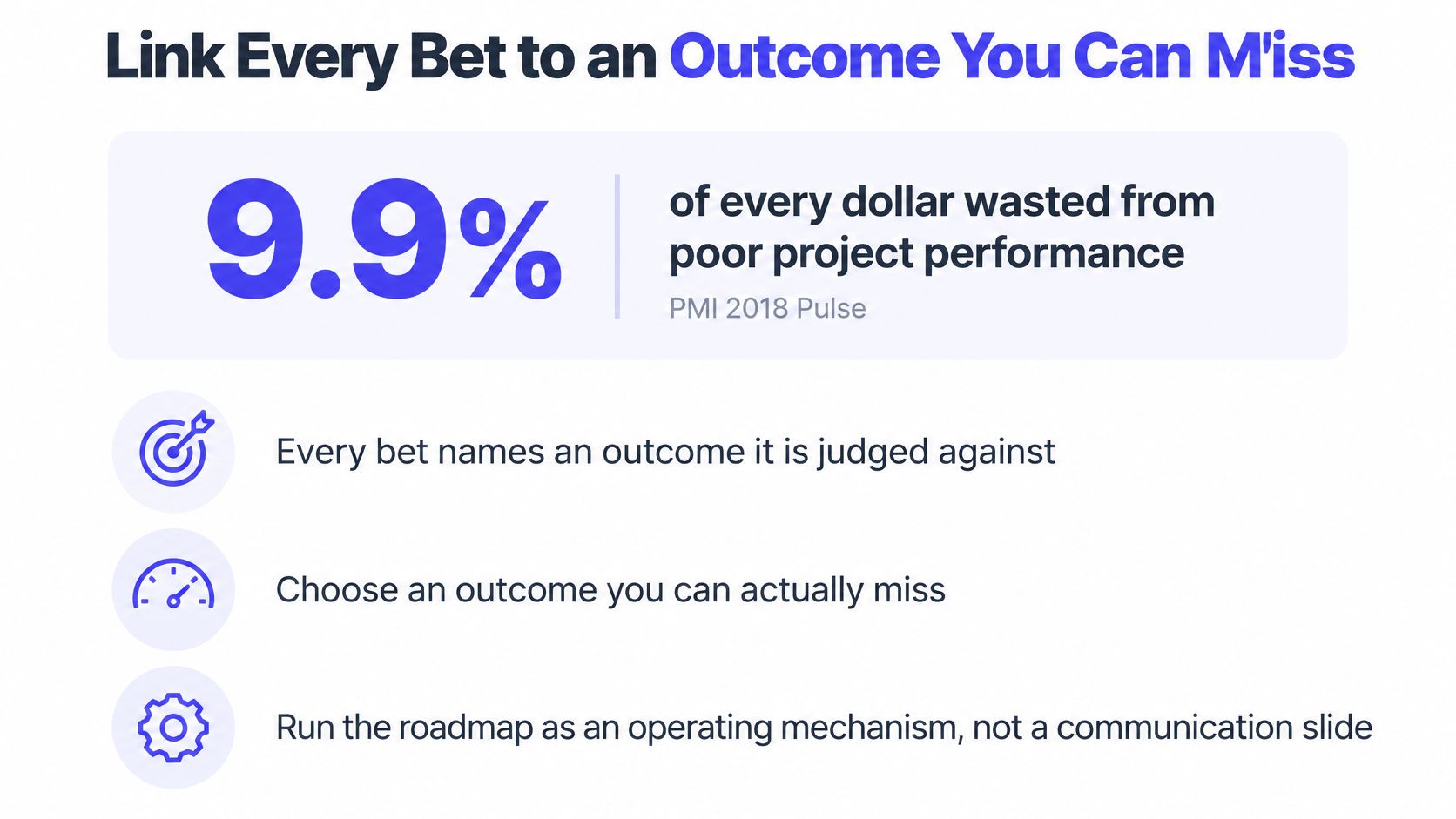
A roadmap that works as an operating mechanism carries four fields per item: the user or business outcome, the observable behavior that would show it, the validation method, and a guardrail that must not get worse. Without those fields, a roadmap item is just a feature with a date attached.
Say a meeting-heavy team keeps producing decisions that evaporate before anyone builds them. The outcome is the share of accepted decisions that show up in a spec or a code change within two weeks. The observable behavior is a decision linked to a PRD section, a commit, or a design file. The validation is a weekly sample of ten decisions, checked by whoever runs the review. The guardrail is change-failure rate, which must stay under a ceiling the team agrees on in advance.
That item is missable. You can check whether it worked, and you can check whether the team paid for the gain somewhere else.
Split throughput from stability before you celebrate
Track two things, not one. Throughput is deployment frequency and change lead time. Stability is change-failure rate and failed-deployment recovery time. A team that ships twice as often while doubling its rollbacks hasn't improved; it has moved the work downstream into support.
Segment every metric by meeting type, team size, and artifact type. One workflow's gain hides another's collapse, and an aggregate number is exactly where that hiding happens. A single average can make a product team look faster while customer-facing work gets slower and less reliable.
There's a second reason to anchor items to users rather than features. The 2024 DORA executive summary reported that user-centered teams had a 40% higher level of organizational performance than teams that didn't apply that approach. That only pays off if each item names a user outcome, an observable behavior, and a validation method, rather than a delivery date.
Before an item earns a slot, put it through the same scrutiny you'd apply to any other risky assumption. The discipline described in this guide to concept validation is the right gate, and it takes an afternoon rather than a quarter. Ask what user behavior would change, what evidence would count, and what would make you stop.
The one-line test: if the item shipped and the outcome didn't move, the item failed. Not the market, the item.
Choose a Scoring Method That Matches Your Evidence
A seed-stage team rarely has the data a mature scoring model assumes. The mistake isn't choosing a simple method. It's choosing a method whose inputs you'd be inventing at the whiteboard, then treating the output as analysis.
Match the method to what you can actually estimate
| Method | Use it when | What you score | Watch-out |
|---|---|---|---|
| RICE | Many ideas and scarce engineering | Reach × Impact × Confidence / Effort | Confidence is often a guess |
| ICE | Very early, almost no usage data | Impact × Confidence × Ease | Easy work crowds out the real bet |
| Opportunity scoring | You have interview evidence | Importance minus satisfaction | Invented scores are worse than no score |
| Cost of delay | Order matters more than rank | Value lost per week of waiting | New markets are hard to price |
| Kill-criteria gate | The item is an experiment | Metric, threshold, and stop date | Teams skip the stop |
RICE earns its popularity in a crowded backlog where you can estimate who's affected. ICE fits the first months, and it has a specific failure mode: the E in Ease becomes the deciding term, so a settings page beats a hard onboarding fix every time. Opportunity scoring is the strongest option once you've done the interviews and the weakest if you fill the numbers in from memory. Cost of delay earns its place when sequence matters more than rank, like a launch that unblocks a sales conversation with a weekly cost you can feel.
Don't average five frameworks into a composite score. That's how a team ends up with a number nobody can defend and a priority list nobody trusts. Pick one scorer for the quarter and write down why you picked it. Then pick one kill rule.
Reversible experiments versus irreversible commitments
The distinction matters more than the score.
- Reversible experiments are prototypes, pricing tests, a one-week technical spike, a landing page that measures intent. For these, the kill rule is the deliverable: name the metric, the threshold, and the date you stop.
- Irreversible commitments are a data model, a public API, a published pricing structure, a hire. These get slower review, because the cost of being wrong gets paid across quarters whether or not the roadmap still says so.
Risk work stalls when it lives in a spreadsheet nobody reads. The approach in this guide to turn risk registers into decisions is worth copying for kill criteria, since it forces every risk into an owner and a next action instead of a color cell.
Go back to the three initiatives you named before you opened the backlog, and mark each as an experiment or a commitment. Most seed-stage roadmaps run about 80% commitments and 20% experiments, which is the wrong ratio for a team still learning what the market wants. Flipping a few of those rows is usually the cheapest strategy change available.
Pick a Roadmap Shape and a Review Rhythm
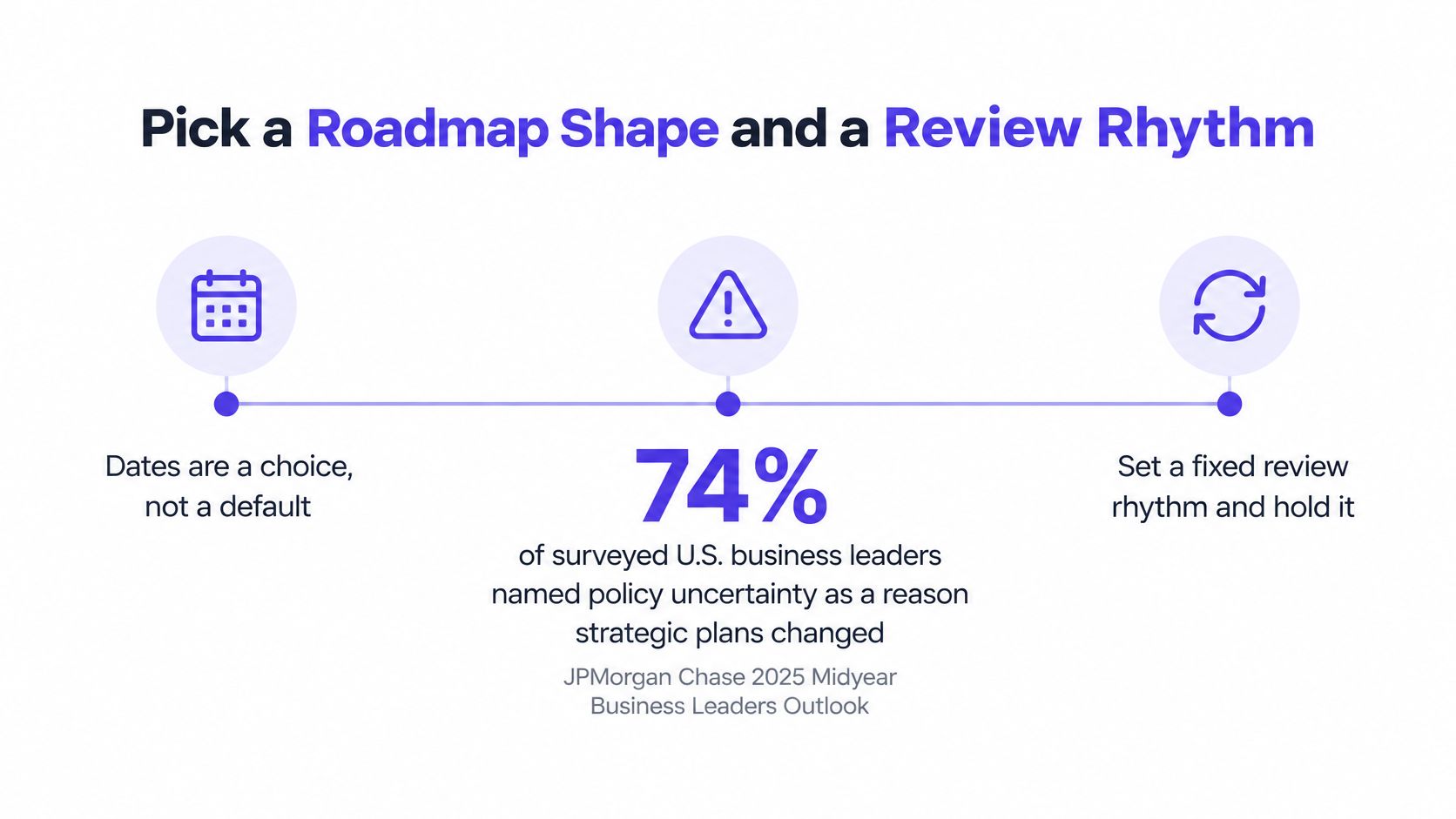
Dates are a choice, not a default. In JPMorgan Chase's U.S. 2025 Midyear Business Leaders Outlook, 74% of surveyed U.S. business leaders identified policy uncertainty as an external factor causing changes to strategic plans (JPMorgan Chase). Those are companies with legal teams and forecasting staff. Yours will move too, and a roadmap shaped like a contract breaks the first time it does.
The shape should match how much you know. Five shapes cover almost every seed-stage situation.
| Type | What it shows | Review cadence | Use it when |
|---|---|---|---|
| Now Next Later | Priority bands without false dates | Monthly for Now, quarterly for Later | Uncertainty is high |
| Outcome roadmap | The result each theme must move | Monthly evidence, quarterly outcomes | Progress must be more than a feature count |
| Timeline | Dates and milestones | Biweekly check, monthly replan | A launch or fundraise date is real |
| Discovery board | Problems in research, build, and learn | Weekly | You are still finding the problem |
| Release plan | What ships in one version | Once per release | Only a small committed slice |
Now Next Later is the default I'd pick for a seed team. It shows priority bands without inventing dates, you review Now monthly, and you re-examine Later each quarter. An outcome roadmap goes a step further and lists the result each theme must move, so check evidence monthly and reset outcomes quarterly. A discovery board, with columns for research, build, and learn, belongs to teams that haven't settled on the problem yet, and it needs a weekly review because that's how fast the picture changes.
When a dated timeline is honest
A timeline is justified in exactly one situation: a launch, a contract, or a fundraise date that's real and already outside your control. Then put dates on one committed slice, check progress biweekly, replan monthly, and keep the rest of the portfolio in bands. What sinks teams is the year-long Gantt drawn in month one and defended in month nine.
Rule of thumb: a date you can't defend with a contract, a launch, or a raise is decoration.
Hold the review rhythm fixed even when the roadmap changes. Sixty to ninety minutes monthly, with the authority to kill or reshuffle anything in Now, beats a quarterly offsite where everyone is polite. Then reopen the strategy itself each quarter, because a roadmap that never forces a strategy question has stopped doing its job. If you want a structure for that session, this quarterly OKR planning template gives you a frame to fill rather than a blank page.
Pick the shape you'll use for the next 90 days before the planning call ends, and write it at the top of the document.
Budget for AI Review Instead of Promised Speed
Most roadmap advice treats AI adoption as free acceleration. The evidence is messier. In Stack Overflow's 2025 developer survey, 69% of developers who use AI agents reported increased productivity, yet only 17% said agents improved team collaboration; 52% either don't use agents or use only simpler AI tools, and 38% have no plans to adopt agents (Stack Overflow). The same survey cites a randomized study of experienced open-source developers where AI tools increased task-completion time by 19%, despite developers expecting the tools to help.
Personal speed and team speed are different quantities. The first shows up in a week. The second shows up in a release.

Put "agent writes the feature" on Now and watch what the sprint becomes: review comments, rework, a design argument nobody captured in writing, and a merge that lands three days late. Nothing on the card predicted any of it.
Write the verification line before the build line
Any item that assumes an agent needs three additions.
- Delegation scope. Which tasks the agent owns outright, which it drafts for human editing, and which stay with people. Architecture decisions and anything touching customer data belong in the last group.
- Approval gate. The named reviewer before merge, and what they're checking for.
- Cost metrics. Cycle time, review time, rework rate, escaped defects. Not lines generated, not time to first commit.
Run the pilot on a bounded task for two weeks. If cycle time or escaped defects move the wrong way, pull the item back to Next rather than defending it in the retro. Early adoption can require more planning and review capacity, especially for experienced engineers working in a tangled repository, and a team that budgets for that cost ships sooner than a team pretending it doesn't exist.
The rule: any roadmap item that assumes an agent gets a second line for the review it creates.
When the generated output rises and the defect count rises with it, the roadmap didn't get faster. It got more expensive. This guide to AI-driven product development goes further into where agent-generated work pays off for a product team.
Price the verification in hours before you promise a date.
Write One Living Roadmap Item This Week
Speed doesn't come from fewer conversations. It comes from not having the same conversation twice. JetBrains surveyed 24,534 developers in 2025 and found 62% view non-technical factors as critical to performance, alongside 51% citing technical factors (JetBrains). The drag on a small team is coordination: a question reopened three weeks later by someone who never saw the original answer, or a decision reversed because the reason behind it left with the person who made it.
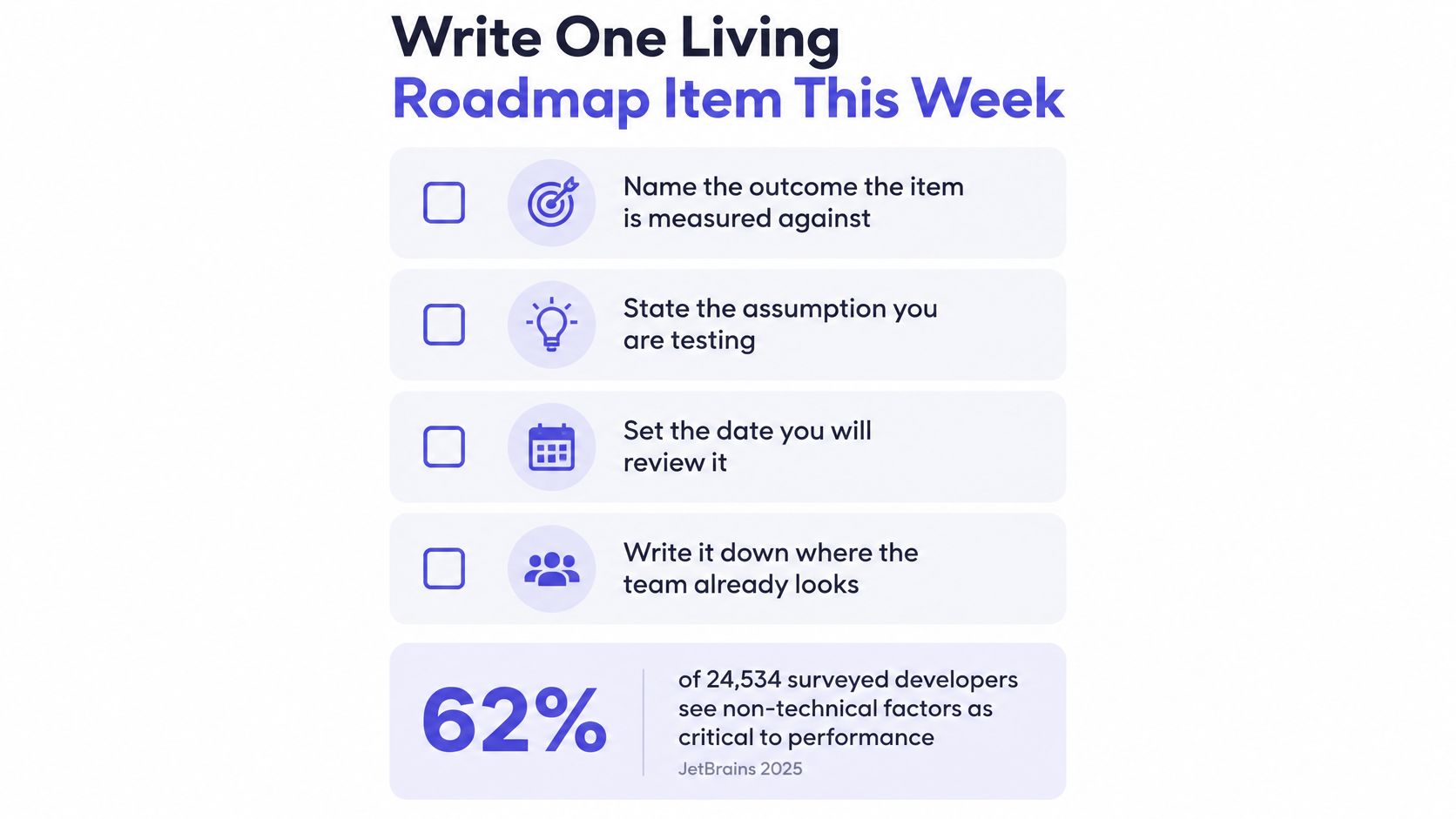
Don't redraw the year. In the next product meeting, pick the single bet that would change the quarter and write six lines before the call ends.
- The outcome. The number or behavior that moves if this works.
- The owner. One name, not a team.
- The type. Reversible experiment or irreversible commitment.
- The kill rule. Metric, threshold, stop date.
- The open questions. Each with a name beside it, and the milestone where it must be answered.
- The band. Now, Next, or Later.
If the item assumes an agent, add the human approval gate and the two-week check on cycle time or escaped defects.
Keep the reasoning attached
When an item moves, write what evidence moved it and leave the old reasoning in place. A roadmap where the previous justification disappears looks decisive and teaches the team nothing. Schedule revalidation when you accept the item, and resurface each unanswered question at the milestone it blocks rather than at the next all-hands.
Then let the people building it read the customer evidence and the decision behind the priority. An engineer who can see why a bet matters makes better calls on a Thursday afternoon than one who was handed a ticket with an estimate.
Separate a promise you made to a customer this month from what you're still learning. Both belong on the roadmap. Only one belongs in a public commitment. This is the problem Stoa exists to solve: its AI listens to the meeting and extracts decisions, drafts specs, and flags open questions as they surface, a Markdown PRD takes shape live during the call, and the session lands as files including decisions.md, prd.md and context.md so the reasoning stays where the people building can open it.
When the quarter ends badly: change the roadmap in the open, with the evidence attached. A plan revised quietly teaches the team to distrust the next one.
Run the monthly review on that one living item instead of waiting for the next offsite. If the outcome didn't move, say so, reshuffle Now, and write down what you learned so nobody rediscovers it in March.
Stoa, built by SpecStory, Inc., is a multiplayer AI workspace where the meeting, the decision, and the roadmap item stay in one place: the AI captures decisions as they're made, drafts a Markdown PRD live during the call, and tracks the open questions your team can't settle yet, with everything saved as plain files you can open in any editor. It costs $5 per meeting hour with no seats or tiers and free guest access, plus a $50 credit to start. Bring one real bet to your next product meeting in SpecStory, Inc. and leave with a plan instead of a transcript.
Older
AI Text to Code: How It Works in 2026
Newer
How to Run Feature Request Management for Small Teams
Newsletter
Get new posts in your inbox
Bring your team together to build better products. Fresh takes on remote collaboration and AI-driven development.