


The usual advice on innovation management is to generate more ideas, encourage experimentation, and build faster. For a seed-stage team using AI coding agents, that advice misses the bottleneck. You can produce another prototype before you've agreed who owns the decision, what evidence would justify shipping it, or how the business will capture the value.
Small teams need fewer unresolved bets, not more output. A useful innovation system connects customer evidence to a decision, the decision to implementation, and the release to a measurable outcome. Governance belongs inside that chain, not in a policy document someone writes afterward.
Table of Contents
- What Innovation Management Does for a Team
- Stage-Gate Lean and Dual Innovation Compared
- A Weekly Operating System for Small Teams
- Metrics That Separate Impact from Activity
- Pitfalls That Kill Momentum and Quick Fixes
- Short Cases, Adoption Checklist and First Decision
What Innovation Management Does for a Team
Say your team agrees that onboarding needs work. A designer proposes a guided setup, an engineer suggests an AI assistant, and the founder wants fewer signup fields. Everyone leaves with a different interpretation of the decision, so nobody makes the first implementation commit.
The problem isn't creativity. The team hasn't chosen the customer problem, the smallest credible test, or the person authorized to settle the trade-off.
Innovation management is the repeatable system for turning ideas and decisions into implemented changes that create value. Those changes can concern a product, a process, a marketing approach, or how people organize their work. A redesigned support workflow or a new pricing motion can deserve attention just as much as a new feature.
Manage the bet, not just the build
In the onboarding scenario, the product lead should first identify the failure: users can't connect their data without help. The team can then test a narrower intervention, such as clearer connection instructions, before committing to an AI assistant with ongoing inference costs and reliability requirements.
That changes the management question from whether the team can build an assistant to whether assistance solves a valuable problem at an acceptable cost. It also makes stopping a reasonable outcome.
Practical rule: Treat innovation management as air-traffic control for bets. Coordinate ownership, evidence, capacity, and safe release rather than trying to pilot every experiment yourself.
Outside knowledge belongs in that system. In an OECD econometric study covering 16 OECD countries from 1980–1998, a 1% increase in business-funded R&D was associated with a 0.13% increase in multifactor productivity growth, while a 1% increase in foreign R&D was associated with a 0.44% productivity increase. These are historical associations, not a guarantee for an individual startup.
Make the handoff explicit
A small team doesn't need a separate innovation department. It needs someone to connect discovery, prioritization, delivery, and commercial follow-through.
For the onboarding bet, that means leaving the discussion with a testable outcome, an implementation owner, and a review condition. The first commit matters because it exposes whether the team can act on its decision. What customers do after release determines whether the decision was worthwhile.
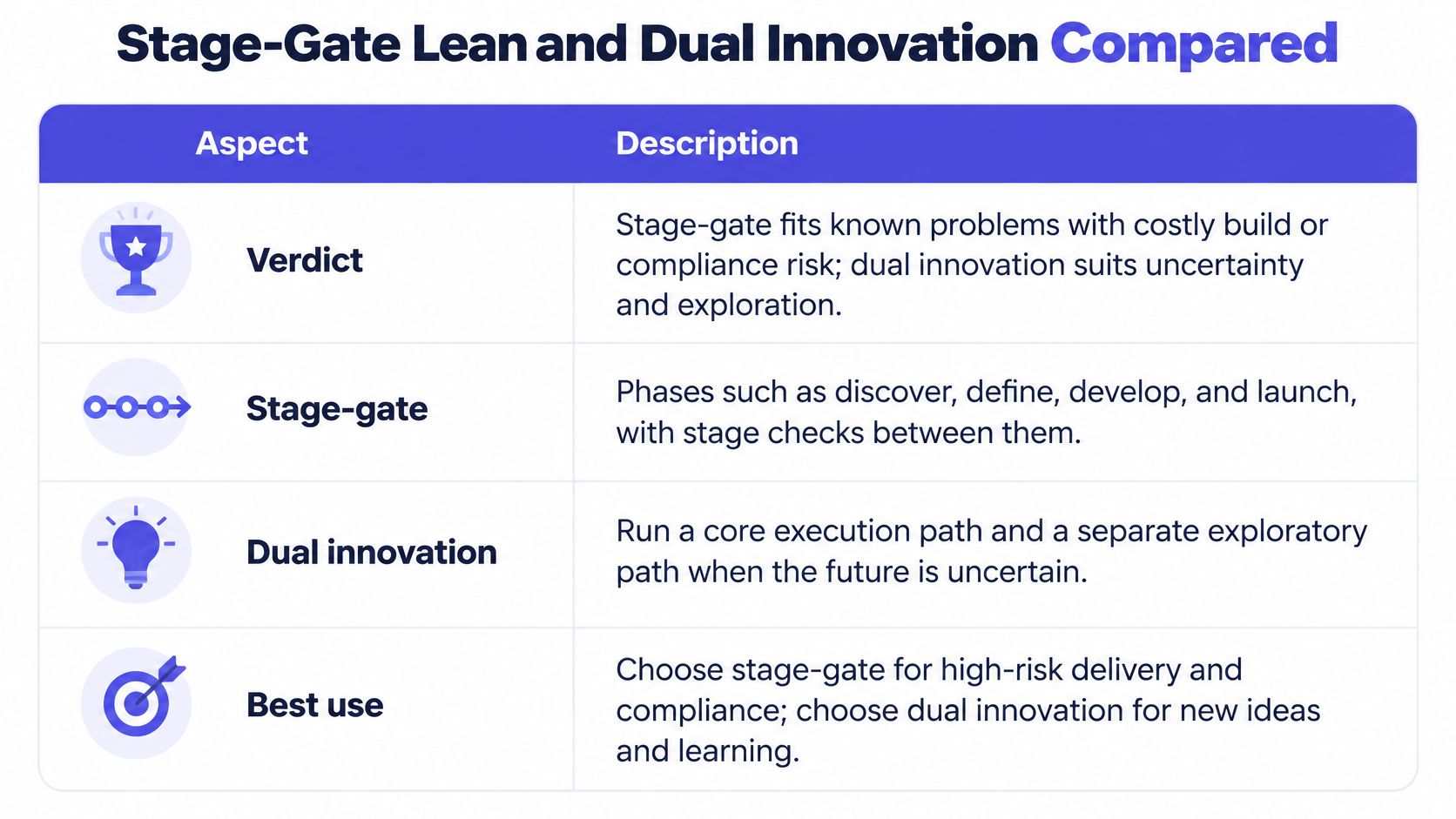
Stage-Gate Lean and Dual Innovation Compared
| Framework | Best when | Cadence and gate | Main failure on a small team |
|---|---|---|---|
| Stage-gate | Known problem, costly or regulated delivery | Phased reviews with go, kill, or hold | Committee overhead on every small idea |
| Lean or startup | High uncertainty and a new bet | Weekly build-measure-learn; pivot or persevere | Activity and prototypes without captured value |
| Ambidextrous or dual | Core product plus exploration | Separate explore and exploit tracks and metrics | Explore work starved by the roadmap |
Choose the method according to the uncertainty and cost of being wrong. Don't make every experiment pass through the same machinery just because the team has adopted a framework.
Stage-gate protects expensive commitments
Stage-gate separates discovery, definition, development, and launch with explicit decisions between them. At each gate, an accountable owner chooses go, kill, or hold against evidence agreed before the review.
Use it when a mistaken release could expose sensitive data, create expensive rework, or violate a customer commitment. A technical-validation gate might require demonstrated permission boundaries and a tested rollback. A commercial gate might require evidence that the intended buyer can adopt the workflow.
The failure mode is approving activity rather than reducing risk. If reviewers merely confirm that a specification exists, you've added a meeting without improving the decision. Keep gates tied to consequential uncertainties, and don't require a committee to approve reversible interface changes.
Lean tests demand before commitment
Lean experimentation fits a new bet whose customer, problem, or offer remains uncertain. Write a falsifiable hypothesis, run the smallest informative test, and choose whether to pivot or persevere.
Use concept validation to distinguish evidence of demand from polite enthusiasm. A prospect agreeing to a demo isn't equivalent to changing a workflow, sharing necessary data, or accepting a paid pilot.
The dangerous version of lean celebrates prototypes indefinitely. A team can learn how to generate attractive demos without learning who will pay, what deployment requires, or whether support costs destroy the margin.
Dual innovation protects both responsibilities
Dual innovation separates improving the live business from exploring future opportunities. Judge the exploit track on reliability, retention, and margin. Judge the explore track on resolving uncertainty and demonstrating demand.
Protect exploration capacity explicitly. Otherwise, the urgent roadmap will consume it, while applying core-product revenue expectations too early will make every unfamiliar idea look weak.
ISO's account of innovation-management standards traces formal measurement to the 1992 Oslo Manual and identifies ISO 56002, published in 2019, as guidance for an innovation management system. That guidance supports a structured system; it doesn't require a particular product-development method.
Different bets need different scoreboards.
Use lean for an uncertain bet, thin stage-gate for costly or regulated delivery, and dual tracks when a live product must keep improving while the team explores.
A Weekly Operating System for Small Teams
Minimum viable governance should answer practical questions: who decided, based on what, what can reach customers, and how can the team reverse it? If answering requires reconstructing a conversation from Slack, your governance is too far from the work.
The Pacific AI governance survey found that 30% of surveyed organizations had deployed generative AI in production, while 45% identified speed-to-market as the leading governance barrier. For a seed-stage team, the response shouldn't be an enterprise approval structure. It should be a lightweight set of controls embedded in delivery.
Run the operating loop
-
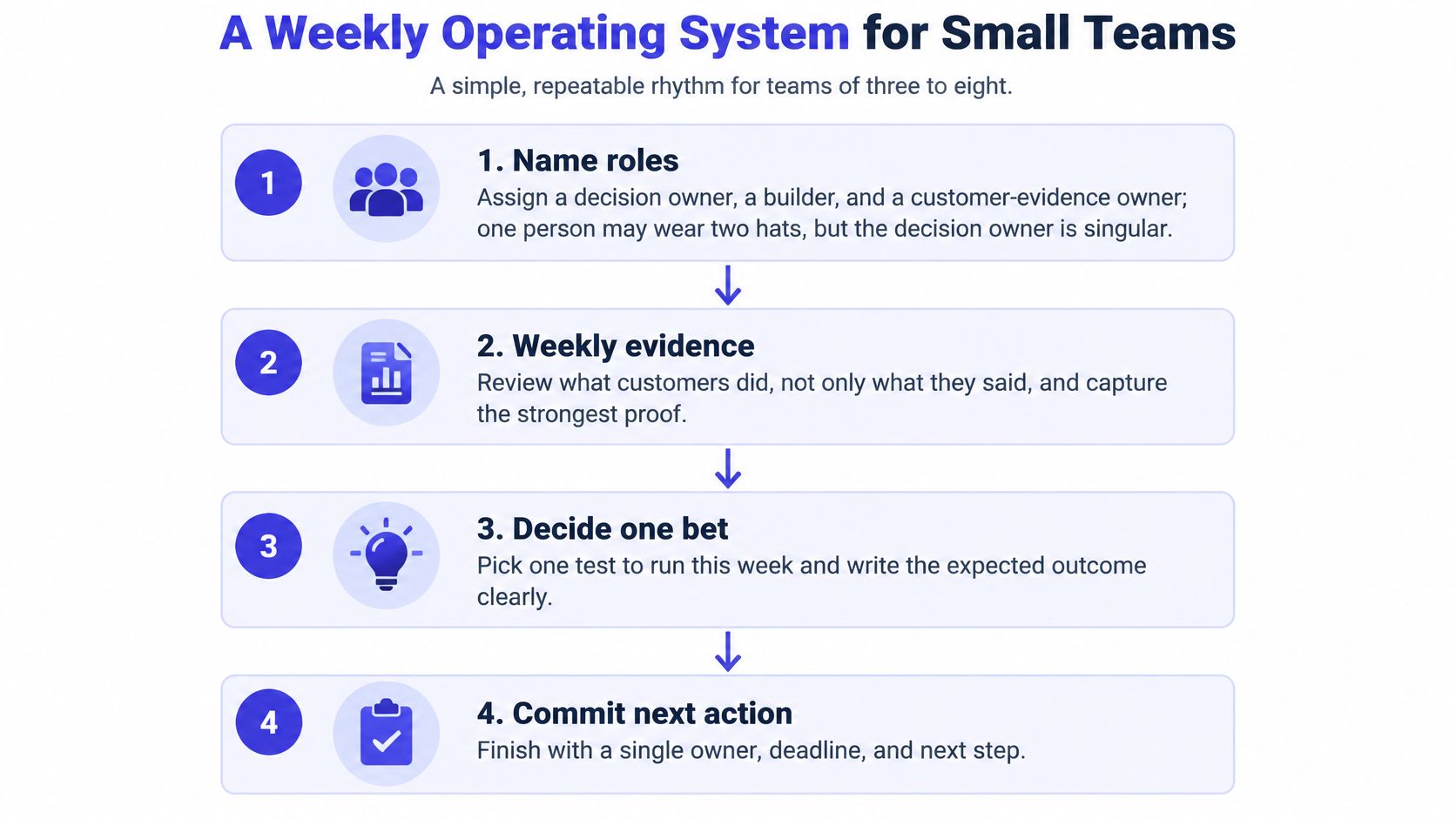
Name the roles before discussing solutions. Assign a decision owner, a builder, and a customer-evidence owner. People can combine responsibilities, but final decision authority must be singular. The evidence owner brings observed behavior, support examples, or buying commitments, not just a summary of opinions.
-
Keep an explicit bet portfolio. Separate active experiments from interesting ideas. Admit a new bet only when someone can name the capacity it will consume and the work it displaces. Reserve exploration time deliberately rather than hoping engineers will find spare hours after roadmap delivery.
-
Write an experiment card before building. Record the intended customer or business outcome, current baseline, hypothesis, smallest informative test, kill criterion, and owner. For an AI-assisted onboarding experiment, include the unacceptable failure: exposing another customer's information, inventing configuration instructions, or blocking recovery.
-
Hold a short weekly gate. Review the strongest evidence and choose continue, pivot, or kill. Record the decision, material dissent, and the condition that would reverse the call. A continuation needs a next question and a deadline, not merely enthusiasm from the person who built the prototype.
-
Review AI-produced work before customer exposure. An accountable human checks generated specifications and code against intended behavior, security boundaries, and failure cases. Keep artifact provenance, a rollback path, and an owner for unresolved risk. A passing test suite doesn't establish that the team built the right behavior.
-
Capture decisions where implementation starts. Attach the card and rationale to the conversation, issue, or pull request that builders will use. Don't require engineers to interpret an abandoned whiteboard before they can begin.
This simplified flow keeps the meeting focused on evidence and a committed next action.
Choose tools by function
You need a shared decision log, a tracker with an experiment card for each bet, and an analytics view that uses the card's baseline. A rapid planning method is useful when it ends in owned work, rather than a more elaborate planning document.
Stoa is one option for teams that want a shared room connecting conversation, intent, open questions, and artifacts, with context usable in Cursor or Figma. A GitHub issue template and a shared document can also work if the team maintains the connections consistently.
The governing principle is auditable, reversible decisions. Keep the reason for a choice close enough to the code that a reviewer can challenge it before release, rather than discovering the disagreement during an incident.
Metrics That Separate Impact from Activity
Faster commits, more prototypes, and enthusiastic demos are activity. Impact means an intended outcome changed, with enough evidence to distinguish the effect from ordinary variation or a different customer mix.
| Metric | What it shows | Timing | Useful signal |
|---|---|---|---|
| Decision to first commit | How long a choice sat before building | Leading | Implementation begins without repeated clarification |
| Experiment cycle time | How fast the team learns | Leading | A completed test ends in an evidence-based decision |
| Closed-decision rate | Share of bets that continue, pivot, or die | Leading | Most reviewed experiments receive an explicit call |
| Activation or adoption | Whether the intended user does the job | Lagging | Lift versus the baseline set before the test |
| Retention or repeat use | Whether the change sticks | Lagging | Better than the prior cohort or a suitable control |
| Paid conversion or gross margin | Whether value was captured | Lagging | Revenue or margin attributable to the change |
Read the signals in order
Decision-to-first-commit exposes handoff friction. If engineers repeatedly ask what was agreed, improve the decision artifact before demanding faster coding.
Experiment cycle time measures learning speed only when the loop closes. A quickly shipped prototype with no evidence review is unfinished experimentation, regardless of how little development time it consumed.
Closed-decision rate reveals whether the portfolio is accumulating unresolved bets. Count meaningful calls, not administrative ticket closures, and retain the reason so the team doesn't reopen the same argument without new evidence.
Activation tests whether users reach the intended outcome, not merely whether they click the new feature. Retention then checks whether that usefulness survives the initial novelty.
Paid conversion and gross margin test commercial capture. Include inference costs, human review, and support effort when assessing an AI feature, because higher usage can coexist with worse economics.
Build a credible impact comparison
Before the test, specify the outcome and freeze the baseline definition. Record the decision, monitor the relevant delivery signals, and compare expected with realized value after launch.
Use a controlled rollout when practical. If you compare cohorts instead, check acquisition channel, customer maturity, and exposure to other changes before attributing the difference to your experiment. When traffic is sparse, label the result inconclusive rather than turning a handful of enthusiastic users into a confident causal claim.
The Governance Institute of Australia's AI deployment and governance survey found that 93% of respondents couldn't effectively measure AI return on investment, while 46% identified automating governance requirements as the most critical technology priority. Controls matter, but a dashboard of approvals won't tell you whether customers benefit.
Treat team productivity improvement as a connection between delivery and outcomes, not a count of generated artifacts. For partner-built work, keep technical progress separate from commercial results so a successful integration doesn't conceal weak customer ownership or unattractive economics.
Close the post-launch review with the hypothesis, baseline, observed result, decision, and evidence that would change the call. If the result is inconclusive, specify the missing evidence before authorizing more work.
Pitfalls That Kill Momentum and Quick Fixes
An idea with no owner is the simplest stall to fix. Before ending the discussion, name the person who can decide its fate and the evidence they need. An assigned builder isn't a substitute for an accountable decision-maker.
More process won't repair unclear authority. Neither will an AI agent that can generate another implementation while the team still disagrees about the goal.
Repair the operating failure
Exploration gets judged like mature delivery. A new opportunity looks unattractive when the team demands immediate revenue while ignoring unresolved demand questions. Give exploratory work a specific uncertainty to resolve, and reserve reliability and margin targets for work that already serves established customers.
Governance arrives after implementation. A policy deck can't retroactively make an unreviewed release safe. Put the relevant review condition on the work item, name the reviewer, and test the recovery path before expanding exposure.
Measurement starts after launch. The team then chooses whichever comparison makes the release look successful. Freeze the outcome definition and baseline before exposure, including which users qualify and what successful behavior means.
Don't confuse shared creation with captured value
Collaboration introduces a different failure: partners help produce useful technology, but your team lacks the rights or customer relationship required to profit from it.
An analysis of the 2010 and 2014 Korea Innovation Survey, using propensity-score matching and network efficiency analysis, found that competitor cooperation increased relative R&D productivity during value creation but produced relatively lower productivity during value appropriation. That finding concerns competitor cooperation, not every partnership or AI workflow.
Creation and appropriation need different controls. Proving that a technology works doesn't establish who can sell it, protect it, or retain the customer.
Before commercialization, examine exclusivity, licensing rights, customer ownership, pricing authority, patent strategy, and knowledge leakage. For agent-assisted development, separately examine dependency licenses, sensitive inputs, and whether your differentiation survives if competitors use similar tools.
I would start with the cheapest operational fixes: retire an experiment nobody can defend, require a kill condition before the next build, and compare a shipped change with its original intended outcome. These actions expose weak decisions without interrupting the whole roadmap.
Avoid turning cleanup into another transformation program. Repair the specific failure at the point where it happens, then check whether the next bet moves through the system with less ambiguity.
Short Cases, Adoption Checklist and First Decision
The following scenarios illustrate how the same operating discipline changes with the delivery context. They're hypothetical examples, not reported company results.
A shared working session should end with a decision artifact that everyone can act on.

Apply the framework to the actual risk
A pricing-page bet uses lean. Say a B2B team believes usage-based copy will help qualified visitors understand the offer and start a trial. It tests the message without rebuilding billing, records trial starts alongside visitor quality, and chooses a kill condition before exposure.
Suppose the revised copy produces no credible improvement, while prospect conversations expose an objection to the minimum commitment. The useful decision is to test the offer, not to keep polishing the page or rebuild the product. The failed hypothesis has narrowed the uncertainty.
A regulated workflow uses thin stage-gate. Consider a team changing an approval workflow that handles sensitive records. Technical validation checks access controls, auditability, and recovery, while customer validation checks whether authorized users can complete the intended task.
The decision owner refuses additional reviews that don't address a distinct risk. The release remains blocked if permission boundaries fail, even if customers like the interface. That's an explicit trade-off between launch speed and an unacceptable failure.
A live app uses dual tracks. The core team owns uptime and repeat use, while an exploratory effort tests AI-assisted onboarding. The exploratory work earns further investment through demonstrated task completion, not through the volume of generated code.
A human reviewer checks the assistant's proposed instructions before exposure. If users need frequent corrections, the team can narrow the assistant's scope instead of forcing a general-purpose experience into production.
Use a single adoption checklist
- Decision authority: Name an accountable owner who can continue, redirect, or stop the bet.
- Portfolio capacity: Keep active bets within the team's actual delivery and review capacity.
- Outcome and baseline: Define successful behavior and the comparison before implementation.
- Weekly gate: Schedule an evidence review that ends with a recorded call.
- Kill criterion: State what would make further investment unjustified.
- AI release controls: Require human review, artifact traceability, and a usable rollback.
- Partner boundaries: Separate technical creation from rights, customer ownership, and commercial capture.
- Post-launch review: Compare the result with the original expectation and record the next decision.
The experiment card can remain plain text: problem, user, outcome, baseline, hypothesis, test, owner, kill line, decision, and reversal trigger. Keep it short enough that the builder and reviewer will use it.
Use this video as a separate discussion prompt, then return to your own unresolved decision.
Make collaboration an accountable bet
External capability deserves a deliberate place in the portfolio. A 2022 study of 195 high-tech companies found that firms engaging in external R&D collaboration generated 3.95 times more revenue and achieved 54% higher innovation productivity than non-collaborating firms. These associations don't prove collaboration caused the differences; stronger firms may also form more productive partnerships.
Treat a proposed partnership as an experiment with a shared problem, an intellectual-property owner, data-access boundaries, and an evidence gate. Don't accept a technically impressive joint demonstration as a substitute for adoption or viable economics.
At your next working session, pick the bet that's already generating disagreement in Slack. Fill the card before authorizing more build work, hold the evidence gate even if the team is tiny, and judge progress by whether you closed a meaningful decision against a recorded baseline, not by prototype count.
SpecStory, Inc. offers a multiplayer AI workspace that turns product conversations into executable context, specifications, and code while keeping artifacts connected to the decisions behind them. Visit SpecStory, Inc. to explore using that shared context for your next experiment, from the initial decision through implementation and review.
Newsletter
Get new posts in your inbox
Bring your team together to build better products. Fresh takes on remote collaboration and AI-driven development.