


Your team ships the feature on schedule. The demo looks right, the tickets are closed, and the code passes its checks. Then someone asks which customer problem it solves, and the product manager, designer, and engineer give different answers.
You don't necessarily need a longer specification. You need a way to keep intent, decisions, implementation, and evidence connected as the work changes. That's the practical job of product requirements management, whether your engineers write the code themselves or delegate parts of it to an AI coding agent.
Table of Contents
- What Product Requirements Management Means and Why It Matters
- The Requirements Lifecycle From Intent to Retirement
- Writing Requirements That Pass Quality Review
- Traceability From Objective to Test Evidence
- Managing Change and Requirements Debt
- Writing Requirements for AI Coding Agents
- Set Up Your First Requirements Baseline This Week
What Product Requirements Management Means and Why It Matters
Say your team adds a customer export button. Sales wanted it for procurement reviews, support wanted it for account troubleshooting, and leadership expected it to help customers leave a competing product. Everyone approved the same feature name, but nobody agreed on the outcome.
Product requirements management turns those competing expectations into controlled, testable product commitments. A product requirements document, or PRD, is one artifact within that discipline. It can describe an agreement, but it doesn't replace the work of reviewing changes, assigning responsibility, or proving delivery.
The discussion starts with people comparing what they expected with what the team built.

Connect expectations to product behavior
Work through the hierarchy rather than jumping straight to tickets:
- Stakeholder expectations describe the desired result, such as helping customers evaluate a migration.
- Customer requirements describe what customers need to accomplish, such as exporting their account records.
- Technical product and component requirements define the behavior needed to support that task, including authorization, export contents, and failure handling.
Each level should justify the one below it. Otherwise, an engineer can faithfully implement a ticket that never supported the intended outcome.
Historical delivery results explain why alignment deserves attention. The Standish Group's CHAOS report reported that 16.2% of software projects finished on time and on budget, 52.7% were challenged, and 31.1% were cancelled; its leading success factors were user involvement, executive management support, and a clear statement of requirements. These are historical figures, not a forecast for your team, and the study's methodology has been debated.
The useful lesson isn't that documentation guarantees success. It's that teams need an explicit agreement about what they're trying to achieve.
Product requirements management is the ongoing discipline of preserving the connection between stakeholder intent, approved product behavior, delivery decisions, and objective evidence.
Try a quick self-test: name the objective behind your last three shipped features. If you can name only their functionality, your team has a feature inventory, not yet a dependable requirements system.
The Requirements Lifecycle From Intent to Retirement
A requirement doesn't become finished when someone approves its wording. Your team still needs to allocate the work, establish evidence, handle revisions, and eventually remove obsolete behavior without breaking its dependencies.
Use the lifecycle illustration to orient the work from discovery through retirement. The table adds the control checkpoints needed to manage approved commitments.
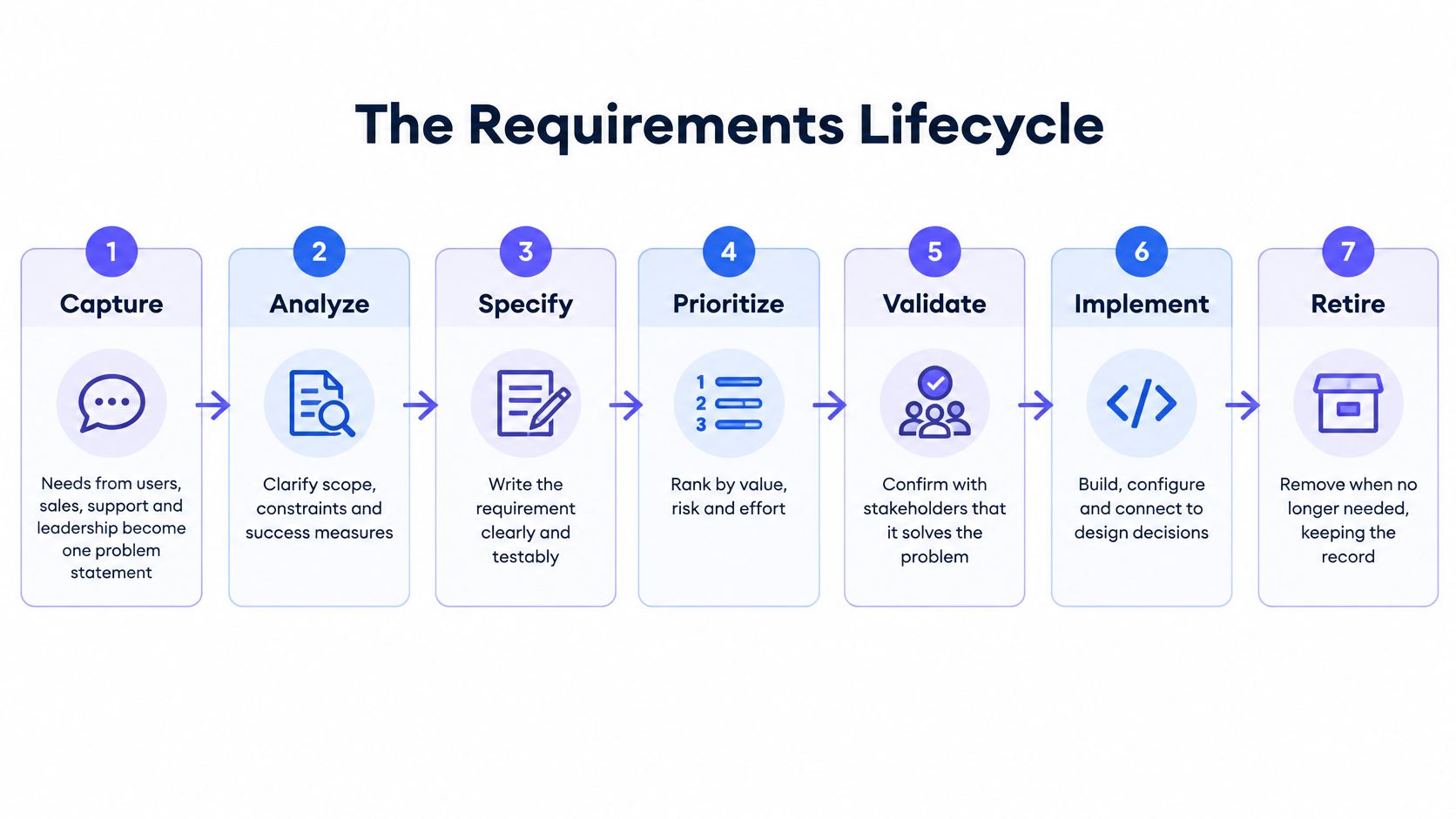
Requirements lifecycle stages
| Stage | What Happens | Output | Exit Check |
|---|---|---|---|
| Capture intent | Gather needs from users, sales, support and leadership | Problem statement and objective | Objective named and owner assigned |
| Specify | Write each requirement as one testable statement | Requirement set | Each requirement passes quality review |
| Baseline | Freeze the approved set for a release or cycle | Versioned baseline | Stakeholders have signed off the scope |
| Decompose and allocate | Split into component requirements and assign owners | Component requirements | Every requirement has exactly one owner |
| Verify | Link tests and acceptance criteria to each requirement | Test evidence | Each requirement has a passing check |
| Control change | Assess proposed changes against the baseline | Change log entry | Impact recorded before acceptance |
| Retire | Remove requirements that no longer match the product | Archived record | Dependent requirements and tests updated |
Capture intent means reconciling inputs, not collecting every request unchanged. A practical requirements gathering process helps a small team turn interview notes, support tickets, and leadership requests into a problem statement before choosing a solution.
Specification makes the commitment explicit. Baselining then records which version stakeholders approved for the current release or cycle. A baseline is a reference point, not a ban on learning. Without one, teams can disagree about whether a request changes scope because they're remembering different agreements.
Allocation makes responsibility visible. An export feature might need interface behavior, access checks, and a background job, but each component requirement still needs a single accountable owner. Contributors can be numerous; accountability shouldn't be ambiguous.
Expect the work to loop
A failed verification check can expose defective code, an incomplete requirement, or a mistaken assumption. Diagnose which one failed before changing the specification to match the implementation.
Likewise, retirement isn't deleting a paragraph. Archive the rationale, identify consumers of the old behavior, and update dependent tests and requirements so the team doesn't accidentally restore it later.
Use this walkthrough as a discussion prompt when establishing the workflow with your team.
The exit checks make movement deliberate. Don't call a requirement specified while its meaning is disputed, verified while its check is failing, or retired while another component still relies on it.
Writing Requirements That Pass Quality Review
A feature idea isn't automatically a usable requirement. The NASA Systems Engineering Handbook recommends identifying the responsible party, stating what must be done, avoiding unnecessary implementation detail, using clear and concise language, and expressing a single requirement rather than combining several.
Use those properties as review questions, not stylistic preferences. They determine whether engineers and testers can make the same interpretation without negotiating the meaning during implementation.
Requirement quality checks
The examples below are illustrative product commitments, not universal performance targets.
| Quality Check | Question to Ask | Weak Example | Stronger Example |
|---|---|---|---|
| Named responsible party | Who owns delivery? | Search should be faster | Search owner delivers repeat-search behavior against the approved performance acceptance test |
| Free of implementation detail | Does it name a solution too early? | Use Redis to cache results | Repeat searches return results without re-running the full query |
| Unambiguous | Could two engineers read it differently? | Pages should load quickly | Product page shows main content within 2 seconds on a 4G connection |
| Concise | Can any word be removed without losing meaning? | The system should be able to handle a lot of users at once | The service supports the concurrent-user load defined in the approved load-test profile |
| One requirement per statement | Does it combine two claims? | Users can log in and reset passwords | Users can log in with email and password; password reset is a separate requirement |
| Verifiable | How would a tester prove it? | Checkout feels reliable | Retrying a completed checkout request returns the existing order without creating a duplicate |
These rewrites isolate particular weaknesses; they aren't all complete specifications. The performance example still needs an agreed device, page fixture, measurement boundary, and network profile. References to approved test profiles work only if those profiles exist and are versioned.
The Redis example also deserves scrutiny. Avoiding a repeated query is appropriate only if that behavior is required. If the customer needs faster results and nothing more, specify the observable outcome and let engineers choose the mechanism.
Turn a goal into an acceptance decision
Consider the same product-page feature at different levels of precision:
- Vague goal: Make product pages faster.
- Specified outcome: Show the main product content promptly on mobile connections.
- Testable statement: Show the main content within the illustrative threshold in the table, measured using the agreed mobile test profile.
Attach an ID, a rationale, and a responsible party to the final statement. The ID lets teammates reference it consistently; the rationale explains why the commitment exists without stuffing business context into the requirement sentence.
Practical rule: If a tester can't derive a pass-or-fail check from the requirement and its referenced conditions, rewrite it before baselining it.
Apply the same discipline to non-functional requirements, including speed, availability, and recovery. For a starting structure, browse eight NFR templates for MVPs from Rite NRG, then replace generic wording with conditions your team can evaluate.
Traceability From Objective to Test Evidence
Traceability lets someone inspect how a product commitment became implemented behavior, and why that behavior belongs in the product. ISO/IEC/IEEE 29148:2018 treats requirements management as lifecycle-wide, iterative work and emphasizes qualities including clarity, consistency, completeness, feasibility, verifiability, and traceability.
Use a connected chain rather than a collection of loosely related documents. Each connection should answer a specific question about the work.
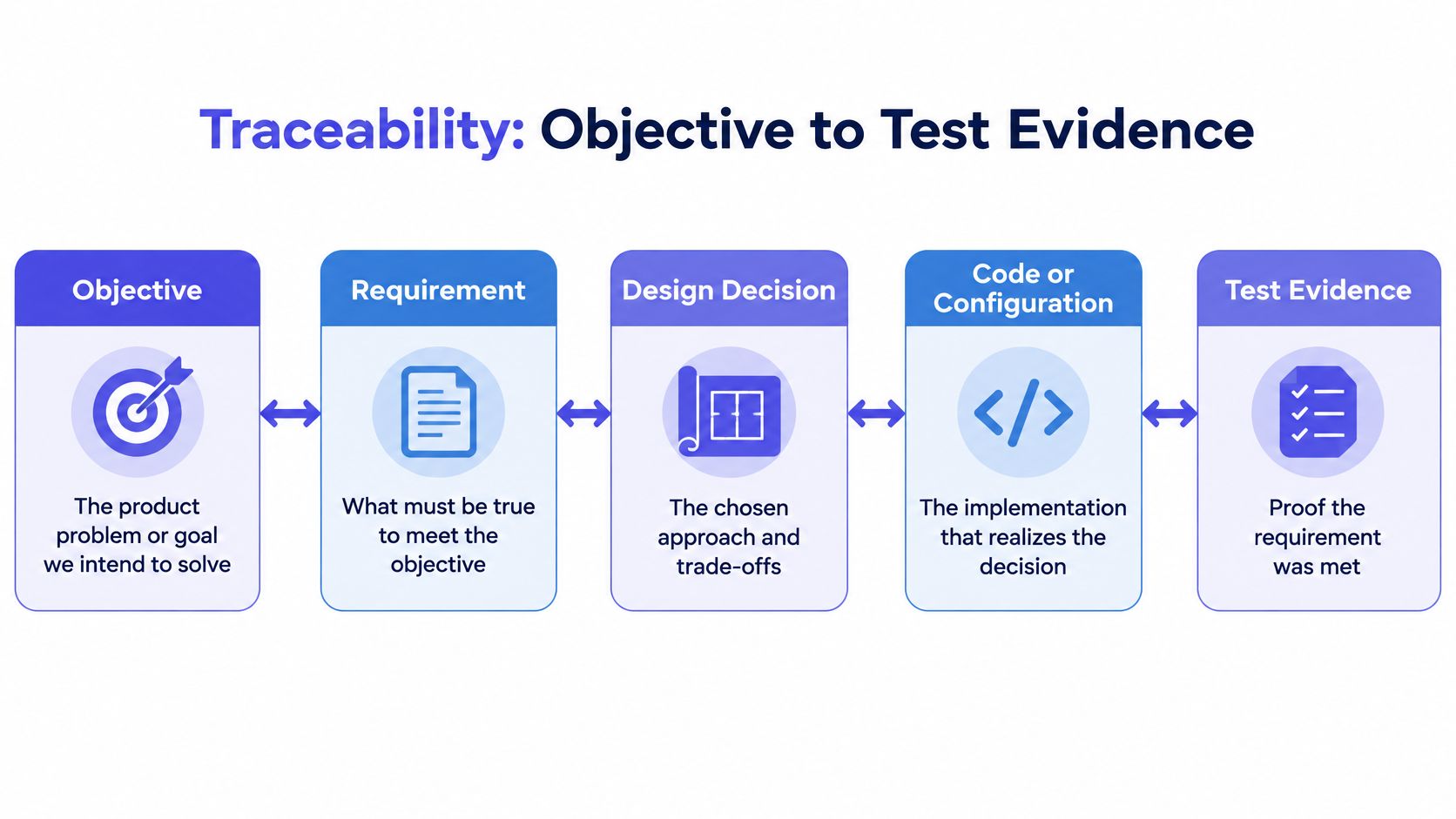
Read the chain in both directions
Start with the objective: customers need an accurate checkout total before payment. The requirement states which approved tax treatment checkout must apply. A design decision records where that calculation happens and how the team handles unavailable tax services.
The code or configuration implements that decision. Test evidence records the result against the relevant requirement version, ideally identifying the build and test conditions rather than merely showing a green status.
Tracing forward answers whether the team built and checked the commitment. Tracing backward answers whether the implemented behavior still serves a validated objective.
An orphaned requirement has no objective behind it or no test in front of it. The former leaves value unexamined; the latter leaves delivery unproven. Neither becomes safe because the ticket is closed.
Use connections for impact analysis
Say the team changes the tax rule at checkout. In this hypothetical case, following the links reveals affected calculation and rounding decisions, a payment test, and a release note. The engineer can update the connected work instead of discovering inconsistencies after deployment.
A practical traceability matrix can show each requirement alongside its objective, implementation reference, test, and current status. Blank cells reveal missing connections; outdated references reveal evidence that needs review. For a testing-focused treatment, use AskYourQA on requirements-to-test traceability to shape the relationship between requirements and checks.
Run these sprint checks:
- Objective coverage: Every requirement traces to an agreed objective.
- Test coverage: Every requirement traces to an appropriate acceptance check.
- Change coverage: Every shipped change traces to a requirement, including approved defect corrections and operational work.
Keep the links beside the work in your shared issue tracker or requirements workspace. A separate spreadsheet can work, but only if someone maintains it as part of delivery, not as an occasional reporting exercise.
Managing Change and Requirements Debt
Freezing scope can feel safer than revisiting an agreement. But if customers reveal a missed need or engineers uncover a false assumption, refusing to revise the requirement preserves the mistake, not the plan.
Requirements debt is the unresolved ambiguity, missing information, stale wording, or broken connections that teammates must work around. A worldwide survey of 69 practitioners on requirements engineering debt found that participants primarily perceived its cost through rework in affected requirements artifacts; the accompanying discussion identifies volatility drivers including market feedback, communication failures, weak stakeholder engagement, domain-knowledge gaps, regulatory demands, and ambiguity or uncertainty.
Distinguish learning from uncontrolled scope
A changed requirement isn't automatically evidence of poor planning. The important distinction is whether the team understands why it changed and what accepting it will displace.
Suppose support discovers that customers need exports after an account is suspended. That raises questions about authorization, retention, support workflows, and customer commitments. Adding an exception to the implementation bypasses the people responsible for those decisions.
Don't optimize for requirements that never change. Optimize for changes whose consequences the team can understand before committing.
Use a compact control routine:
- Record the proposal and rationale. Describe what should change, why, and which customer or business outcome it affects.
- Assign a decision owner. Separate the person investigating the question from the person authorized to accept the trade-off when necessary.
- Inspect affected work. Review related requirements, design decisions, code, tests, and release commitments.
- Record the decision before acceptance. Preserve approval, rejection, or deferral, including the reason and any follow-up work.
Make unresolved questions visible
An unanswered question becomes dangerous when engineers can't tell whether they're allowed to proceed. Mark it as blocking or non-blocking, name the assumption permitted in the meantime, and set a deadline for resolving it.
Our Feature Kickoff template recommends that every open question has an owner and a deadline before the kickoff meeting ends. Apply that rule to informal conversations too, especially when a remote teammate will implement the decision later.
Use regular cross-functional reviews to reconcile the change log with current artifacts. Ask product, engineering, design, and testing representatives to resolve conflicting interpretations together rather than forwarding separate documents for approval.
For a small team, a lightweight log is enough: proposal, rationale, owner, affected requirements, decision, and linked acceptance criteria. Keep a deferred correction visible until someone either resolves it or explicitly accepts its consequences.
Writing Requirements for AI Coding Agents
Most requirements advice assumes someone will read a specification, interpret it, and turn it into tickets. An AI coding agent changes the operational problem: you must constrain generated behavior while keeping its successive edits aligned with the intended outcome.
Cheaper code generation makes explicit requirements more important, not less. A 2025 empirical paper on explicit requirements for language models reports improvements in reliability, maintainability, usability, and explainability across the tested models, alongside better constraint-following and fewer arbitrary assumptions. That finding supports stronger instructions, not automatic trust in generated output.
Give the agent boundaries and evaluation criteria
Don't hand an agent a broad request to improve checkout and judge the result by whether it compiles. Give it the authorized behavior, relevant existing decisions, prohibited changes, and checks it must satisfy.
Use these safeguards:
- Behavioral acceptance criteria. State observable outcomes and failure cases. For checkout retries, require reuse of the existing order and rejection of conflicting request contents, rather than merely asking for reliability.
- Decision provenance. Preserve which conversation established a constraint, who owns the decision, and when it was approved. The agent shouldn't have to choose between contradictory notes with no indication of authority.
- Human approval points. Require review before generated code merges, particularly when it changes access controls, data handling, dependencies, or externally visible behavior.
- Assumption correction. When generated code exposes a mistaken assumption, update the requirement and its evaluation criteria. Don't leave the accepted behavior only in a reviewer's comment.
Keep a distinction between approved requirements and agent suggestions. An agent may propose a simpler interaction or a different data model, but that proposal doesn't become product policy because it appears in a working branch.
Include constraints that aren't visible in the interface
Capture privacy, security, reliability, and observability alongside feature intent. An export requirement might prohibit sensitive fields in logs, require authorization checks, define retry behavior, and require an operational event when processing fails.
Tie those commitments to checks: inspect log output, exercise denied-access cases, simulate retries, and confirm failure events. Don't let the agent redefine its own success criteria after seeing its implementation.
Use context engineering for AI agents to organize the approved instructions, relevant decisions, and working context. Keep human approval separate from agent execution so a persuasive explanation can't substitute for demonstrated compliance.
Set Up Your First Requirements Baseline This Week
Start with a bounded piece of work, not a company-wide process overhaul. Hold the first working session in a shared document or requirements workspace where product, design, engineering, and testing can edit the same draft.
Build an agreement your team can use
-
Pick a real delivery target. Choose a release or feature with an actual deadline. Keep unrelated roadmap ideas outside its baseline.
-
Write the problem and objective. Describe who needs help, what they can't accomplish today, and the outcome you intend to enable. Name the person accountable for the agreement.
-
Create identifiable requirements. Give each statement an ID, a responsible party, and a rationale. Keep unresolved assumptions separate from approved commitments.
-
Run the quality review. Challenge vague adjectives, bundled claims, premature solution choices, and missing conditions. Rewrite anything teammates interpret differently.
-
Attach acceptance evidence. Add a test or acceptance criterion to every requirement. Include negative cases where permissions, retries, or failure handling matter.
-
Open the change log. Record the next three decisions with owners and deadlines. Include rejected alternatives when they explain an important constraint.
-
Inspect the connections. Check objective coverage, test coverage, and shipped-change coverage. Resolve missing references before calling the baseline ready.
Keep the baseline small enough to maintain
Ask the people doing the work to approve the agreement, not just acknowledge that they received it. Engineering should confirm feasibility, testing should confirm verifiability, and the product owner should confirm that the scope addresses the intended customer problem.
Don't wait for perfect prose. Resolve uncertainty that could change implementation or acceptance, and leave minor editorial cleanup outside the critical path.
Your test of success is that you can trace three requirements from objective to passing test without searching through chat history.
SpecStory, Inc. offers Stoa, a shared AI workspace that extracts decisions, drafts specifications and user stories, and flags open questions from product conversations. It also drafts a Markdown PRD live during the meeting, giving your team a working plan to review before the call ends. Visit SpecStory, Inc. to turn your next feature discussion into a living requirements plan your team can carry into implementation.
Older
How to Reduce Rework Before It Reaches Your Release
Newer
Spec Driven Development vs Vibe Coding: When to Use Each
Newsletter
Get new posts in your inbox
Bring your team together to build better products. Fresh takes on remote collaboration and AI-driven development.